

Across schools, early years leaders are looking for one thing: stronger foundations in literacy and numeracy—without increasing teacher workload or turning learning into worksheets.
A fast-growing approach is multisensory, 3D learning supported by augmented reality (AR). Done right, it’s not “more screen time.” It’s better learning time—short, purposeful, teacher-led moments that make concepts easier to understand and remember.
Recent classroom evidence from an early years implementation shows how consistent multisensory routines can drive measurable improvements in letter recognition, letter sounds, number recognition, and shapes over a short period.
Why This Matters for GCC Schools
Early years classrooms in the UAE, Saudi Arabia, Qatar, Oman, Bahrain, and Kuwait are often diverse and multilingual. Children enter KG with different readiness levels, language backgrounds, and learning needs. That’s why schools need approaches that are:
- Visual + hands-on (supports EAL/ESL learners)
- Routine-based (supports consistency and behavior expectations)
- Engaging (supports attention and motivation)
- Outcome-driven (supports measurable progress)
What Is Multisensory AR Learning in Early Years?
Multisensory AR learning combines:
- Teacher-led instruction
- 3D visuals / AR experiences to make ideas “real”
- Mnemonics (memory cues) that help children retain sounds and concepts
- Hands-on practice that reinforces learning through doing
This model supports evidence-informed literacy instruction often aligned with Science of Reading principles, especially around sound–letter connections.
What the Classroom Data Showed (in 90 Days)
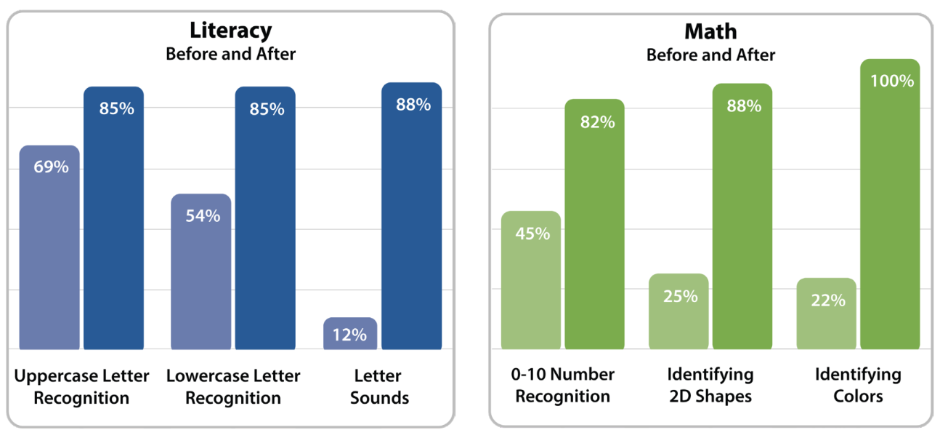
In one pre-K implementation, progress was tracked using classroom assessment data across a 90-day period. The results showed strong gains in core readiness skills:
Literacy gains included:
- Uppercase letter recognition improved (69% → 85%)
- Lowercase letter recognition improved (54% → 85%)
- Letter sounds improved significantly (12% → 88%)
Math gains included:
- 0–10 number recognition (45% → 82%)
- 2D shapes (25% → 88%)
- Colors (22% → 100%)
For KG leaders, these are exactly the skills that impact Grade 1 success.
Beyond Academics: Confidence, Engagement, and SEL
What’s equally important for schools: multisensory learning is designed to keep learning joyful.
The implementation also highlighted improvements in:
- student engagement and motivation
- confidence and communication
- peer interaction and participation
- home connection through take-home activities
What This Looks Like in a KG Classroom
A strong implementation usually includes:
- Short daily instruction blocks (whole group + small groups)
- Teacher-friendly routines that reduce prep time
- Visual + hands-on reinforcement, especially for multilingual learners
- A practical classroom setup (for example, using an interactive display as a shared teaching hub)
The key is not the “technology.” It’s the instructional structure that makes learning consistent, memorable, and measurable.
How Knowledge Hub Dubai Supports Early Years Classrooms
At Knowledge Hub we help schools implement modern early years learning experiences that strengthen literacy and numeracy foundations—while keeping teacher workload realistic.
Schools typically look for support in:
- onboarding and classroom implementation planning
- teacher training and routine mapping
- aligning outcomes to school frameworks (British, American, IB, MOE)
- sustained support so adoption sticks beyond the first few weeks