

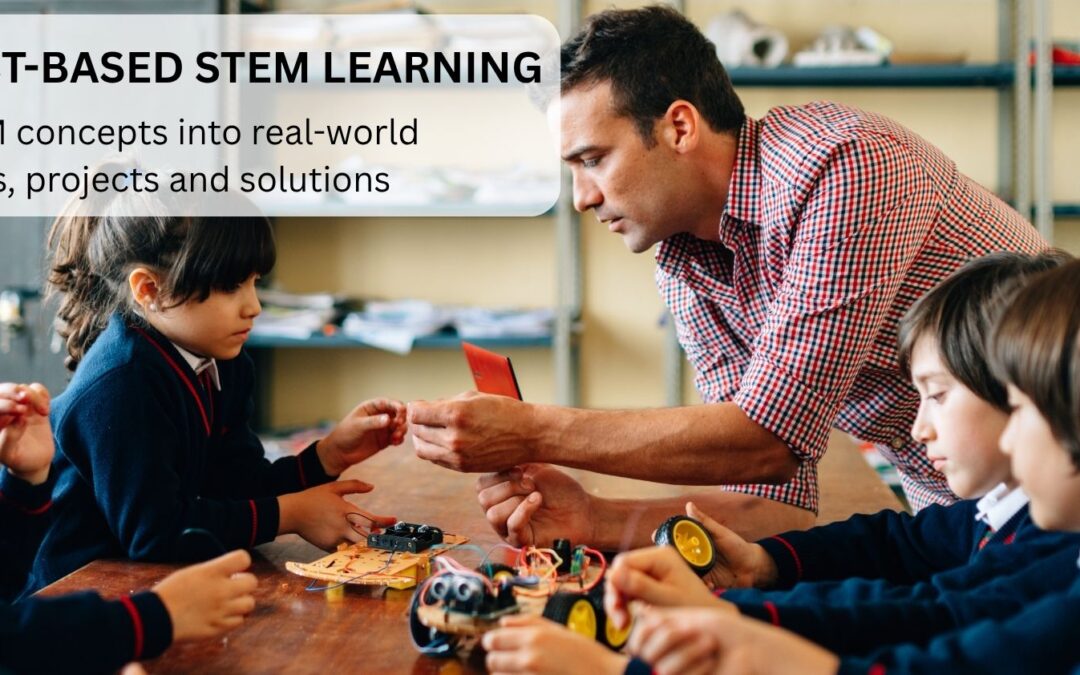
Project-Based STEM Learning: A Practical Guide for Schools
STEM education becomes more meaningful when students have opportunities to use what they learn to solve problems, create ideas, test solutions, and improve their work.
This is where project-based STEM learning can make a significant difference.
Instead of learning science, technology, engineering, and mathematics as disconnected concepts, students can bring these disciplines together through practical challenges. They might design a sustainable structure, build a robotic solution, analyse environmental data, create a water filtration system, or develop a simple automated device.
The emphasis is not simply on completing a project. It is on the learning process behind the project: asking questions, researching, planning, designing, experimenting, testing, communicating, and reflecting.
For schools, project-based STEM learning provides a practical way to connect curriculum objectives with real-world applications while giving students opportunities to develop and apply important skills.
What Is Project-Based STEM Learning?
Project-based STEM learning is an approach in which students learn and apply STEM concepts while working on a meaningful project or real-world problem.
Rather than receiving information and then completing a conventional exercise, students are presented with a challenge that requires them to investigate and develop a solution.
A typical project might involve:
Identify → Research → Plan → Design → Build → Test → Improve → Present
For example, students could be asked:
How can we design a structure that is strong, sustainable, and able to support a specific amount of weight?
To address the challenge, students might use:
- Science to understand materials and forces
- Mathematics to calculate dimensions and measurements
- Engineering principles to develop the structure
- Technology to model, test, or document the design
This interdisciplinary approach demonstrates how STEM concepts can work together outside the boundaries of individual subjects.
Why Project-Based STEM Learning Matters
Project-based learning changes the role students play in the classroom.
Instead of only receiving information from the teacher, students actively investigate questions and develop solutions.
A well-designed STEM project can encourage students to:
- Apply classroom knowledge
- Investigate real-world problems
- Develop and test ideas
- Work collaboratively
- Use technology purposefully
- Learn from mistakes
- Communicate their thinking
- Improve solutions through iteration
The approach can also help students understand why they are learning particular concepts.
For example, calculating area becomes more meaningful when students need the measurement to design a model. Programming becomes more purposeful when students need code to control a robot or automate a process.
This connection between knowledge and application is central to effective STEM learning.
Project-Based Learning vs Traditional STEM Activities
Not every STEM activity is a project-based learning experience.
A short classroom activity might ask students to follow instructions and produce a predetermined result.
A project-based approach generally gives students greater responsibility for investigating a challenge and making decisions about their solution.
| Traditional STEM Activity | Project-Based STEM Learning |
|---|---|
| Often follows predetermined steps | Students make decisions about the process |
| Usually shorter | Can extend over multiple lessons |
| Often has an expected outcome | May have multiple possible solutions |
| Focuses on completing an activity | Focuses on solving a problem |
| Limited iteration | Encourages testing and improvement |
| Individual or guided work | Often involves collaboration |
| Knowledge-focused | Combines knowledge with application |
Both approaches can have value. However, project-based STEM learning creates additional opportunities for students to work through complex problems and apply multiple concepts together.
Key Elements of Effective Project-Based STEM Learning
1. A Meaningful Problem or Challenge
A strong STEM project starts with a question or challenge that gives students a reason to investigate.
For example:
- How can we reduce water waste at school?
- How can we design a safer pedestrian crossing?
- How can we generate renewable energy?
- How can we create a robot that sorts objects?
- How can we reduce energy consumption in a classroom?
- How can we design a structure using sustainable materials?
The challenge should be appropriate for the students' age and connected to relevant learning objectives.
2. A Clear Learning Objective
The project should not be technology for technology's sake.
Teachers should identify what students need to learn before selecting materials, software, robotics platforms, or other resources.
A project might target:
- Forces and motion
- Measurement
- Data analysis
- Programming
- Environmental science
- Engineering design
- Mathematical reasoning
- Computational thinking
The project then becomes a vehicle for achieving those learning objectives.
3. Student Investigation
Students should have opportunities to investigate the problem before immediately building a solution.
Depending on the project, they may:
- Research information
- Collect data
- Conduct experiments
- Observe existing systems
- Compare different approaches
- Identify constraints
This stage helps students understand that good solutions are usually based on evidence and investigation.
4. Design and Planning
Students can then develop possible solutions.
They might create:
- Sketches
- Diagrams
- Flowcharts
- Algorithms
- Models
- Prototypes
- Design specifications
Teachers can guide students with questions without providing the complete solution.
For example:
What problem are you solving?
What constraints do you have?
How will you measure success?
What materials or technologies could help?
These questions encourage students to take greater ownership of the design process.
5. Building and Creating
This is where students turn ideas into something tangible or testable.
Depending on the project, students might:
- Build a physical model
- Program a robot
- Create a digital simulation
- Develop a prototype
- Construct an engineering solution
- Analyse and visualise data
- Create an automated system
Hands-on creation gives students an opportunity to apply concepts rather than simply discuss them.
6. Testing and Iteration
Testing is one of the most valuable stages of project-based STEM learning.
The first solution may not work.
A structure may be unstable. A robot may move in the wrong direction. A program may contain errors. A prototype may not perform as expected.
Students can use these results to ask:
- What happened?
- Why did it happen?
- What needs to change?
- What evidence do we have?
- How can we improve the design?
This creates a cycle of test → analyse → modify → test again.
Iteration teaches students that improving a solution is part of the engineering and problem-solving process.
7. Communication and Presentation
Students should have opportunities to explain what they created and how they developed it.
They might present:
- The original problem
- Their research
- Their design
- The testing process
- Challenges they encountered
- Changes they made
- Their final solution
- What they would improve next
This develops communication skills and encourages students to reflect on their learning.
STEM Project Ideas for Schools
Project selection should depend on student age, curriculum objectives, available resources, and the school's STEM strategy.
Here are several examples.
1. Sustainable School Design
Challenge: Design a model school that reduces energy and water consumption.
Students can explore:
- Solar energy
- Water conservation
- Building design
- Measurement
- Data
- Sustainability
2. Smart Irrigation System
Challenge: Design a system that delivers water to plants when needed.
Students can explore:
- Sensors
- Programming
- Water conservation
- Data
- Automation
3. Bridge Engineering Challenge
Challenge: Design and build a bridge that can support a specific load.
Students can investigate:
- Forces
- Materials
- Structural design
- Measurement
- Engineering principles
4. Robotic Sorting System
Challenge: Build and program a robot to identify or move objects according to defined conditions.
Students can practise:
- Coding
- Robotics
- Logic
- Sensors
- Problem-solving
5. Water Filtration Project
Challenge: Design a simple system to improve the quality of contaminated water.
Students can investigate:
- Filtration
- Materials
- Environmental science
- Measurement
- Experimental design
6. Smart Classroom Project
Challenge: Design a system that monitors or improves a classroom condition.
Students could investigate:
- Temperature
- Light
- Noise
- Energy consumption
- Sensors
- Data analysis
The best projects are not necessarily the most technologically advanced. They are the ones that create meaningful opportunities for students to investigate, apply knowledge, and develop solutions.
How to Design a Project-Based STEM Lesson
A project does not need to be complicated to be effective.
Schools can use a simple structure.
Step 1: Introduce the Challenge
Present a real-world problem or question.
Step 2: Connect to Existing Knowledge
Ask students what they already know about the topic.
Step 3: Investigate
Give students opportunities to research, observe, experiment, or collect information.
Step 4: Define the Problem
Students identify what they need to solve and establish requirements or constraints.
Step 5: Develop Ideas
Students brainstorm possible solutions and select an approach.
Step 6: Build or Create
Students develop a prototype, model, program, experiment, or other solution.
Step 7: Test
Students evaluate how well the solution performs.
Step 8: Improve
Students make changes based on evidence and feedback.
Step 9: Present
Students explain their process and final solution.
Step 10: Reflect
Students consider what they learned and what they would do differently next time.
This structure can be adapted for primary, middle, and secondary students.
Project-Based STEM Learning by Age Group
Primary School
Projects should be relatively simple, highly visual, and hands-on.
Examples include:
- Building structures
- Simple machines
- Pattern challenges
- Basic coding
- Water experiments
- Environmental projects
The focus should be on exploration, curiosity, and foundational problem-solving.
Middle School
Projects can introduce greater complexity.
Students can work with:
- Robotics
- Coding
- Engineering
- Electronics
- Data
- Scientific experiments
- Sustainable design
Students can begin managing more stages of the project independently.
Secondary School
Older students can work on extended projects involving:
- Artificial intelligence
- Advanced robotics
- Automation
- Data analysis
- Engineering
- Programming
- Research
- Sustainability
These projects can also be connected to real-world industries and emerging technologies.
The Role of Teachers in Project-Based STEM Learning
Project-based learning does not mean teachers become less important.
Their role changes from primarily delivering information to facilitating learning.
Teachers can:
- Define learning objectives
- Select appropriate challenges
- Provide resources
- Ask guiding questions
- Monitor progress
- Support collaboration
- Help students interpret results
- Provide feedback
- Assess learning
Teachers should provide enough guidance to keep students moving forward without removing the opportunity for students to think independently.
Professional development can help teachers develop the confidence to design and facilitate effective STEM projects. Schools can also connect STEM initiatives with broader teacher training and certification programs.
How Technology Supports Project-Based STEM Learning
Technology can make STEM projects more engaging and enable students to explore ideas that may otherwise be difficult to demonstrate.
Depending on the project, students might use:
- Coding platforms
- Robotics kits
- Sensors
- Digital simulations
- Data collection tools
- Artificial intelligence tools
- Digital design applications
- Interactive learning platforms
However, technology should always have a clear educational purpose.
A useful question for schools is not:
What technology should we buy?
Instead, ask:
What do we want students to learn, and which technology can help them achieve it?
This keeps the learning objective at the centre of the project.
Creating a Project-Based STEM Environment
A supportive environment can make it easier for students to collaborate, experiment, and build.
Schools may use:
- Flexible classroom spaces
- STEM labs
- Maker areas
- Robotics stations
- Coding workstations
- Engineering materials
- Collaborative tables
- Digital tools
A dedicated STEM lab can provide students with access to equipment and flexible spaces for longer-term projects, prototyping, testing, and collaboration.
However, schools can also begin project-based STEM learning within existing classrooms and gradually expand their facilities.
Assessing Project-Based STEM Learning
Assessment should consider both the final product and the learning process.
Teachers can assess:
Knowledge
Did students understand the relevant scientific, technological, engineering, or mathematical concepts?
Problem-Solving
How did students identify and respond to challenges?
Design Process
Did students develop, test, and improve their ideas?
Collaboration
How effectively did students work together?
Communication
Can students explain their ideas and results?
Reflection
Can students identify what worked, what did not, and what they would change?
A project rubric can combine these criteria to provide a more complete picture of student learning.
Common Challenges and How Schools Can Address Them
Projects become too focused on the final product
A visually impressive model does not necessarily demonstrate strong learning.
Approach: Assess the research, reasoning, design process, testing, and reflection as well as the final result.
Students rely too heavily on teacher guidance
If teachers provide every step, students have limited opportunities to solve problems independently.
Approach: Use guiding questions and checkpoints rather than providing every answer.
Technology becomes the focus
Students may spend more time learning a tool than solving the intended problem.
Approach: Start with the learning objective and select technology that supports it.
Projects become too ambitious
Large projects can become difficult to manage within the school timetable.
Approach: Begin with manageable challenges and gradually increase complexity.
Assessment becomes difficult
Open-ended projects can be harder to evaluate consistently.
Approach: Establish clear rubrics before the project begins and communicate the criteria to students.
How UAE Schools Can Use Project-Based STEM Learning
For schools in the UAE, project-based STEM learning can provide opportunities to connect classroom learning with challenges relevant to the local environment and wider society.
Projects can explore themes such as:
- Sustainability
- Water conservation
- Renewable energy
- Smart cities
- Environmental monitoring
- Sustainable architecture
- Automation
- Artificial intelligence
- Transportation
These themes can help students see how STEM knowledge can be applied to real-world challenges while developing skills that extend beyond individual subjects.
Project-based learning can also complement a school's wider STEM curriculum in the UAE by giving students practical opportunities to apply concepts introduced through classroom instruction.
Building a Strong Project-Based STEM Culture
Project-based STEM learning becomes more effective when it is treated as part of a broader school culture rather than an occasional activity.
Schools can build this culture by:
- Giving teachers time to plan interdisciplinary projects
- Providing appropriate professional development
- Creating access to STEM resources
- Encouraging student collaboration
- Connecting projects to curriculum objectives
- Giving students opportunities to present their work
- Reviewing projects and improving them over time
The objective is not to make every lesson a large project.
Instead, schools can identify meaningful opportunities where students can apply knowledge, investigate problems, and create solutions.
Conclusion
Project-based STEM learning gives students an opportunity to move from learning concepts to using those concepts.
Through meaningful challenges, students can research, design, build, test, communicate, and improve solutions while connecting science, technology, engineering, and mathematics.
For schools, successful implementation does not require every project to involve advanced technology or expensive equipment. What matters most is having a clear learning objective, a meaningful challenge, appropriate guidance, and enough freedom for students to investigate and make decisions.
When students are encouraged to ask questions, experiment with ideas, learn from setbacks, and improve their solutions, STEM becomes an active learning experience rather than simply another set of subjects.
For schools in the UAE and beyond, project-based STEM learning can be a practical way to create classrooms where students don't just learn about the world—they design, test, and build solutions for it.
Frequently Asked Questions
What is project-based STEM learning?
Project-based STEM learning is an approach where students develop STEM knowledge and skills by investigating a meaningful problem or challenge and creating, testing, and improving a solution.
What are examples of project-based STEM learning?
Examples include designing a sustainable building, developing a smart irrigation system, building a bridge, programming a robot, creating a water filtration system, or developing a smart classroom solution.
What are the benefits of project-based STEM learning?
It can help students apply academic concepts, develop problem-solving and critical-thinking skills, collaborate with peers, communicate ideas, experiment with solutions, and learn through iteration.
Does project-based STEM learning require a STEM lab?
No. Schools can begin with classroom-based projects using accessible materials. A dedicated STEM lab can provide additional equipment, space, and resources as the program develops.
How can teachers assess project-based STEM learning?
Teachers can assess subject knowledge, research, problem-solving, design, collaboration, communication, testing, iteration, and reflection using clear project rubrics.
How can schools start project-based STEM learning?
Schools can begin with a manageable project connected to an existing curriculum objective. Teachers can define the challenge, provide appropriate resources, guide students through investigation and design, and assess both the process and outcome.





Recent Comments