

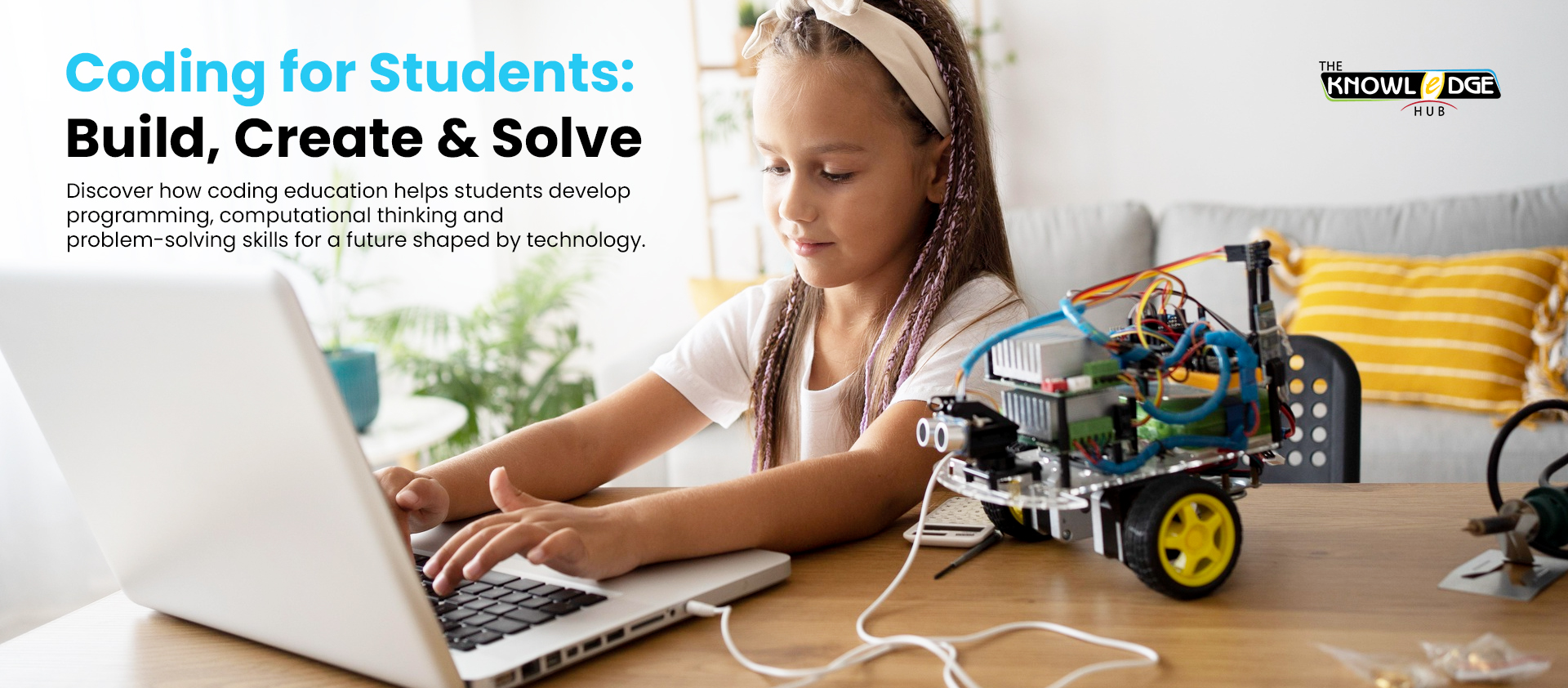
Students today grow up surrounded by technology. They use websites, apps, games, smart devices and digital platforms every day. But using technology and understanding how technology is created are two very different things.
This is why coding for students is becoming an important part of modern school education.
Learning to code gives students an opportunity to understand how digital systems work and how instructions can be transformed into functioning programs. More importantly, programming creates a structured way for students to turn ideas into digital solutions.
For schools in Dubai and across the UAE, coding can become an important part of a broader technology and STEM learning pathway, alongside robotics and coding programs in the UAE—helping students develop programming knowledge while preparing them to participate in an increasingly digital world.
Why Should Schools Teach Coding?
Coding should not be viewed only as preparation for students who want to become software developers.
Programming can be used as a learning tool across different subjects and age groups. When students write code, they learn to organise information, break tasks into steps, identify errors and refine their solutions.
A simple coding activity might require a student to:
- Understand a problem
- Plan a solution
- Write instructions
- Run the program
- Identify what went wrong
- Modify the code
- Test the result again
This process gives students a practical way to develop structured thinking.
The objective is therefore not simply to teach students programming syntax. It is to help them understand how to think, create and solve problems using computational methods.
What Do Students Actually Learn Through Coding?
A well-designed coding curriculum can introduce students to a progression of concepts rather than teaching isolated programming commands.
Depending on age and ability, students may learn:
- Algorithms and instructions
- Sequencing
- Patterns and logic
- Loops
- Conditions
- Variables
- Functions
- Debugging
- Data and information
- Problem decomposition
- Program design
Younger students may begin with visual or block-based programming, while older learners can gradually move toward text-based programming languages.
For example, school technology programs can introduce programming through interactive stories, games, animations, simulations and other projects before progressing to more advanced applications.
This makes coding more accessible and gives students opportunities to apply concepts rather than simply memorise them.
Coding and Computational Thinking
One of the most important reasons to introduce coding education in schools is its relationship with computational thinking.
Computational thinking involves approaching problems systematically. Students learn to break a larger challenge into smaller parts, recognise patterns, develop procedures and evaluate solutions.
Coding provides a practical environment for applying these ideas.
For example, when creating a program, students may ask:
- What is the problem?
- What should happen first?
- What should happen next?
- What conditions could change the result?
- How can the task be divided into smaller steps?
- Why did the program produce this outcome?
These questions encourage students to think about processes rather than simply searching for an answer.
Coding Is About Creating, Not Just Using Technology
Students are already technology users.
They interact with digital products every day, but coding can help them move from being technology consumers to technology creators.
Instead of only playing a game, students can learn how a game might be designed.
Instead of only watching an animation, they can create one.
Instead of simply using a website, they can explore how webpages are structured.
This shift can make technology more meaningful in the classroom because students begin to see digital tools as things they can understand, modify and create.
Project-based coding platforms such as TechnoKids, for example, provide activities covering programming, animation, web design and other technology skills across different age groups.
Coding Across Different Age Groups
Coding education does not need to begin with complex programming languages.
A progressive approach allows students to build skills over time.
Early Years and Primary Students
Younger learners can begin with activities involving:
- Sequencing
- Patterns
- Directions
- Cause and effect
- Simple problem-solving
- Block-based or screen-free coding
The focus should be on understanding instructions and developing computational thinking in an age-appropriate way.
Upper Primary and Middle School
Students can progress to:
- Loops
- Conditions
- Variables
- Interactive stories
- Games
- Animations
- Robotics programming
- More complex problem-solving
Secondary Students
Older learners can explore more advanced programming concepts, including:
- Text-based programming
- Web development
- Data
- Algorithms
- Python
- Application development
- Artificial intelligence concepts
The exact pathway should depend on the school’s curriculum, student age and learning objectives.
How Coding Connects With Other Subjects
Coding does not have to exist separately from the rest of the curriculum.
It can support learning across several subject areas.
Mathematics
Programming can reinforce patterns, logic, sequences, coordinates and problem-solving.
Science
Students can use coding to model processes, analyse information or control technology-based projects.
Design and Technology
Coding can be combined with engineering and digital design to create functional solutions.
Language and Storytelling
Students can use programming to create interactive stories, animations and digital presentations.
Robotics and STEM
Coding becomes particularly tangible when students use programs to control physical systems.
This connection is important for schools developing integrated STEM, robotics and coding programs rather than teaching each technology in isolation.
Why Coding Matters for Schools in Dubai and the UAE
The UAE has a strong focus on innovation, technology and future-ready education. For schools in Dubai and across the UAE, coding can support this direction by giving students practical exposure to programming and computational thinking.
However, introducing coding successfully requires more than purchasing software or asking students to complete coding exercises.
Schools need a structured learning pathway.
This can include:
- Age-appropriate curriculum
- Progressive learning objectives
- Suitable coding platforms
- Teacher training
- Hands-on projects
- Assessment and feedback
- Opportunities for students to create original solutions
A structured approach allows coding to become part of the school’s wider educational strategy rather than an isolated activity.
How Schools Can Build a Coding Program
Schools considering a coding program for students can begin with a clear progression.
1. Define the Learning Goals
Determine what students should understand at each stage—from basic sequencing to advanced programming.
2. Match Coding to Age and Ability
Choose tools and programming environments appropriate for each student group.
3. Start With Practical Projects
Projects can make programming concepts easier to understand by giving students a specific outcome to work towards.
4. Encourage Experimentation
Students should have opportunities to modify code, test ideas and discover different ways of solving a problem.
5. Develop Teacher Capability
Teachers need suitable training and curriculum resources to guide students effectively.
6. Connect Coding With Other Learning
Where appropriate, integrate programming with mathematics, science, STEM, robotics, design and creative projects.
This creates a more meaningful technology learning pathway.
Coding and Robotics: A Natural Progression
Coding can also become a foundation for robotics education.
When students program a robot, they can immediately see how instructions translate into physical actions. A change in the program can change the robot’s movement, behaviour or response.
This creates a bridge between digital programming and physical problem-solving.
For schools building a broader technology pathway, students can progress from basic coding concepts to robotics, engineering challenges and eventually more advanced technology applications.
Knowledge Hub’s robotics and coding solutions can support schools looking to create these kinds of connected learning experiences in the UAE.
What Makes Coding Education Effective?
Simply giving students access to a coding platform does not automatically create effective coding education.
The learning experience matters.
Effective coding education should give students opportunities to:
- Understand concepts progressively
- Apply what they learn
- Create projects
- Test their ideas
- Debug problems
- Work independently and collaboratively
- Explain their solutions
- Improve their work
The emphasis should be on learning through programming, rather than simply completing a predetermined set of coding exercises.
Building Future-Ready Coding Skills
The purpose of teaching coding is not to predict exactly which programming languages students will use in their future careers.
Technology changes quickly.
Instead, schools can focus on developing transferable capabilities such as computational thinking, structured problem-solving, logical reasoning, creativity and the ability to learn new technologies.
These capabilities can help students adapt as technology continues to evolve.
For schools in Dubai and the wider UAE, this makes coding a valuable component of a broader future-ready education strategy.
Conclusion
Coding for students is about more than learning programming languages.
It gives learners a structured way to understand technology, break down problems, develop solutions and create digital experiences. When introduced progressively and connected to meaningful projects, coding can support computational thinking while strengthening learning across STEM and other subject areas.
For schools in Dubai and across the UAE, a well-designed coding curriculum can help students move from simply using technology to understanding how technology works—and eventually creating with it.
Knowledge Hub helps schools build structured technology learning pathways through coding, robotics, STEM and ICT programs designed to support practical, future-focused learning.
Bring Coding Into Your School
Ready to give students the opportunity to learn, create and solve through coding?
Knowledge Hub’s Robotics & Coding Programs UAE help schools introduce structured, hands-on coding experiences that can develop programming knowledge, computational thinking and creative problem-solving.
Whether your school is introducing coding for the first time or looking to strengthen an existing technology curriculum, Knowledge Hub can help you develop a learning pathway suited to your students and educational goals.
Explore Knowledge Hub’s Robotics & Coding Programs UAE and discover how coding can become a meaningful part of your school’s future-ready learning strategy.
Frequently Asked Questions
Why should schools teach coding to students?
Coding helps students understand how digital systems work while providing practical opportunities to develop computational thinking, logical reasoning, problem-solving and creativity.
What age should students start learning coding?
Students can begin coding through age-appropriate activities from the early years and primary grades. Younger learners can start with sequencing and visual or screen-free coding, while older students can progress to more advanced programming.
Is coding difficult for students to learn?
Coding can become accessible when concepts are introduced progressively and through age-appropriate activities. Visual and block-based programming can provide an entry point before students move toward text-based programming.
What programming skills should students learn?
Students can progressively learn sequencing, algorithms, loops, conditions, variables, functions, debugging and problem decomposition. Older learners may then progress to text-based programming and more advanced applications.
How does coding support STEM education?
Coding gives students a practical way to apply logic, mathematics and problem-solving. It can also connect with science, engineering, robotics and other STEM activities.
Can coding be taught without focusing on becoming a programmer?
Yes. The educational value of coding extends beyond programming careers. Students can develop computational thinking, structured problem-solving and creativity—skills that can be applied across many disciplines.
How can schools in Dubai introduce coding?
Schools can begin by defining learning objectives, selecting age-appropriate coding tools, training teachers and creating a progressive curriculum that combines programming concepts with practical projects.