

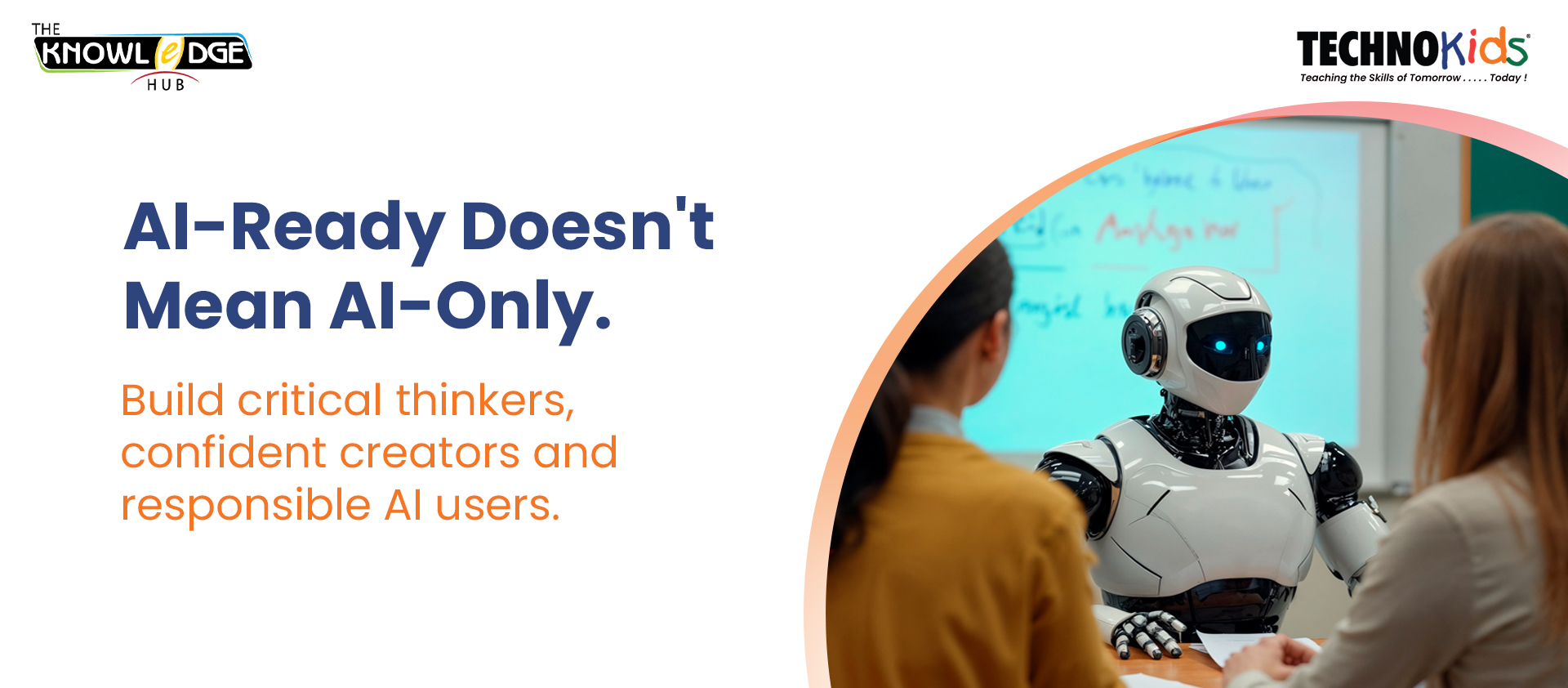
Artificial Intelligence is becoming an important part of everyday life, influencing how people learn, communicate, create and solve problems. As AI-powered technologies become more accessible, schools have an opportunity to prepare students to understand and use these technologies effectively.
However, AI education for students should go beyond learning how to use AI tools. It should help learners understand how artificial intelligence works, question the information it generates, explore creative possibilities, and recognise the importance of responsible technology use.
The goal is to develop students who can think independently, solve problems, and confidently navigate an increasingly AI-driven world.
AI Education Is More Than Using AI Tools
Knowing how to open an AI application or generate content does not necessarily mean a student understands artificial intelligence.
Meaningful AI education introduces students to the concepts behind the technology. They explore how AI uses data, identifies patterns, generates predictions and responds to instructions.
Students should also learn to question AI-generated information, recognise potential inaccuracies and understand that AI systems have limitations.
This encourages learners to become active participants in technology rather than simply relying on automated outputs.
Essential Skills Students Need in an AI-Driven World
AI education should develop a combination of technical, creative and analytical skills.
Some important capabilities include:
- Critical Thinking: Questioning information, evaluating AI-generated responses and verifying accuracy.
- Creativity: Exploring new ideas and using AI to support content creation and project development.
- Problem-Solving: Breaking challenges into smaller tasks and developing logical solutions.
- Evaluation: Identifying errors, recognising patterns and making informed decisions.
- Innovation: Experimenting with technology and developing solutions to real-world challenges.
These skills help students understand how to work alongside technology while maintaining their own creativity and independent thinking.
How Students Can Explore AI Through Hands-On Learning
Practical learning makes complex AI concepts easier to understand.
Students can explore artificial intelligence through activities involving content creation, image recognition, machine learning and simple model training.
For example, they can organise sample images into categories, train a basic machine learning model and observe how it identifies patterns. They can also experiment with AI-generated content, compare different outputs and improve results through better instructions.
Project-based activities provide further opportunities to apply these concepts. Students can develop ideas, experiment with AI technologies and build projects that demonstrate their understanding.
Such experiences connect theoretical knowledge with practical application while encouraging curiosity and computational thinking.
The Role of Teachers in AI Education
Teachers play an essential role in creating meaningful AI learning experiences.
AI-assisted technologies can support educators with lesson ideas, activity adaptation, differentiated learning, resource creation and curriculum planning.
For example, teachers can explore different ways to explain a concept, create supplementary learning materials or adapt activities to suit varying student abilities.
However, AI should support teaching rather than replace educators' expertise. Teachers must continue to evaluate resources, guide classroom discussions and ensure that technology supports learning objectives.
Why Responsible AI Education Matters
Understanding artificial intelligence also means learning how to use it responsibly.
Students need guidance on important areas such as:
- AI Safety: Understanding safe and appropriate interactions with AI applications.
- Privacy: Protecting personal information and sensitive data.
- Bias Awareness: Recognising how biased data can influence AI-generated results.
- Digital Citizenship: Developing responsible online behaviour.
- Ethics: Understanding fairness, accountability and the impact of AI on society.
Introducing these principles early helps students become informed digital citizens who can make responsible decisions when using technology.
Preparing Students to Become AI Thinkers and Creators
The future of education is not simply about introducing more technology into classrooms. It is about developing learners who understand technology and know how to use it meaningfully.
TechnoKids supports this approach by bringing together AI exploration, digital literacy, coding, computational thinking and project-based learning.
Through structured learning experiences, students can move beyond simply using digital tools to questioning, experimenting, creating and solving problems.
Because being AI-ready isn't about using AI alone. It's about thinking critically, creating confidently and using technology responsibly.
From AI users to AI thinkers to AI creators – that's what makes learners future-ready.