

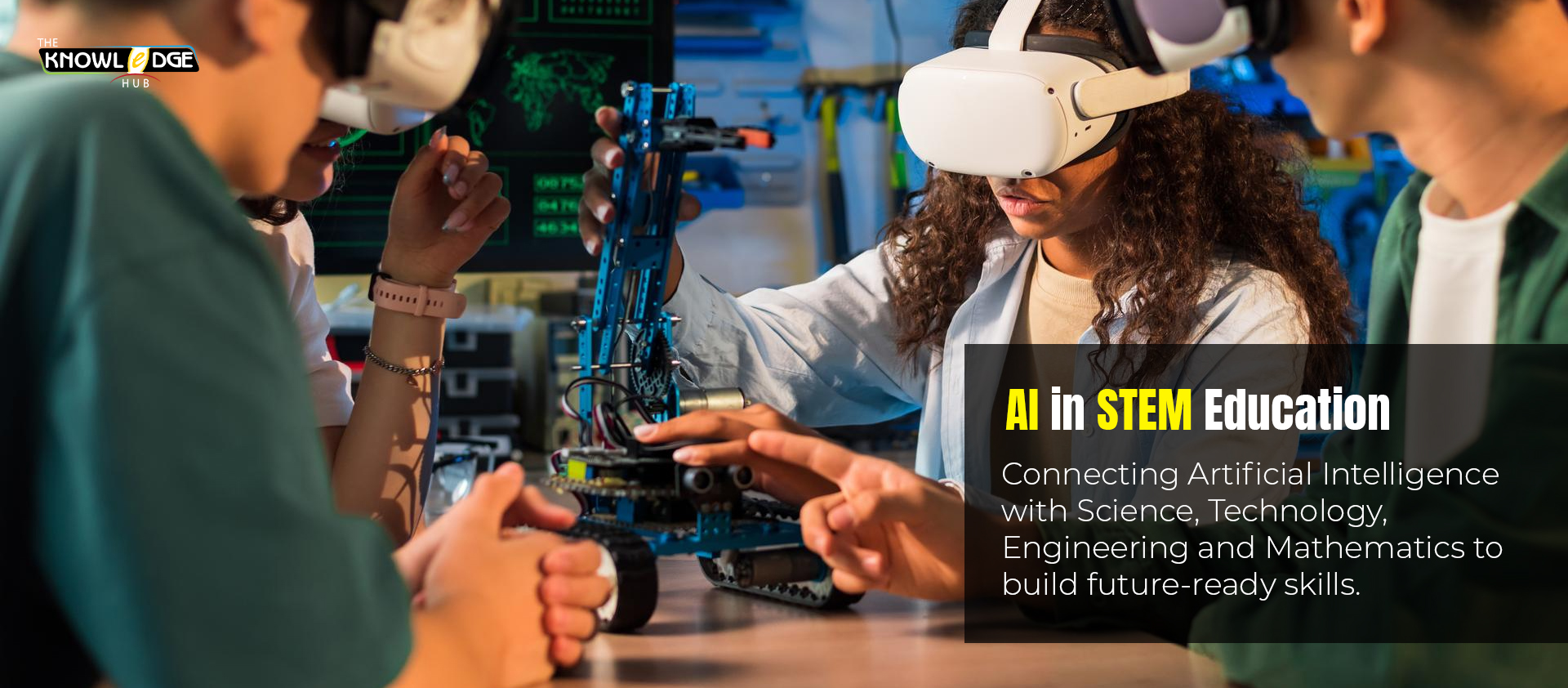
Artificial intelligence is changing how students explore scientific concepts, work with data, solve problems, and develop new ideas. When combined with Science, Technology, Engineering, and Mathematics (STEM), AI creates opportunities for students to move beyond theoretical learning and engage with practical, real-world challenges.
AI in STEM Education brings together artificial intelligence concepts and hands-on STEM learning. Students can investigate patterns, analyse information, experiment with solutions, and understand how intelligent systems are used in different fields.
For schools, this creates an opportunity to make STEM learning more interactive while developing the critical thinking, creativity, computational thinking, and problem-solving skills students need for the future.
Schools looking to introduce AI through a structured learning approach can explore AI Education Solutions UAE.
What Is the Role of AI in STEM Education?
AI supports STEM education by helping students explore complex concepts, analyse data, recognise patterns, test ideas, and investigate real-world problems.
Rather than replacing traditional STEM subjects, artificial intelligence can strengthen how students learn and apply them.
For example:
- Science: Students can explore how AI supports scientific research, environmental monitoring, and data analysis.
- Technology: Learners can understand algorithms, machine learning, automation, and intelligent systems.
- Engineering: Students can investigate how AI supports design, testing, and optimisation.
- Mathematics: Learners can use data, patterns, and mathematical reasoning to understand how AI systems make predictions.
This integration helps students understand that STEM disciplines are connected and that AI can be applied across different areas of knowledge.
5 Ways AI Is Transforming STEM Learning
1. Making Scientific Investigation More Interactive
AI can help students explore scientific questions by identifying patterns in information and supporting the analysis of observations.
For example, students investigating climate change could examine temperature records, rainfall patterns, or environmental data. They can discuss what the information reveals and consider how AI systems might help researchers identify trends.
Teachers can use these investigations to encourage students to ask questions, form hypotheses, examine evidence, and explain their findings.
The focus remains on scientific thinking, with AI serving as a supporting tool.
2. Strengthening Mathematical and Data Skills
Mathematics is an important foundation of artificial intelligence.
Students can explore how data, mathematical relationships, patterns, and probability contribute to AI systems.
Classroom activities could include analysing datasets, identifying trends, comparing predictions, and examining how changes in input data affect results.
These experiences help students connect mathematical concepts with practical applications.
They also encourage learners to understand that AI-generated predictions depend on the quality and relevance of the data used.
3. Connecting Coding With Artificial Intelligence
Coding helps students understand how instructions, algorithms, and logical sequences control digital systems.
When connected with AI, coding education can introduce students to more advanced concepts such as machine learning, automation, pattern recognition, and intelligent decision-making.
For example, students can explore how a computer follows instructions, how an algorithm processes information, or how a system can identify patterns from examples.
These learning experiences build on foundational computational thinking and help students understand the relationship between programming and artificial intelligence.
Schools can connect these concepts with structured Robotics and Coding Programs UAE to develop a progressive technology learning pathway.
4. Supporting Engineering Design and Problem-Solving
Engineering education encourages students to identify challenges, develop solutions, build prototypes, test ideas, and make improvements.
AI can add another dimension to this process.
Students might investigate how intelligent systems could help:
- Reduce energy consumption in buildings
- Improve traffic management
- Monitor environmental conditions
- Support waste management
- Make everyday products more efficient
For example, a classroom challenge could ask students to design a smart building that uses energy efficiently. They can identify the information an intelligent system would need, discuss possible solutions, and explain how technology could support better decisions.
This approach combines engineering design with data analysis, creativity, and problem-solving.
5. Encouraging Innovation Through Project-Based Learning
AI provides opportunities for students to apply STEM concepts to challenges that connect with the world around them.
Through project-based learning, students can work in teams to investigate a problem, research possible solutions, develop ideas, and present their findings.
Possible projects include:
- Designing a smart irrigation concept
- Exploring AI applications in healthcare
- Developing an idea for reducing school energy consumption
- Investigating how robots can support everyday tasks
- Exploring how AI can improve environmental monitoring
These projects help students connect different STEM disciplines instead of learning each subject in isolation.
Teachers looking for practical ideas can also explore AI Classroom Activities That Build Future Skills.
How Schools Can Integrate AI Into STEM Curriculum
Introducing AI into STEM learning does not necessarily require a completely new subject or a major curriculum redesign.
Schools can begin by identifying opportunities to connect AI concepts with existing science, mathematics, technology, and engineering lessons.
A practical approach includes:
Start with foundational concepts: Introduce students to patterns, data, algorithms, and logical reasoning before moving towards more advanced AI topics.
Connect AI with existing subjects: Identify lessons where students can investigate how AI is used in scientific research, mathematical analysis, engineering, and technology.
Use hands-on learning: Provide opportunities to experiment, investigate, build, test, and improve solutions.
Prepare teachers: Support educators with professional development so they can confidently introduce AI concepts and guide students through practical activities.
Evaluate learning outcomes: Assess students on their understanding, reasoning, creativity, and ability to apply concepts—not simply their ability to use an AI tool.
Schools in the UAE can align these activities with their broader STEM Curriculum UAE to create a structured approach to interdisciplinary learning.
The Importance of Responsible AI in STEM Learning
As students begin exploring artificial intelligence, they also need to understand its limitations.
AI systems can produce inaccurate information, reflect biases in their training data, and generate results that require human evaluation.
Teachers can encourage students to:
- Check AI-generated information against reliable evidence.
- Question how data influences predictions.
- Identify possible errors or bias.
- Explain the reasoning behind their conclusions.
- Understand when human judgement is necessary.
This helps students develop a balanced understanding of artificial intelligence as a useful technology that requires responsible application.
Developing these habits is closely connected to AI Literacy for Students: Why Every School Should Teach It, which explores how learners can evaluate information and use AI responsibly.
Preparing Students for the Future Through AI and STEM
The relationship between AI and STEM extends beyond classroom learning. Artificial intelligence is increasingly used in fields such as healthcare, engineering, manufacturing, transportation, environmental science, and scientific research.
Students who understand the fundamentals of STEM and AI will be better prepared to explore these evolving fields.
More importantly, they will develop transferable capabilities such as analytical thinking, creativity, collaboration, adaptability, and problem-solving.
For schools, the opportunity is to create learning experiences that help students understand technology, question how it works, and apply their knowledge to meaningful challenges.
For a broader perspective on the changing classroom environment, read How AI Is Transforming Modern Classrooms.
Conclusion
AI is creating new opportunities for STEM education by connecting scientific investigation, mathematics, coding, engineering, and real-world problem-solving.
When introduced through meaningful classroom experiences, it helps students understand how intelligent technologies work and how they can be applied to address practical challenges.
The goal is not simply to teach students how to use AI. It is to help them develop the knowledge, creativity, and critical thinking needed to work with emerging technologies and contribute to future innovation.
Explore AI Education Solutions UAE to discover how schools can introduce structured AI learning and connect artificial intelligence with broader STEM and technology education.