

The skills students need for the future are changing. As technology continues to influence education, business, science, and everyday life, students need more than the ability to remember information. They need to know how to think critically, solve problems, work with others, adapt to change, and apply what they learn to real-world situations.
This is where STEM education plays an important role.
By bringing together Science, Technology, Engineering, and Mathematics, STEM learning encourages students to explore problems, experiment with ideas, develop solutions, and learn through practical experiences.
But what makes STEM education valuable for students?
The benefits go beyond learning science or technology. A well-designed STEM learning experience can help students develop a broad set of academic, technical, and transferable skills that can support them throughout their education and future careers.
What Is STEM Education?
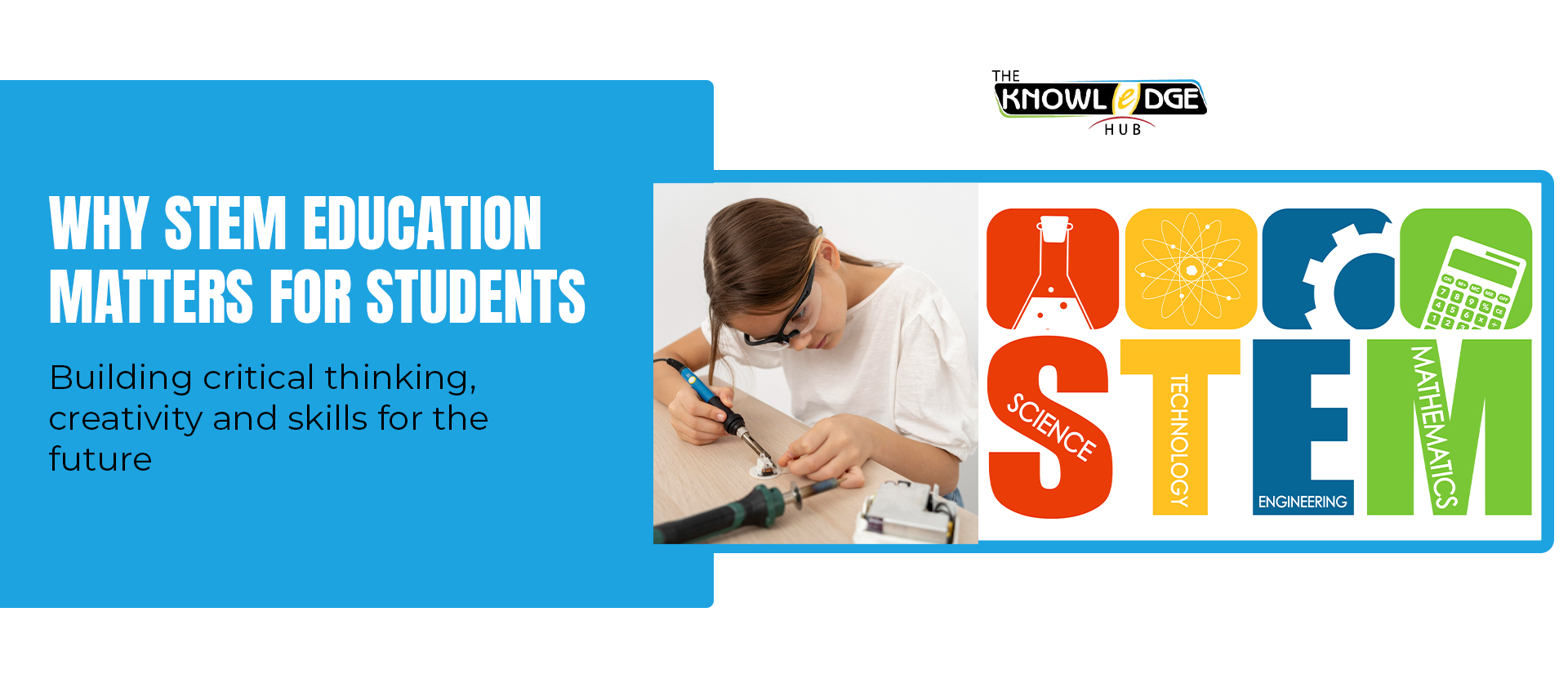
STEM stands for Science, Technology, Engineering, and Mathematics.
Rather than treating these subjects as completely separate areas of learning, STEM education encourages students to connect concepts across disciplines and apply them to practical challenges.
For example, students might use mathematics to analyse data, science to understand a problem, engineering principles to design a solution, and technology to test or improve it.
This approach makes learning more active and encourages students to understand not only what they are learning, but also how and why it can be applied.
Schools looking to build a structured approach can explore our STEM Curriculum UAE resource for a broader view of STEM learning and curriculum integration.
10 Key Benefits of STEM Education for Students
1. Develops Critical Thinking
One of the most important benefits of STEM education is the development of critical thinking.
STEM activities often require students to examine information, identify patterns, compare possible solutions, and make decisions based on evidence.
Instead of simply accepting an answer, students are encouraged to ask:
- Why does this happen?
- What evidence supports this idea?
- Is there another way to solve the problem?
- What could be improved?
- What happens if we change one part of the solution?
This encourages students to become more thoughtful and analytical learners.
2. Strengthens Problem-Solving Skills
STEM learning frequently begins with a problem rather than a predetermined answer.
Students may be asked to design a structure, develop a working model, program a robot, analyse data, or find a way to improve an existing system.
They need to understand the challenge, develop possible solutions, test their ideas, identify problems, and make improvements.
This creates a valuable habit:
Identify → Explore → Build → Test → Improve
Students learn that a problem does not always have one immediate solution and that improvement is often part of the process.
These problem-solving skills can be applied well beyond the STEM classroom.
3. Encourages Creativity and Innovation
STEM is sometimes associated primarily with technical subjects, but creativity is an important part of STEM learning.
When students are given an open-ended challenge, they may develop different approaches to solving the same problem.
For example, a classroom engineering project might ask students to design a bridge using a limited set of materials.
Different teams may produce completely different designs.
Students must think creatively about:
- Materials
- Structure
- Design
- Function
- Efficiency
- Improvements
This encourages students to move from simply consuming information to creating and testing their own ideas.
4. Builds Collaboration and Communication
Many STEM projects are collaborative.
Students may work in teams to research a problem, divide responsibilities, develop a prototype, test their ideas, and present their results.
This requires students to:
- Share ideas
- Listen to others
- Explain their reasoning
- Give and receive feedback
- Resolve disagreements
- Work toward a common goal
Communication becomes particularly important when students need to explain why their solution works or why they changed their original approach.
These collaboration skills are valuable across education, employment, and everyday life.
5. Develops Digital Literacy
Technology is an increasingly important part of modern learning and work.
STEM education can provide students with opportunities to use technology for meaningful purposes rather than simply consuming digital content.
Depending on their age and curriculum, students may work with:
- Coding platforms
- Robotics
- Simulations
- Digital design tools
- Sensors
- Data collection tools
- Artificial intelligence
- Educational software
The focus should be on helping students understand how technology can be used to create, analyse, communicate, and solve problems.
This contributes to stronger digital literacy and helps students become more confident technology users.
6. Introduces Computational Thinking
Computational thinking is a valuable skill that extends beyond computer science.
It involves breaking complex problems into smaller parts, identifying patterns, developing logical steps, and creating processes that can be followed or tested.
For example, when students program a robot to complete a task, they may need to:
- Understand the objective.
- Break the task into smaller steps.
- Create instructions.
- Test the program.
- Identify errors.
- Modify the instructions.
- Test again.
This process encourages logical thinking and teaches students how to approach complex challenges systematically.
7. Connects Classroom Learning With Real-World Problems
One of the strongest benefits of STEM education is its connection to real-world applications.
Students can see how classroom concepts relate to problems involving:
- Sustainability
- Energy
- Transportation
- Healthcare
- Environmental protection
- Smart cities
- Communication
- Engineering
- Technology
For example, instead of learning about energy only through textbooks, students could investigate renewable energy and design a model solution.
This can make learning more meaningful because students can see why the knowledge matters.
8. Encourages Learning Through Experimentation
STEM education gives students opportunities to learn by doing.
They can build, test, observe, modify, and try again.
This is particularly important because the first attempt does not always produce the desired result.
A robot may not complete its task.
A structure may collapse.
A program may contain an error.
A design may not perform as expected.
Rather than viewing these outcomes simply as failures, STEM learning can use them as opportunities for investigation.
Students can ask:
What went wrong?
Why did it happen?
What can we change?
Will the new approach work better?
This develops persistence and encourages students to view mistakes as part of the learning process.
9. Builds Confidence and Student Agency
STEM projects can give students greater ownership of their learning.
When students are given the opportunity to choose an approach, build something, test an idea, and present a solution, they become active participants in the learning process.
Successfully solving a challenge can also build confidence.
Students begin to recognise that they are capable of:
- Investigating unfamiliar problems
- Learning new technologies
- Developing ideas
- Testing solutions
- Learning from mistakes
- Creating something of their own
This sense of ownership can encourage students to become more independent learners.
10. Prepares Students for Future Careers
STEM education can help students develop skills relevant to a wide range of future careers.
Students may eventually pursue fields such as:
- Engineering
- Computer science
- Data science
- Artificial intelligence
- Robotics
- Healthcare
- Environmental science
- Architecture
- Technology
- Research
However, the value of STEM education is not limited to students who eventually enter STEM professions.
Skills such as critical thinking, creativity, communication, problem-solving, collaboration, and adaptability can benefit students regardless of their future career path.
STEM Skills Students Can Develop
The benefits of STEM education can be grouped into several broad skill areas.
| Skill Area | Examples |
|---|---|
| Thinking Skills | Critical thinking, logical reasoning, analysis |
| Problem-Solving | Identifying problems, testing solutions, improving designs |
| Technical Skills | Coding, robotics, digital tools, data |
| Creative Skills | Ideation, design, innovation |
| Social Skills | Collaboration, communication, teamwork |
| Learning Skills | Curiosity, experimentation, persistence |
| Future Skills | Adaptability, digital literacy, computational thinking |
This combination is what makes STEM learning particularly valuable. Students are not only developing subject knowledge; they are learning how to apply that knowledge.
How STEM Education Supports Different Age Groups
The benefits of STEM can be introduced from the early years and developed progressively throughout school.
Early Years and Primary
At younger ages, STEM learning can focus on curiosity and exploration.
Activities might include:
- Building and construction
- Simple experiments
- Patterns and sequencing
- Observation
- Basic coding concepts
- Problem-solving games
The objective is to encourage students to ask questions and explore how things work.
Middle School
As students develop, STEM activities can become more complex.
Students may explore:
- Robotics
- Coding
- Engineering design
- Electronics
- Data
- Scientific experiments
- Design challenges
They can begin applying multiple concepts to solve structured problems.
Secondary School
Older students can work on more advanced challenges involving:
- Artificial intelligence
- Advanced robotics
- Programming
- Engineering
- Data analysis
- Automation
- Research
- Real-world innovation
The progression allows students to build upon previously developed skills rather than encountering STEM as a series of unrelated activities.
STEM Education and Project-Based Learning
Project-based learning is a natural way to develop many of the benefits associated with STEM.
Instead of learning a concept and immediately moving on to another topic, students can apply multiple concepts to a longer-term challenge.
For example, a sustainability project might require students to:
Research an environmental issue.
↓
Analyse available information.
↓
Design a possible solution.
↓
Build a prototype.
↓
Test the prototype.
↓
Improve the design.
↓
Present the final solution.
Through one project, students can practise science, mathematics, technology, communication, collaboration, creativity, and problem-solving.
This makes STEM learning more connected and purposeful.
How Schools Can Maximise the Benefits of STEM Education
Simply adding STEM activities to the school calendar does not guarantee meaningful outcomes.
Schools can maximise these benefits by taking a structured approach to implementing STEM education in schools, from curriculum alignment and teacher training to technology selection and assessment.
Align STEM With Curriculum Goals
Activities should connect with learning outcomes rather than becoming isolated technology demonstrations.
Provide Teacher Training
Teachers need the confidence and knowledge to facilitate hands-on STEM experiences effectively.
Use Age-Appropriate Technology
Technology should match students' abilities and support clear learning objectives.
Encourage Hands-On Learning
Students should have opportunities to build, test, experiment, and improve.
Make Projects Meaningful
Whenever possible, connect activities to real-world challenges and situations.
Assess Skills as Well as Knowledge
Assessment can consider problem-solving, creativity, collaboration, communication, and the student's ability to apply knowledge.
The Role of STEM Labs in Student Learning
A dedicated STEM lab can provide an environment where students can regularly engage in hands-on learning.
A well-designed STEM learning space can bring together:
- Robotics
- Coding
- Engineering
- Electronics
- Maker activities
- Digital tools
- Collaborative workspaces
However, a STEM lab is most effective when it is connected to a broader curriculum and teaching strategy.
The physical space should support the learning objectives rather than become the objective itself.
Schools exploring dedicated STEM learning environments can learn more about STEM labs and learning spaces.
Conclusion
The benefits of STEM education extend far beyond science, technology, engineering, and mathematics.
Through meaningful STEM experiences, students can develop critical thinking, problem-solving, creativity, collaboration, communication, digital literacy, computational thinking, and adaptability.
Perhaps most importantly, STEM encourages students to approach challenges differently. Instead of looking only for the right answer, they learn to ask questions, investigate possibilities, test ideas, learn from mistakes, and improve their solutions.
For schools, the goal should not simply be to introduce more technology into the classroom. It should be to create learning experiences that help students think, create, solve, and innovate.
When STEM is thoughtfully integrated into the curriculum, it can help prepare students with the skills and mindset they need to navigate an increasingly complex and technology-driven future.
Frequently Asked Questions
What are the main benefits of STEM education?
The main benefits include developing critical thinking, problem-solving, creativity, collaboration, communication, digital literacy, computational thinking, and innovation skills.
How does STEM education help students in the future?
STEM education helps students develop skills that can support further education and a wide range of careers. It also encourages adaptability, logical thinking, creativity, and the ability to apply knowledge to real-world problems.
Does STEM education only benefit students who want STEM careers?
No. STEM develops transferable skills such as problem-solving, communication, collaboration, creativity, and critical thinking that can be useful across many different fields.
How does STEM education develop problem-solving skills?
Students are often given practical challenges that require them to identify a problem, explore possible solutions, build or test an idea, evaluate the result, and make improvements.
How does robotics support STEM learning?
Robotics gives students opportunities to combine programming, engineering, mathematics, and problem-solving while designing and testing physical systems.
What age should students start STEM education?
STEM concepts can be introduced from the early years through age-appropriate activities. As students progress through school, activities can become more advanced and incorporate coding, robotics, engineering, AI, data, and other technologies.