

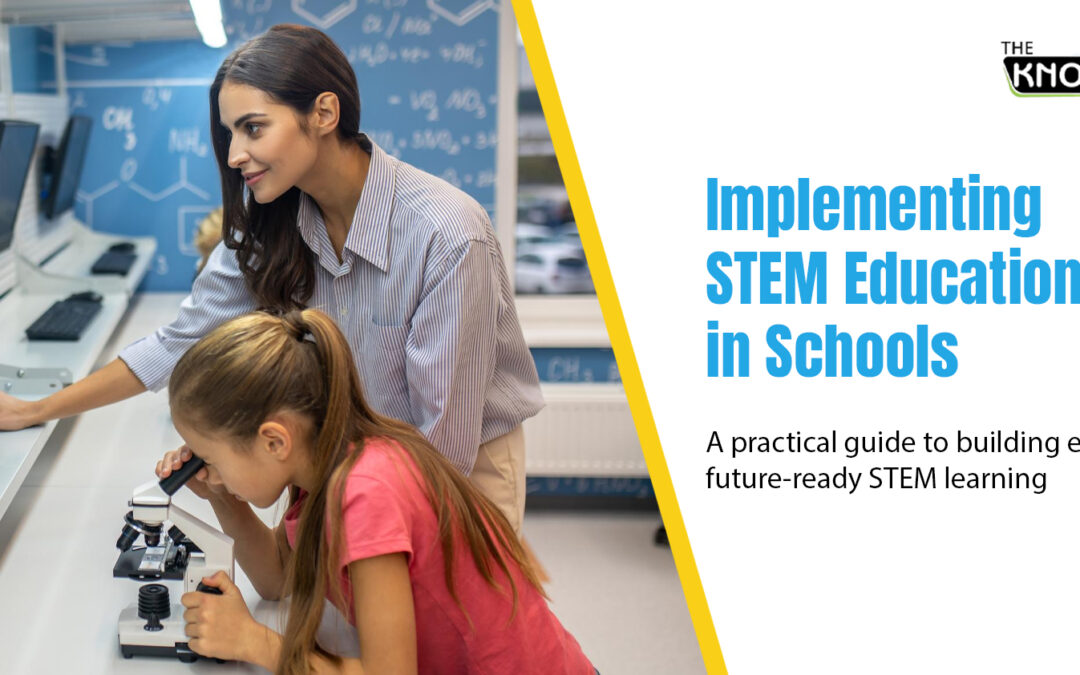
How to Implement STEM Education in Schools: A Step-by-Step Guide
STEM education is becoming an increasingly important part of modern schooling. But successfully introducing STEM is about much more than adding robotics kits, coding tools, or a dedicated laboratory.
A strong STEM program connects science, technology, engineering, and mathematics with real-world challenges. It encourages students to ask questions, experiment with ideas, solve problems, collaborate with others, and apply what they learn.
For schools, the challenge is knowing where to begin.
Implementing STEM education requires a clear strategy that brings together curriculum, teachers, learning experiences, technology, and assessment. This guide explains the key steps schools can take to build a meaningful and sustainable STEM learning program.
Why STEM Education Matters in Schools
Traditional learning can sometimes separate subjects into individual areas of knowledge. STEM takes a more integrated approach.
Students might use mathematics to analyse data, science to understand a problem, engineering to design a solution, and technology to test or improve it.
This approach can help develop skills such as:
- Critical thinking
- Problem-solving
- Creativity
- Collaboration
- Communication
- Digital literacy
- Computational thinking
- Innovation
The goal isn't simply to teach students more technology. It is to help them use knowledge to solve meaningful problems.
A well-designed
1. Define Your School's STEM Goals
Before purchasing equipment or selecting technology, schools should first establish what they want their STEM program to achieve.
Start by considering:
- Which age groups will participate?
- What STEM skills should students develop?
- Which subjects can be connected?
- What technology is already available?
- What gaps exist in the current curriculum?
- What learning outcomes should the program deliver?
For example, a primary school may focus on curiosity, building, observation, and basic problem-solving, while secondary students may work on robotics, artificial intelligence, engineering design, programming, or data analysis.
Clear objectives make it easier to select appropriate activities, resources, teacher training, and technology.
2. Align STEM With the Existing Curriculum
STEM should not necessarily become another disconnected subject on the timetable.
Instead, schools can identify opportunities to integrate STEM into existing curriculum objectives.
For example:
- Science + Engineering: Students investigate renewable energy and design a small solar-powered system.
- Mathematics + Technology: Students collect and analyse data using digital tools.
- Science + Coding: Students create a simple program that models a scientific process.
- Mathematics + Engineering: Students calculate dimensions and materials while designing a structure.
This interdisciplinary approach helps students understand that knowledge is connected and that real-world problems rarely fit neatly into one subject.
3. Introduce Project-Based STEM Learning
One of the most effective ways to make STEM meaningful is through project-based learning.
Instead of simply asking students to memorise information, teachers give them a problem or challenge and allow them to develop a solution.
A project might ask students to:
- Design a bridge that can support a specific weight.
- Create a water filtration system.
- Build a model sustainable city.
- Program a robot to complete a task.
- Design a system for reducing classroom energy consumption.
- Develop a simple solution to a local environmental problem.
Students research, plan, build, test, evaluate, and improve their ideas.
This process makes failure part of learning. If a design doesn't work, students can investigate why, modify their approach, and try again.
Project-based STEM learning also creates opportunities for collaboration and communication because students often need to explain their ideas, divide responsibilities, and present their solutions.
4. Develop Teachers' STEM Skills
Technology alone cannot create an effective STEM program.
Teachers play a central role in designing meaningful activities, guiding students through challenges, asking the right questions, and connecting projects with learning objectives.
Professional development can help teachers build confidence in areas such as:
- Project-based learning
- STEM pedagogy
- Coding and computational thinking
- Robotics
- Engineering design
- Digital tools
- Classroom technology integration
- Assessment of project-based learning
Teacher training should also be continuous. As technologies and classroom practices evolve, teachers need opportunities to experiment with new approaches and share successful practices with colleagues.
For schools developing long-term capability, structured teacher training and certification programs can complement classroom implementation.
5. Choose the Right STEM Technologies
Schools often face a wide range of STEM technology options, from coding platforms and robotics kits to AI tools, electronics, sensors, and digital learning resources.
The most expensive technology is not necessarily the most effective.
When evaluating a STEM solution, schools should consider:
Curriculum Alignment
Does the technology support specific learning objectives?
Age Appropriateness
Can students understand and use it independently at their developmental level?
Hands-On Learning
Does it allow students to experiment, build, test, and modify ideas?
Scalability
Can the solution be used across multiple grades or subjects?
Teacher Usability
Can teachers integrate it into lessons without creating unnecessary complexity?
Long-Term Value
Can students progress from basic activities to more advanced challenges as their skills develop?
The best technology should support the learning experience rather than become the focus of it.
6. Create a STEM Lab or Flexible Learning Environment
A dedicated STEM lab can provide students with a space to experiment, collaborate, build, and solve problems.
However, schools don't always need a large specialised facility to begin.
A STEM learning environment can include:
- Flexible workstations
- Robotics areas
- Coding stations
- Engineering materials
- Electronics and sensors
- Maker equipment
- Digital learning tools
- Collaborative project spaces
The key is creating an environment where students can move beyond passive learning and actively work with ideas.
For schools planning a dedicated facility, a STEM lab can bring together technology, hands-on resources, and collaborative learning in one structured environment.
7. Introduce Age-Appropriate STEM Experiences
STEM implementation should evolve as students progress through school.
Early and Primary Years
Younger students can develop STEM foundations through:
- Building activities
- Simple experiments
- Pattern recognition
- Sequencing
- Observation
- Basic coding concepts
- Problem-solving games
At this stage, the emphasis should be on curiosity and exploration.
Middle School
Students can begin working with:
- Robotics
- Programming
- Engineering challenges
- Electronics
- Data collection
- Scientific experimentation
- Design projects
Learning becomes increasingly focused on applying concepts to solve problems.
Secondary School
Older students can explore more advanced areas such as:
- Artificial intelligence
- Advanced robotics\Engineering
- Data science
- Automation
- Programming
- Research projects
- Real-world innovation challenges
A progression-based approach prevents STEM from becoming a collection of disconnected activities.
8. Measure More Than Academic Scores
Traditional assessments may not fully capture what students learn through STEM projects.
Schools should consider evaluating both knowledge and transferable skills.
Possible measures include:
- Problem-solving
- Critical thinking
- Creativity
- Collaboration
- Communication
- Research
- Design process
- Ability to test and improve solutions
- Application of subject knowledge
For example, a student's final model may not be the only thing assessed. Teachers can also evaluate how the student identified the problem, developed ideas, tested different approaches, responded to failure, and communicated the final solution.
This creates a more complete picture of STEM learning.
9. Start Small and Build a Sustainable STEM Program
Schools do not need to transform everything at once.
A phased approach can often be more effective.
Phase 1: Assess
Review the current curriculum, resources, teacher capabilities, and student needs.
Phase 2: Pilot
Introduce STEM activities with a selected grade, subject, or group of teachers.
Phase 3: Train
Build teacher confidence and establish consistent approaches to STEM learning.
Phase 4: Expand
Introduce additional technologies, projects, grade levels, or dedicated learning spaces.
Phase 5: Evaluate
Review student outcomes, teacher feedback, participation, and program effectiveness.
Phase 6: Scale
Use the results to develop a broader STEM strategy across the school.
This approach allows schools to learn from early implementation rather than investing heavily before understanding what works best for their students.
STEM Education in UAE Schools
For schools in the UAE, STEM education can support the development of skills that are increasingly important in a technology-driven economy.
Schools can use STEM learning to expose students to areas such as:
- Artificial intelligence
- Robotics
- Coding
- Engineering
- Data
- Digital technologies
- Innovation
- Sustainable development
However, successful implementation still depends on the fundamentals: curriculum alignment, teacher capability, appropriate resources, meaningful projects, and clear learning outcomes.
The technology should support the educational strategy—not replace it.
Common Challenges When Implementing STEM Education
Schools may encounter several challenges when introducing STEM.
Limited Teacher Confidence
Teachers may be comfortable with their existing subjects but less familiar with robotics, coding, engineering, or other technologies.
Solution: Provide practical professional development and ongoing support.
Limited Resources
Schools may have difficulty deciding which equipment or platforms to purchase.
Solution: Start with clearly defined learning objectives and select resources based on curriculum needs.
Curriculum Pressure
Teachers may feel that STEM projects require additional classroom time.
Solution: Integrate STEM projects into existing curriculum objectives rather than treating them as completely separate activities.
Difficulty Measuring Outcomes
Project-based learning can be more complex to assess than traditional tests.
Solution: Establish clear rubrics that measure both subject knowledge and transferable skills.
Starting Too Big
Attempting to launch a school-wide STEM program immediately can create unnecessary complexity.
Solution: Begin with a focused pilot, evaluate the results, and expand progressively.
What Does a Successful STEM Program Look Like?
A successful STEM program is not defined by how much technology a school owns.
It is defined by what students do with the opportunities they are given.
Students should have opportunities to:
- Ask questions
- Investigate problems
- Build and experiment
- Use technology purposefully
- Work collaboratively
- Learn from failure
- Apply knowledge
- Create solutions
- Explain their thinking
Teachers should have the training and resources to facilitate these experiences, while school leaders should provide the structure and long-term vision needed to sustain them.
When curriculum, pedagogy, teachers, technology, and learning environments work together, STEM becomes more than an additional educational initiative. It becomes a way of helping students approach problems with curiosity, creativity, and confidence.
Conclusion
Implementing STEM education is a journey rather than a single project.
Schools can begin with clear goals, connect STEM to the existing curriculum, provide teachers with the right support, introduce hands-on projects, select technology carefully, and gradually develop learning environments that encourage experimentation and innovation.
The most effective STEM programs are those that give students meaningful opportunities to think, create, test, solve, and improve.
With a structured approach, schools can build STEM learning experiences that prepare students not only for today's classroom, but for the changing world of work beyond it.
Frequently Asked Questions
How can schools implement STEM education?
Schools can begin by defining STEM learning goals, aligning activities with the curriculum, training teachers, introducing project-based learning, selecting appropriate technology, and gradually developing dedicated STEM learning environments.
What resources are needed for STEM education?
Resources depend on the age group and learning objectives. They may include coding platforms, robotics kits, engineering materials, electronics, digital tools, scientific equipment, and maker resources.
Does a school need a STEM lab to implement STEM education?
No. STEM education can begin inside existing classrooms through hands-on projects and interdisciplinary activities. A dedicated STEM lab can provide additional space and resources as the program develops.
What skills does STEM education develop?
STEM learning can develop critical thinking, problem-solving, creativity, collaboration, communication, digital literacy, computational thinking, and innovation skills.
When should schools introduce STEM education?
STEM concepts can be introduced from the early years through age-appropriate activities. The complexity of projects, technologies, and problem-solving challenges can increase as students progress through school.



Recent Comments