
Use of Science in Our Daily Lives

Use of Science in Our Daily Lives

Use of Science in Our Daily Lives

While growing up, all of us must have had a chance to learn about legendary figures such as Aristotle or Galileo Galilei. They were considered one of the few people who pioneered techniques of logic, inquiry and observation, thereby making significant discoveries and spearheading the subject of science. While science by definition is the study of how the universe works but it is ever-changing in nature and a blessing to the human race. Science and scientific discoveries are the main reason why our lives have been enhanced in comparison to what it was in the earlier centuries. This is why brands like Carolina continue to provide top-notch educational kits and digital resources all across Dubai, UAE, GCC and the Middle East so students can get their hands on quality education in science. And to further encourage their interest in this subject, let’s understand the uses of science in our daily lives.

Examples of science being used in our day-to-day activities:

  1. We use various types of automobiles such as cars, bikes; cycles etc. to commute daily, all of these are inventions of science.
  2. All the packaged food products we have in our homes are also a result of scientific discoveries made in the food industry
  3. Medicine itself is an excellent example of science playing an important factor in our daily lives as it has transformed the pharmaceutical industry all across the globe.
  4. Even the use of soap is a scientific invention as soap is made with the help of multiple chemicals.
  5. Cooking requires heat energy and that is also a scientific discovery.

From the clothes we wear to the programs we watch on our phones, all of these are consequences of the advancement of science. And platforms such as Carolina are encouraging students to understand the importance of it alongside feeding their curiosity for this unending subject.

The importance of science in daily life

While some refuse to understand the sheer importance of science in daily life, without it, our lifestyle would go back to what it was in the stone-age.

Medicine

This entire industry is largely based on scientific inventions and has largely influenced the lives of people in a positive way. All medicines that we use in everyday life are a result of science and even machinery, equipment and testing methods such as CT-scan etc. are scientific developments.

Communication

Today, we are living in a global village as science has transformed the way we keep in touch with people. The advent of 5G internet and high-quality video calling are all results of scientific research and inventions

Transportation

In earlier times, people discovered a wheel and that led to the scientific discovery of transportation. We started with horse carts and handheld carts and now our world is moving towards automatic vehicles and space cars. All of this is possible only through continuous research and scientific inventions.

Food

Agriculture and food is largely based on what we learn in biology and along with multiple technologically advanced scientific inventions, we have come a long way. From the kind of seeds we sow to the irrigation methods we use, all of this is given to us by science.

Our entire livelihood is based on science and it plays an important factor in how we enhance our standards of living. Science has made the world what it is and it continues to grow and open new possibilities of discoveries. If students today understand the true value of it, they hold the potential to do wonders in this world.

Contact us

Fill in your details below or send us an email on info@knowledge-hub.com

Home-Based, Screen-Free Coding For Pre-schoolers and Elementary Graders

Home-Based, Screen-Free Coding For Pre-schoolers and Elementary Graders

Home-Based, Screen-Free Coding For Pre-schoolers and Elementary Graders

The technological future of industries is indisputable. Coding therefore will play a pivotal role in shaping the skills of young individuals today.

Children as young as seven years old can begin coding and learning the fundamentals of programming. In reality, as technology becomes more integrated into daily life, coding for kids has grown in popularity significantly in recent years. Children who learn to code when they are young can pave the way for a lifetime of chances.

What is coding?

Computer programmers use coding (or programming) to teach a computer or machine how to complete a given task. It entails the use of computer programming languages such as Java or Python to create executable scripts.

Some people consider coding to be a form of computer communication. Programmers issue commands to computers, which the latter executes. Coders, programmers, and developers can make games, applications, computer software, websites, and interactive digital content

How does Matatalab help?

Matatalab is a technology education startup that aims to give new STEAM education solutions to schools and families throughout the world. The company’s vision is to deliver creative learning and entertainment experiences that are enabled by technology, to improve students’ talents and confidence in facing the dynamic world. Matatalab coding robots have now been adopted by over 4,000 kindergartens, primary schools, and educational institutions throughout the world and especially in Dubai, UAE, and the rest of the Middle East and GCC.

Coding Set Home Edition

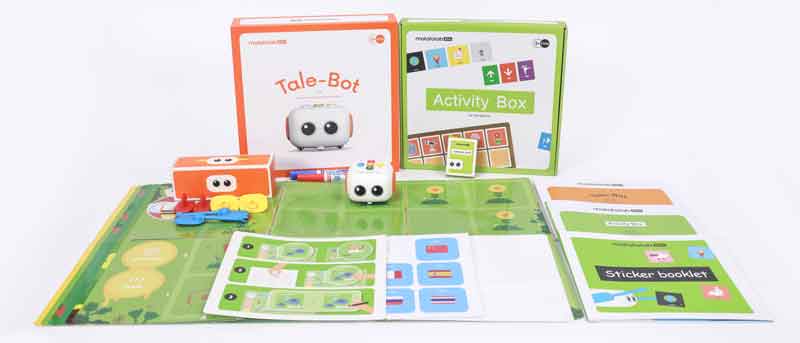
The coding set created by Matatalab enables young students to learn hands-on coding with the help of simplified tools. Use colored plastic blocks to symbolize coding commands; no need for a screen; youngsters may build their comprehension directly with their hands.

There are 4 simple steps used by young learners to build their understanding of coding.

Step 1: Create your playground

Young learners can create their playground with basic building blocks. This enables them to establish their sandbox, which essentially acts as their canvas for any coding or programming that they apply to their build.

Step 2: Plan their route

Planning the route for the code in the Home kit allows the learner to chart their instructions to the playground that they have already created. The route determines which actions are executed and in what particular order. This is the step where the learner decides the primary function of their build.

Step 3: Go and observe

After the program is complete, the learner essentially needs to run their code. This is the most fun part of the process for the children. Seeing what they’ve built work in action, gives a sense of completion and accomplishment to the learner.

Step 4: Debugging

Debugging, like professional coding, is a very important part of programming anything. The functions that are correctly executed can be kept and the functions that caused a hitch in the execution can be altered to best suit the actual action that needs to be executed.

A favorable association between computer programming and cognitive ability has been discovered in several recent research. Students who knew how to code scored higher on cognitive ability tests than those who had little to no programming expertise, according to the findings. Computer programming, according to MIT research, may be beneficial to cognitive growth.

When children learn to code, they are taught how to break down big issues into smaller, more manageable chunks so that they may develop functioning scripts. This is known as decomposition, and it is a valuable ability that students will find extremely handy whenever they are faced with real-life problems.

As children learn to code, they grow more accustomed to the problem-solving process, and eventually comfortable with it. The more people write, rewrite, troubleshoot, and debug lines upon lines of code, the easier it gets for them to cycle through the procedures and execute them correctly.

Contact us

Fill in your details below or send us an email on info@knowledge-hub.com

Key Mathematic Concepts of Speed, Time, and Distance

Key Mathematic Concepts of Speed, Time, and Distance

Key Mathematic Concepts of Speed, Time, and Distance

The link between the three variables is the core notion of speed, time, and distance. The distance traveled by a body per unit of time is its speed. To put it another way, speed is distance divided by time.

We’ll go over the fundamentals of speed, time, and distance, as well as the many sorts of questions, tips, and strategies, in this Blog. We’ve also included a few solved examples that can help students prepare for their exams. To dispel any questions about the topic, read the text completely.

Straight line, relative motion, circular motion, trains, and other questions about speed, distance, and time fall into several categories. As a result, applicants should study how the variables of speed, distance, and time interact.

The Speed, Time, and Distance Relationship

Let us examine the link between speed, distance, and time now that we have a firm grasp on their definitions. When an object changes its location in relation to any external fixed point, it is said to be in motion or moving. The three variables that make up the mathematical model of motion; are speed, time, and distance.

  • The length of time is proportional to the distance traveled. It states that if two vehicles travel the same distance in the same amount of time, the time is proportional to the distance.
  • Distance and speed are closely proportional. It indicates that if two cars are traveling two distances at two different speeds, time remains constant.

“In contrast to” is how “relative” is defined. When two or more bodies traveling at different speeds are compared, the idea of relative speed is applied. To make things easier, one body may be made stationary (i.e. Speed = zero) and the other body’s speed with regard to the stationary body can be calculated as the total of the speeds if the bodies are traveling in different directions or as the difference if they are going in the same direction. Relative speed refers to the speed of a moving object in relation to a stationary object.

The movement of the body is generally calculated in relation to a fixed location. However, there are instances when we need to establish a movement’s direction and its links to a moving body. In such instances, we must take into account the movement of the body against which relative motion is being calculated. The movement of one body with another moving body is called relative movement.

Objects traveling in circles have a speed equal to the distance traveled divided by the time it takes to travel. A circumference is equal to the distance around a circle and is computed as 2π(r), where R is the radius. The period is the amount of time it takes to complete one revolution around the circle, and it is represented by the symbol T. As a result, the calculation 2π(r)/ T gives the average speed of an item moving along a circular path. The rotational frequency is stated in revolutions per minute or revolutions per second in the issue statement. A circumference of distance is equal to one rotation around the circle. By multiplying the rotational frequency by the circumference, one may calculate the object’s average speed.

Mathseeds is a comprehensive online math education platform for children aged 3 to 9 years old, with active reach in Dubai, UAE, and the rest of the Middle East and GCC regions. It includes a large number of well-structured lessons and exercises that help students develop mathematical abilities in a variety of numbers, shapes, and measurement themes. The Mathseeds curriculum is jam-packed with engaging, child-centered activities that make learning a pleasurable and meaningful experience. It rewards students for their accomplishments while teaching key concepts in a fun, motivating, and engaging way.

Contact us

Fill in your details below or send us an email on info@knowledge-hub.com

Prominent Advantages of Using Fee Management System by Education Institutes

Prominent Advantages of Using Fee Management System by Education Institutes

Prominent Advantages of Using Fee Management System by Education Institutes

School admins & finance teams are often under the constant stress of managing ‘fee payment deadlines’ effectively and making sure the ‘fee schedule’ is followed by all parents. The workload further increases when fees are not paid on time, and computing ‘late fee’ is another task in itself. This manual process may cause errors, accounts may not tally, and there are chances of misplacing invoices. Thus, the only other feasible option that makes sense, is to automate the process by opting for a ‘Fee Management System’ and customizing the parameters as per your school’s requirement. These days most IB schools and many local institutes in Dubai and other regions of the Middle East, have found it utmost beneficial to automate the entire ‘fee process’, thereby saving costs, unnecessary wastage of time, and reducing error to nearly a nil percentage.

#1 Transparency

As the end-to-end fee payment process is automated, there is no chance of fraud or misrepresentation of information. Parents who falsely claim to have made the tuition fee payment or deny paying the late fee, are immediately identified so that school authorities can take necessary action in time. You can even track the past fee payment records and history, as every child is allocated a ‘unique ID’ through which all data can be retrieved.

#2 User-Friendly Process

Digital payment systems integrated with the school management software are absolutely user-friendly. One can login and make fee payments at any time of the day or night via credit/debit cards or even through digital wallets. No need to write cheques, no visiting banks, and no issues with cheque bouncing as well. This saves time and effort manifold for both parties involved. Some schools even have a dedicated fee-payment app with an auto-deduct facility from time to time, thereby further reducing hassles.

#3 Clear Overview of Accounts

The school accountant has a huge responsibility to ensure all fees are collected on time and even account for salary payments to staff, teachers, and other stakeholders associated with the school. If proper records are not showcased, one might not get a clear picture of ‘cash inflows’ and ‘cash outflows’. The digital payment system creates buckets such as; sum collected, sum due, and list of defaulters so that there is no ambiguity and proper financial planning can be undertaken.

#4 Timely Notifications

A fee payment software sends automatic notifications to parents before the deadline, so that they can make necessary arrangements and avoid any delay. It is no more a hassle for the admin staff to send individual SMS/emails to parents as reminders. The ERP system is capable of sending customized reminders to the phone numbers fed into the system, on an advanced date as per the quarterly or half-yearly fee schedule structure. Also, if students avail for special classes arranged by the school; such as; guitar or coding classes; parents can securely pay the fee online by logging into their child’s Fee ID account.

5 Easy Invoice Generation

Once the fee payment is complete, parents often seek an invoice for record and it also serves as proof. An educational ERP auto-generates the invoices for all transactions in a real-time manner and passes on a copy to the registered email address. An option is available to download the invoice in .pdf or excel format, thereby offering convenience.

Next-Education_-ERP-Management-system-Banner

NLP is a comprehensive ERP platform adopted by over 1,200+ schools across the globe, including UAE and other GCC regions in the Middle East. This all-in-one platform offers integration of LMS, ERP, and other Digital Add-Ons, in an endeavor to progress towards paperless education and administration.

NLP’s Fee Payment Module Has the Following Benefits;

  • Convenience in creating ‘Student Fee Categories’ gives the flexibility to create different fee structures for a different set of students across various grades
  • Seamlessly review the Free Structure Overview and filter class-wise to quickly check the status of late payments, defaulters, etc.
  • Any ad-hoc fines, concessions, or scholarships, can be mapped to the individual student Fee ID and the calculation is computed automatically, such that there is no error in the amount of fee needed to be paid in that particular installment.
  • Admin can select a Fee Receipt template in three sizes: A4, A5, or A6 format, as per convenience.
  • It is easy to enter details of the Bank to which the fee money should be credited and track whether the transaction has been successful.

Contact us

Fill in your details below or send us an email on info@knowledge-hub.com

Intelligent Humanoid Robot That Can Interact and Entertain

Intelligent Humanoid Robot That Can Interact and Entertain

Intelligent Humanoid Robot That Can Interact and Entertain

Modern social robots employ a range of analogue sensors to communicate with humans, with the inputs being translated to digital data that the robot’s programming can understand. Artificial senses and outwardly perceptible responses, with the latter being mediated by artificial intelligence, which is the product of all protocols by which they are designed to process and respond to data received and memories stored, can be broadly divided into artificial senses and outwardly perceptible responses.

MiRo-E is a character made up of a vast range of sensors, motors, and software controlled by a breakthrough brain-based control system, the product of a unique blend of mechanical engineering and software.

MiRo’s mechatronics and software are completely re-engineered to build a perfect companion that has been evolved for education, based on expertise from our MiRo-B, which is being utilized by academics and developers in universities all over the world.

Moving

MiRo-E can move and interact with the surroundings since it has 11 degrees of freedom and an animal-like form. MiRo’s range of neck and head movements allows for exceptional eye contact and interaction with users. The multiple ranges of motion allow the user to fully immerse into the character that MiRo-E is. It also enables the user to programme MiRo-E for a variety of activities and actions

Feeling

MiRo’s head and torso are covered in touch sensors, as well as sonar, light, and cliff sensors, which enable MiRo to view and perceive the environment as well as interact with the humans (and animals) in it. With its cutting edge sensors, MiRo-E processes data and enables self preservation. The sensors act as inputs for the robot, while outputs can be programmed by the users themselves.

Thinking

MiRo’s animal-like behavior is the result of years of study into biomimetic robot behavior, and its brain-based controller produces a brilliant organic thought process behind each action/response, allowing for natural interactions. You will find yourself wondering if the robot were actually thinking for themself, due to the thought process built organically with years of study.

Observing

MiRo-E is fitted with two cameras that capture high-resolution images of the environment, allowing him to detect and recognise faces, forms, and objects in real time. This enables MiRo-E to identify and differentiate between visual inputs. Recognising faces also helps it segment different memories and actions for the particular face the robot is observing.

Speaking

MiRo-E utilizes a loudspeaker to transmit its feelings to the world, using a pleasant voice pattern created by imitating mammalian vocal chords. Taking the real-like feel a notch further, the voice emanating from the robot is designed to sound organic. This brings a sense of reality to MiRo-E being an independent organic animal.

Hearing

MiRo-E features two directional microphones in each ear (which spin like rabbits) so that MiRo may respond to any sounds in a natural manner, such as speaking or clapping. MiRo’s tail also has a third microphone to aid with sound localization!

Miro-E

MiRo-E allows learners to acquire teamwork, problem-solving, and AI coding abilities while learning and expanding their knowledge and imagination through robotics and technology. The one-of-a-kind educational programme allows you to test and simulate your student’s code in real time using a web browser.

For students, educators, researchers, and developers in the USA,UK and the UAE, the newly developed MiRo-E is a highly specified, low-cost, adaptable, autonomous, and completely programmable robotic platform. MiRo is being used by universities and colleges all around the world including frontier cities such as Dubai, the GCC and the rest of the Middle East, as a platform for robotics and artificial intelligence research and education.

Contact us

Fill in your details below or send us an email on info@knowledge-hub.com

Reading Eggs: Tips for Using Pauses in Speech

Reading Eggs: Tips for Using Pauses in Speech

Reading Eggs: Tips for Using Pauses in Speech

In today’s day and age, it is vital for young learners to develop a strong vocabulary. However, that goes hand in hand with clear speech, which is often not given too much importance in the conventional education scenario. However, various universities, schools and other institutions across Dubai, UAE, GCC and the Middle East have started recognising the importance of effective speaking in a children’s career.

One of the most important concepts here is learning how and when to pause, which is why new-age learning platforms such as Reading Eggs are coming up with engaging new modules that teach young children concepts like vocabulary, pauses in speech, comprehension, phonics and much more through games and activities. Before we get into the effective ways for children to use pauses in their speech, let’s understand why it is so beneficial.

Reading-Eggs_ Products

Benefits of using pauses in your speech

Below are the benefits of using pauses in your speech

Control over your pace

If you teach your child how to correctly pause, it gives them ample time to pace their content according to what they feel comfortable with. This presents them as someone who is confident and composed.

Time to breathe

Using pauses between a speech allows students time to breathe properly. We often see them get nervous while delivering a speech and that tends to cause breathlessness among many. To prevent this from happening, Reading Eggs uses interactive stories and activities that teach young kids how to pause properly while talking.

Gives the audience time to think

What is the point of someone reading in front of you if you do not find time to comprehend what they are saying. If a speaker uses pauses effectively between their speech, it gives the listener ample time to digest information and react appropriately.

Tips to use pauses effectively in speech

Now that we know some of the many benefits of using pauses in speech. Here’s how you can use it while reading, talking or teaching.

Lay emphasis on the keywords

One of the best places to pause is right before you are about to say something important. This allows you to highlight the key word and leads to more retention among those who are listening.

Time your pause

One of the simplest ways to do this is to teach students to pause for one second every time they see a comma and for two seconds when they have reached the end of a sentence. This easy formula plays a significant role in making speech sound clear.

Make eye contact

One of the most widely popular ways of pausing is while making eye contact with the listeners. This not only makes you sound more confident and composed but also builds a strong connection with the audience.

Practice makes perfect

This is not something anyone can master in a day; it is a gradual process towards continual improvement. It is best for children to dedicate some time in the day towards practicing their speech along with learning how and when to take pauses.

Get feedback

Get a friend to listen to you speak and gather objective feedback. Teachers can also conduct group activities in class where students get a chance to listen to their classmates’ talk and gather points of constructive feedback.

While these are just a few important tips on how to effectively use pauses in speech, there are multiple ways to master this skill. With the past-faced education system around the globe, it is key for young learners to develop objective techniques like these, which will help them become more confident and well-spoken individuals in the 21st century.

Contact us

Fill in your details below or send us an email on info@knowledge-hub.com