

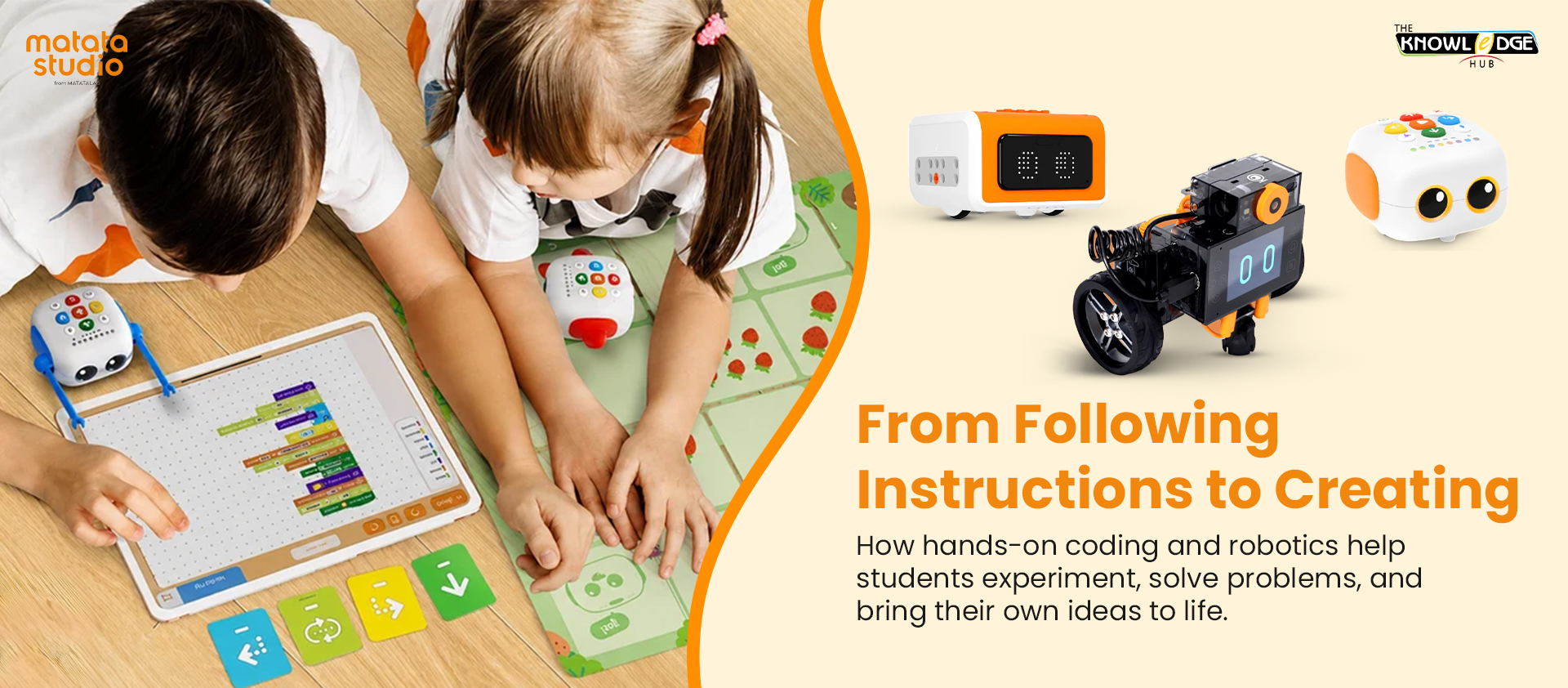
Following instructions is an important first step in learning. But for children to become confident problem-solvers and creators, learning needs to go beyond simply doing what they are told.
This is where coding for kids can make a difference.
When children begin experimenting with code, they learn that there is rarely just one way to solve a problem. They can change instructions, test different sequences, identify mistakes, and try again. Over time, coding becomes more than learning commands—it becomes a way for students to think, explore, and create.
From Following Instructions to Making Decisions
A typical coding activity may begin with a simple instruction: move forward, turn left, reach a destination.
At first, students follow the steps provided to them. But once they understand how the commands work, something changes.
They start asking:
- What happens if I change the sequence?
- Can I find a shorter route?
- What if I add another command?
- Can I create my own challenge?
These questions encourage students to move from following instructions to making decisions.
Hands-on coding makes this process particularly engaging because children can immediately see the results of their choices.
Learning Through Experimentation
One of the most valuable aspects of hands-on coding and robotics is that mistakes become part of the learning process.
If a robot does not reach the expected destination, students can look at what went wrong, change their program, and test it again. This creates a natural cycle of plan, test, debug, and improve.
Instead of seeing an incorrect result as failure, students begin to understand it as useful feedback.
This develops computational thinking while also encouraging patience, logical reasoning, persistence, and problem-solving.
How MatataStudio Turns Coding Into Creative Learning
Tools such as MatataStudio are designed to make coding tangible and accessible for young learners.
With hands-on coding solutions such as the MatataStudio Coding Set, children can arrange physical coding blocks, create sequences, control a robot, observe the result, and modify their program when necessary. The screen-free approach allows students to focus on coding logic, movement, sequencing, and problem-solving through physical interaction.
The experience can then move beyond solving prepared challenges.
Children can create their own routes, drawings, music, stories, and activities. Optional add-ons can extend learning into areas such as art, music, geometry, and interactive exploration.
This is an important transition: students are no longer simply completing someone else’s task—they are designing their own possibilities.
Building Future-Ready Skills Through Robotics
The value of coding and robotics education extends beyond programming.
When students experiment with a robot, they practise:
- Problem-solving by finding different ways to complete a task
- Computational thinking by breaking problems into logical steps
- Creativity by designing original projects and challenges
- Critical thinking by evaluating whether a solution works
- Persistence by debugging and trying again
- Decision-making by choosing how to approach a problem
- Collaboration by sharing ideas and testing solutions with others
These are transferable skills that can support learning across STEM and other subject areas.
Give Students Space to Create
The ultimate goal of coding for kids should not be simply to memorise commands.
It should be to help children understand that technology can be something they create with—not just something they use.
A structured activity can provide the starting point. But once students begin changing the instructions, testing possibilities, and designing their own solutions, learning becomes more active and meaningful.
That is the power of combining coding, robotics, and hands-on STEM learning.
At Knowledge Hub, we help schools introduce engaging technology-enabled learning experiences through innovative solutions such as MatataStudio, giving students opportunities to explore coding, robotics, computational thinking, and creative problem-solving.
The journey can start with following instructions.
The real learning begins when students start asking, “What can I create?”