

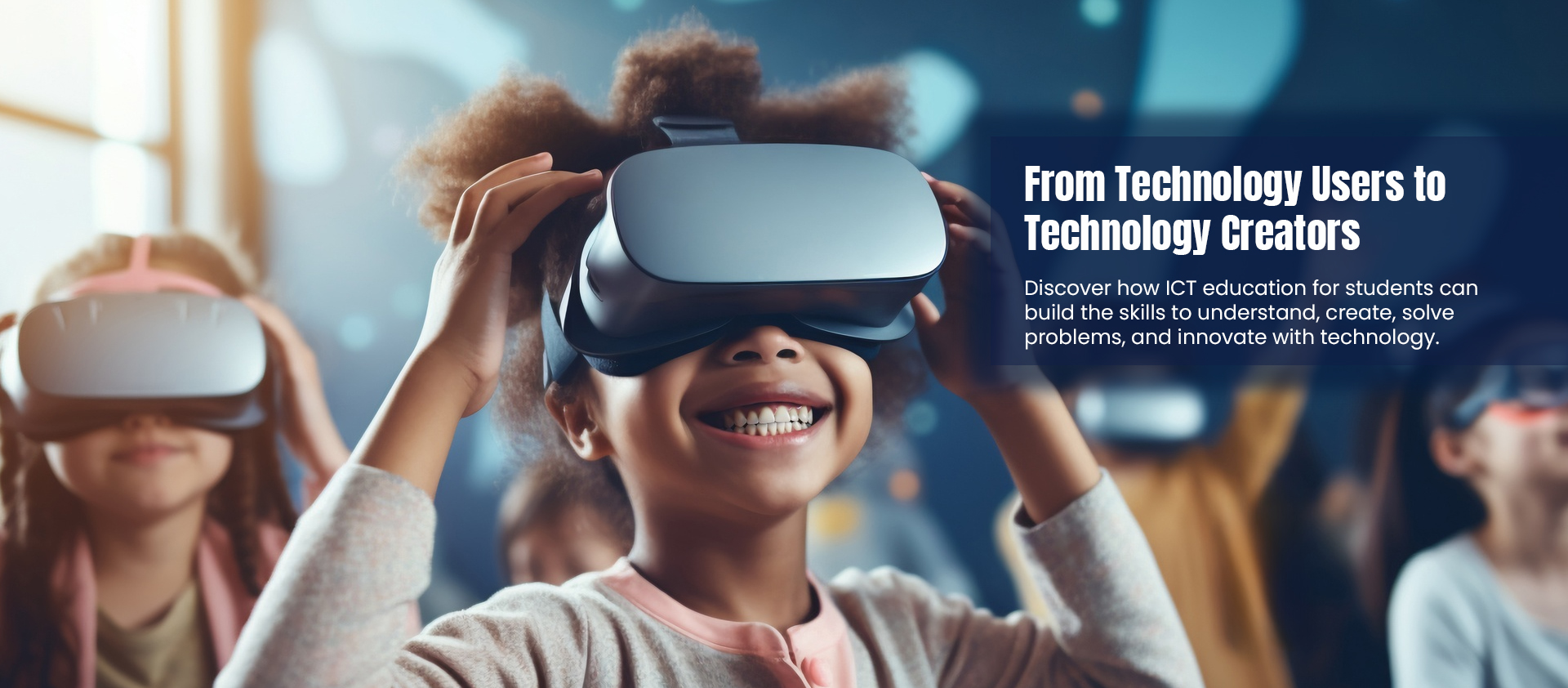
Students interact with technology every day. They use apps, search for information, communicate online, create digital content, and work with a growing range of digital tools.
But using technology is only the beginning.
What if students could go beyond using technology and understand how it works? What if they could learn to create with technology rather than simply consume digital content?
This is where ICT education for students can play an important role.
Effective ICT learning can help students progress from simply using technology to understanding digital systems, creating solutions, solving problems, and developing innovative ideas. Instead of treating technology as something students only consume, schools can use ICT education to help learners become confident digital creators.
What Is ICT Education for Students?
ICT education refers to learning experiences that help students understand and use information and communication technologies effectively.
However, modern ICT education can go beyond basic computer skills.
A well-structured ICT curriculum for students can introduce learners to areas such as coding, computational thinking, digital creativity, problem-solving, information management, and technology-based projects.
The goal is not simply to teach students which buttons to click or which software to use.
It is to help them understand how technology can be used to turn ideas into meaningful outcomes.
From USE to UNDERSTAND
The first stage of technology learning is often use.
Students learn to operate devices, applications, software, and digital platforms. These are important digital literacy skills, but they represent only one part of ICT learning.
The next step is understanding.
Students can begin asking questions such as:
- How does this technology work?
- Why does a particular process produce a certain result?
- How can information be organised or represented?
- How can technology be used to solve a problem?
This shift encourages students to become more thoughtful and capable technology users.
From UNDERSTAND to CREATE
Once students understand the principles behind technology, they can begin creating it.
This could involve coding a simple program, designing digital content, developing a presentation, creating an interactive project, or exploring how data can be organised and used.
Coding for students, for example, can introduce logical thinking and structured problem-solving while giving learners opportunities to turn their ideas into working digital outcomes.
Digital creativity also becomes an important part of the learning process. Students are no longer simply following instructions—they can experiment, make decisions, test ideas, and improve their work.
From CREATE to INNOVATE
The final step is innovation.
Innovation does not necessarily mean creating the next major technological breakthrough. In a classroom, it can begin with something much simpler: identifying a problem and thinking of a better way to solve it.
Students can apply their ICT skills to develop solutions, test different approaches, learn from mistakes, and refine their ideas.
This is where computational thinking, creativity, collaboration, and problem-solving can come together.
A strong ICT learning environment therefore gives students opportunities to move through a progression:
USE → UNDERSTAND → CREATE → INNOVATE
How ICT 360 Supports ICT Learning
A structured approach to ICT education for students can help schools develop these capabilities progressively.
With ICT 360, students can build their ICT knowledge through structured learning experiences that connect technology skills with coding, computational thinking, digital creativity, and problem-solving.
Rather than viewing ICT as a standalone computer subject, schools can create learning experiences where students understand how technology can be used to explore ideas and develop solutions.
This progression can help learners become more confident with technology while developing skills that extend beyond the classroom.
Preparing Students for a Digital Future
Technology will continue to evolve, but students will not simply need to know how to use the latest tools.
They will need to think critically, solve problems, create, adapt, and understand how technology can support their ideas.
That is why meaningful ICT education should focus on more than digital consumption.
The real opportunity is to help students move from using technology to understanding it, from understanding it to creating with it, and from creating with it to innovating.
Because the goal of ICT education isn’t simply to prepare students to use technology.
It is to empower them to create with it.