

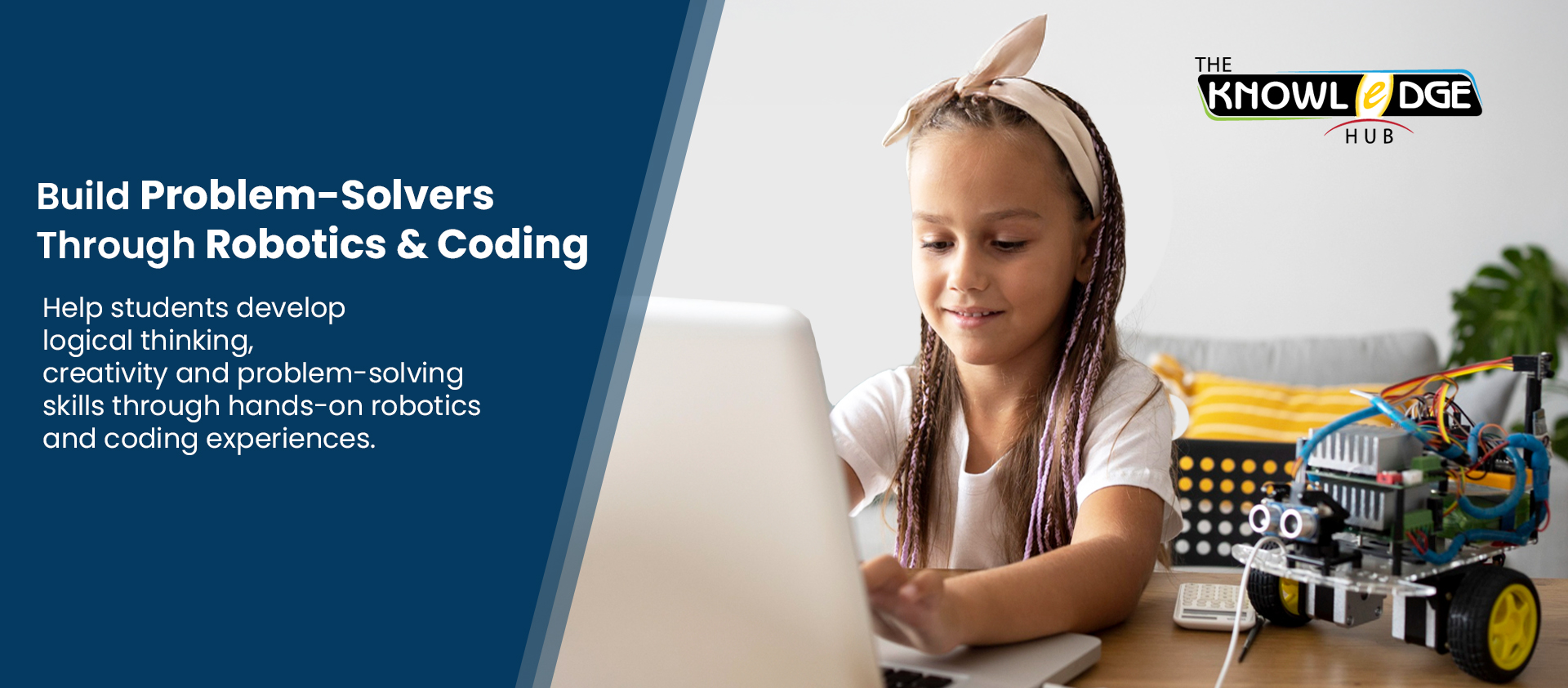
Problem-solving is an essential skill in modern education. Students are constantly presented with questions, challenges and situations that require them to analyse information, consider different possibilities and find effective solutions.
However, developing these abilities requires more than learning concepts from textbooks. Students need opportunities to apply their thinking, experiment with ideas and understand the consequences of their decisions.
This is where robotics and coding skills can make a meaningful difference.
Through programming challenges and hands-on robotics activities, students learn to break down complex problems, create instructions, test solutions and make improvements. These experiences encourage a structured approach to thinking while giving students practical ways to apply what they learn.
For schools in Dubai and across the UAE, integrating robotics and coding into classroom activities can provide valuable opportunities to develop problem-solving and critical-thinking abilities.
Understanding the Connection Between Robotics, Coding and Problem-Solving
Robotics and coding involve more than building machines or writing programming instructions. Both require students to understand a problem and determine how to achieve a specific outcome.
Consider a simple classroom challenge: programming a robot to move through a path without hitting an obstacle.
Students must first understand the challenge, decide how the robot should move, develop a sequence of instructions and test whether their solution works.
If the robot takes the wrong direction, they need to identify the problem and modify their approach.
This process introduces students to an important problem-solving cycle:
Understand → Plan → Execute → Test → Improve
Rather than immediately receiving an answer, students actively work towards finding one.
1. Breaking Complex Problems Into Smaller Steps
One of the first skills students develop through robotics and coding is the ability to break down a larger problem into manageable tasks.
This approach is known as decomposition, an important element of computational thinking, which helps students approach complex challenges through structured steps.
For example, imagine students need to program a robot to reach a destination, collect an object and return to its starting position.
Instead of approaching the entire challenge at once, they can divide it into smaller steps:
- Identify the starting position.
- Determine the direction of movement.
- Calculate the distance.
- Program the robot to collect the object.
- Plan the return journey.
- Test the complete sequence.
By organising a challenge into smaller tasks, students can understand what needs to happen at each stage.
This method of thinking can also be applied to mathematics, science, project work and everyday problem-solving situations.
2. Developing Logical Reasoning
Through coding education for students, learners explore the relationship between instructions and outcomes while understanding how different programming commands work together.
Every command in a program serves a purpose. The order of instructions, conditions, and repetition can determine whether a program produces the expected result.
For example, students creating a simple game may need to decide:
- What happens when a player presses a button?
- When should an object move?
- What happens if a particular condition is met?
- How should the program respond to an incorrect action?
These decisions encourage students to think logically and consider different possibilities before developing their programs.
As coding challenges become more advanced, students learn to organise instructions, recognise patterns and understand how different parts of a program work together.
3. Learning to Debug and Correct Mistakes
Not every program works correctly the first time.
A robot may move in the wrong direction, a game may not respond as expected or an instruction may produce an unexpected result.
These situations introduce students to debugging.
Debugging involves identifying errors, understanding why they occurred and making the necessary corrections.
For example, if a robot moves too far, students may need to review the movement instructions, adjust the distance or change the sequence of commands.
This process teaches students to investigate problems rather than simply start again.
It also encourages a valuable learning habit: mistakes can provide useful information about what needs to change.
Through repeated testing and correction, students become more systematic in identifying errors and improving their solutions.
4. Improving Decision-Making Skills
Robotics challenges often allow students to explore multiple ways of achieving the same objective.
A robot can sometimes reach a destination through different routes. A programming task may have several possible solutions. Students need to decide which approach is most suitable.
This requires them to consider different factors:
- Which solution is more efficient?
- Are there unnecessary instructions?
- What could go wrong?
- Will the solution work consistently?
- Is there a simpler approach?
By comparing alternatives and evaluating outcomes, students practise making informed decisions.
These experiences also encourage independent thinking, as students learn to justify their choices rather than simply follow predetermined instructions.
5. Encouraging Creativity Through Experimentation
Problem-solving is not always about finding one correct answer. Sometimes, it involves exploring different possibilities.
Robotics and coding provide opportunities for students to experiment with designs, programming approaches and alternative solutions, making them valuable components of STEM education.
For instance, students may be asked to create a robotic model that completes a particular task. Different teams might develop completely different designs to achieve the same result.
One team may focus on movement, while another may explore a different mechanism or programming sequence.
This encourages students to think beyond the first solution that comes to mind.
By experimenting, comparing outcomes and refining their ideas, students can develop creative approaches to technical challenges.
6. Building Persistence Through Trial and Improvement
Some robotics and programming challenges require several attempts before students find a working solution.
A program might fail because of an incorrect instruction. A robotic design might not perform as expected. A different approach may be needed to complete the task.
Instead of viewing these experiences as failures, students can learn to treat them as part of the development process.
They can review what happened, identify possible improvements and try again.
This encourages persistence and helps students understand that complex problems often require patience, observation and repeated refinement.
How Schools Can Develop Problem-Solving Through Robotics and Coding
For schools in Dubai and across the UAE, robotics and coding activities can be incorporated into technology lessons, STEM projects and structured classroom programs.
The focus should be on giving students meaningful challenges rather than simply asking them to follow instructions.
Schools can consider the following approaches:
Introduce open-ended challenges: Give students a specific objective but allow them to explore different ways of achieving it.
Encourage independent thinking: Ask students to explain their approach before providing solutions.
Include debugging activities: Allow students to identify and correct errors in existing programs.
Use collaborative projects: Give students opportunities to discuss ideas, compare approaches and solve challenges together.
Increase complexity gradually: Introduce more challenging programming and robotics tasks as students develop confidence and experience.
Teachers play an important role in guiding these activities and connecting practical experiences with specific learning objectives.
Connecting Problem-Solving With Robotics and Coding Education in the UAE
As schools increasingly incorporate technology into their learning environments, robotics and coding can provide practical opportunities for students to apply their knowledge.
For schools in Dubai and the wider UAE, these activities can complement existing STEM and ICT learning by connecting programming concepts with real-world challenges.
Knowledge Hub supports schools through its Robotics & Coding Programs UAE, helping introduce structured technology learning experiences that allow students to explore programming, robotics and practical problem-solving.
When students are encouraged to build, experiment, test and improve, technology becomes more than a subject to study. It becomes a tool for thinking, creating and finding solutions.
Conclusion
Developing problem-solving abilities requires opportunities to think, experiment and learn through experience.
Robotics and coding provide students with practical environments to break down challenges, apply logical reasoning, debug errors, evaluate alternatives and improve their solutions.
For schools in Dubai and across the UAE, integrating these activities into technology and STEM education can help students develop a more structured and creative approach to problem-solving.
The real value of robotics and coding is not simply in the programs students create or the robots they build. It lies in the thinking process they develop along the way.
Give Students the Skills to Think, Create and Solve
Help your students move beyond learning technology to actively using it to solve problems.
Knowledge Hub's Robotics & Coding Programs UAE bring structured, hands-on technology learning experiences into schools, giving students opportunities to explore programming, robotics and practical challenges.
Whether you are introducing robotics and coding for the first time or expanding your school's existing technology curriculum, Knowledge Hub can help you identify suitable learning solutions for your students.
Explore Knowledge Hub's Robotics & Coding Programs UAE and take the next step towards building more engaging, problem-solving-focused learning experiences.