

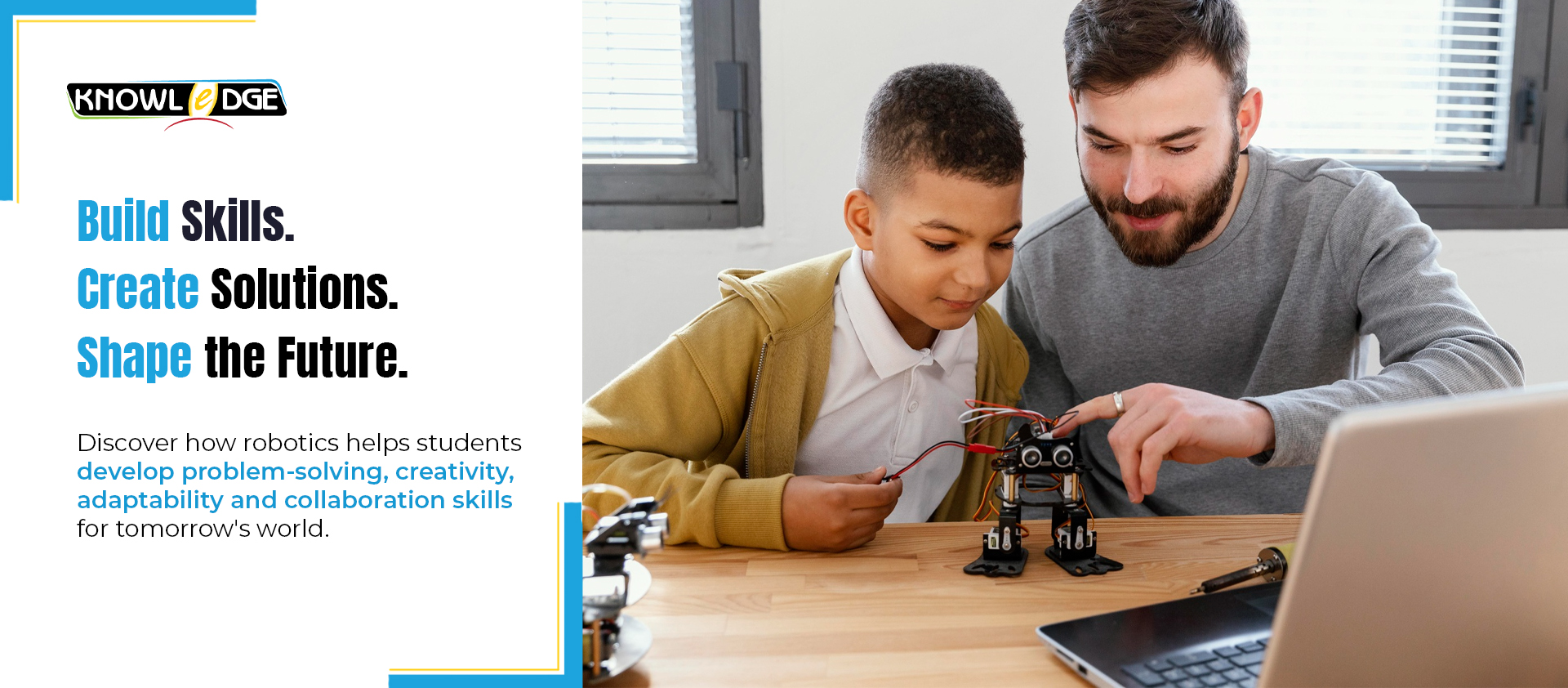
The skills students need for tomorrow's workforce are changing rapidly. While academic knowledge remains important, employers increasingly value adaptability, creativity, problem-solving, collaboration, and the ability to use technology effectively.
This is where robotics education can make a meaningful difference.
Robotics gives students an opportunity to move beyond simply consuming technology. Instead, they learn to design, build, program, test, troubleshoot, and improve solutions. Through these hands-on experiences, students develop skills that extend well beyond the classroom and prepare them for an increasingly technology-driven future.
Why Robotics Education Matters for Future Skills
Robotics brings together concepts from STEM education, coding, engineering, mathematics, and technology in an engaging learning environment.
Instead of learning concepts only through textbooks or theoretical exercises, students can apply what they learn to real challenges. They may need to build a robot that completes a task, program a system to respond to specific conditions, or redesign a solution when their first attempt does not work.
This process naturally encourages students to think critically and creatively.
For schools, robotics education can therefore become more than an extracurricular activity. It can be a practical approach to developing the future-ready skills students need for higher education, careers, and everyday problem-solving.
1. Robotics Develops Problem-Solving Skills
Robotics challenges rarely have a single obvious solution.
Students need to understand the problem, break it into smaller steps, develop a solution, test it, identify what went wrong, and make improvements.
This develops a structured approach to problem-solving.
When a robot does not move as expected or a program produces an unexpected result, students must investigate the cause rather than simply look for the correct answer.
Over time, they learn to approach challenges with curiosity and persistence.
2. It Encourages Creativity and Innovation
Robotics is not only about programming instructions. Students also need to think about what they can create and how they can make it better.
A classroom robotics challenge may have several possible solutions. Students can experiment with different designs, mechanisms, programs, and strategies.
This gives them space to turn ideas into working prototypes.
Such experiences help develop creative thinking and encourage students to see technology as a tool for innovation rather than something they simply use.
3. Students Learn to Adapt and Learn From Failure
One of the most valuable lessons robotics teaches is that failure can be part of the learning process.
A robot may not perform as expected. A program may contain errors. A design may need to be rebuilt.
Instead of treating these setbacks as the end of the task, students learn to test, analyse, modify, and try again.
This builds adaptability and resilience—qualities that are increasingly important in a world where technologies, industries, and job roles continue to evolve.
4. Robotics Strengthens Collaboration
Many robotics projects involve teamwork.
Students may divide responsibilities, discuss designs, write code together, test their robot, and present their final solution. They must communicate ideas, listen to others, manage disagreements, and work towards a shared objective.
These collaborative experiences help students develop interpersonal skills alongside technical knowledge.
The result is a more balanced learning experience that combines technical capability with communication and teamwork.
5. It Connects Coding, AI and STEM to Real Applications
Robotics provides a practical environment where students can connect different areas of learning.
Coding controls behaviour. Mathematics can influence measurements and movement. Engineering helps students understand structures and mechanisms. Artificial intelligence can introduce concepts such as sensors, decision-making, and automation.
This interdisciplinary approach helps students understand how different technologies work together in real-world applications.
For schools exploring coding, AI and STEM education, robotics can therefore provide an engaging pathway from concepts to practical application.
Building Future-Ready Classrooms With Robotics
Preparing students for the future is not simply about teaching them how to use the latest technology. It is about helping them develop the confidence and ability to think, create, experiment, solve problems, and adapt.
Robotics education provides a powerful environment for developing these capabilities.
At Knowledge Hub, we support schools in the UAE with innovative learning solutions across robotics, coding, AI, STEM, and educational technology. Our goal is to help schools create learning environments where students become active creators and problem-solvers—not passive technology users.
Because the future belongs to students who can do more than understand technology.
It belongs to those who can use it to create what comes next.
💬 What future-ready skill do you think is most important for today's students—creativity, problem-solving, adaptability, or collaboration?