

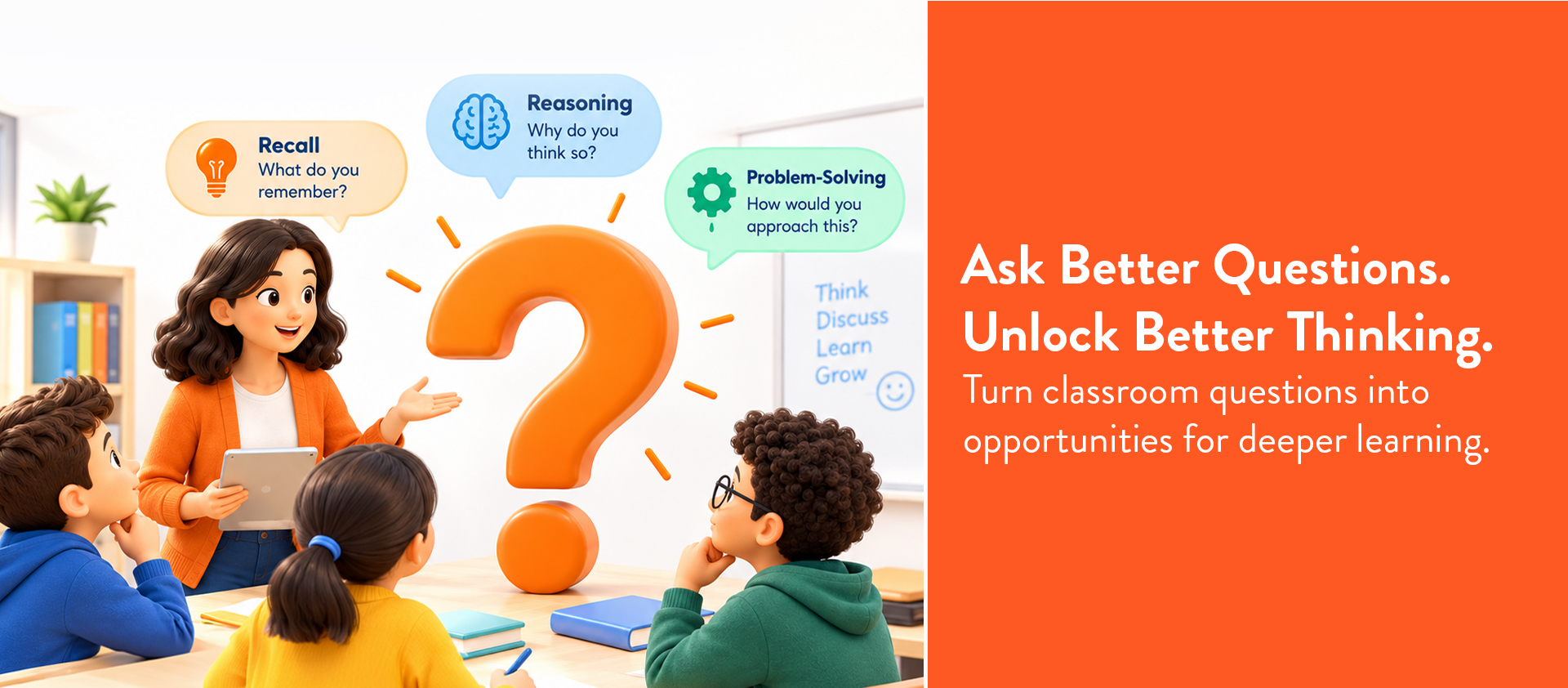
A good question does more than check whether a student remembers an answer. It can reveal how they think, what they understand, where they are struggling, and what they need to learn next.
That is why effective questioning in the classroom is an important part of meaningful teaching and assessment. When questions are carefully designed, they can encourage students to explain their thinking, analyse information, connect ideas, and explore different perspectives.
Instead of simply asking students to recall information, teachers can use questioning to make learning more active and purposeful.
Why Is Questioning Important in the Classroom?
Questions are one of the simplest tools teachers can use to understand student learning.
A correct answer does not always mean a student fully understands a concept. Similarly, an incorrect answer does not necessarily mean they have learned nothing. The reasoning behind an answer can provide valuable insight.
Effective questioning helps teachers identify:
- What students already know
- Where misconceptions may exist
- Whether students can apply what they have learned
- How well they can explain their reasoning
- Which concepts may need further support
This makes questioning valuable not only at the end of a lesson but throughout the learning process.
Moving Beyond Questions That Test Recall
Traditional questions often focus on remembering facts. For example:
“What is photosynthesis?”
This can establish whether a student remembers the definition, but it does not necessarily show whether they understand the concept.
A deeper question could be:
“Why is photosynthesis important for plants and other living organisms?”
An even more exploratory question might ask:
“What might happen to an ecosystem if photosynthesis stopped?”
These questions require students to explain, connect, predict, and apply their knowledge.
This is where effective questioning strategies can help teachers move from simply checking answers to exploring student thinking.
Different Types of Questions for Deeper Learning
Teachers can use different types of questions depending on the learning objective.
Recall Questions
These check foundational knowledge.
“What are the three states of matter?”
Understanding Questions
These encourage students to explain an idea in their own words.
“How would you explain evaporation to someone who has never studied it?”
Application Questions
These ask students to use their knowledge in a new situation.
“How could you use what you know about evaporation to explain drying clothes?”
Analysis Questions
These encourage students to examine relationships and evidence.
“What factors could have caused this result?”
Evaluation Questions
These invite students to make and justify a judgement.
“Which solution would be most effective, and why?”
Using a combination of these classroom questioning techniques can give teachers a broader picture of student understanding.
Making Every Question an Opportunity to Learn
Effective questioning is not only about asking more questions. It is about asking questions that have a clear purpose.
Teachers can consider:
- Does the question connect to the learning objective?
- Does it encourage students to explain their thinking?
- Is there more than one reasonable way to approach it?
- Does it challenge students without creating unnecessary complexity?
- Can the responses reveal misconceptions or gaps in understanding?
The responses are just as important as the questions themselves. When teachers analyse student answers, they can identify patterns and adapt instruction accordingly.
For example, if several students make the same mistake, the teacher may discover that a concept needs to be explained differently. If students provide strong reasoning, the teacher can introduce a more challenging question to extend their thinking.
Using Technology to Support Better Questioning
Digital assessment tools can make it easier for teachers to create questions, collect responses, and gain visibility into student understanding. With Redmenta, teachers can create interactive quizzes and assessments that go beyond simple recall. Different question formats can be used to encourage students to demonstrate their knowledge and thinking, while responses can provide useful insights into learning.
This can help make assessment a more continuous part of classroom learning rather than something that happens only after a lesson or unit.
From Questions to Better Learning
A well-designed question can open a conversation, uncover a misconception, or encourage a student to look at an idea differently.
The goal of effective questioning in the classroom is therefore not simply to find out who knows the correct answer. It is to understand how students are thinking and use that information to support their next step in learning.
When teachers approach questioning with purpose, every question can become more than an assessment task—it can become an opportunity for students to think, explain, explore, and learn.