

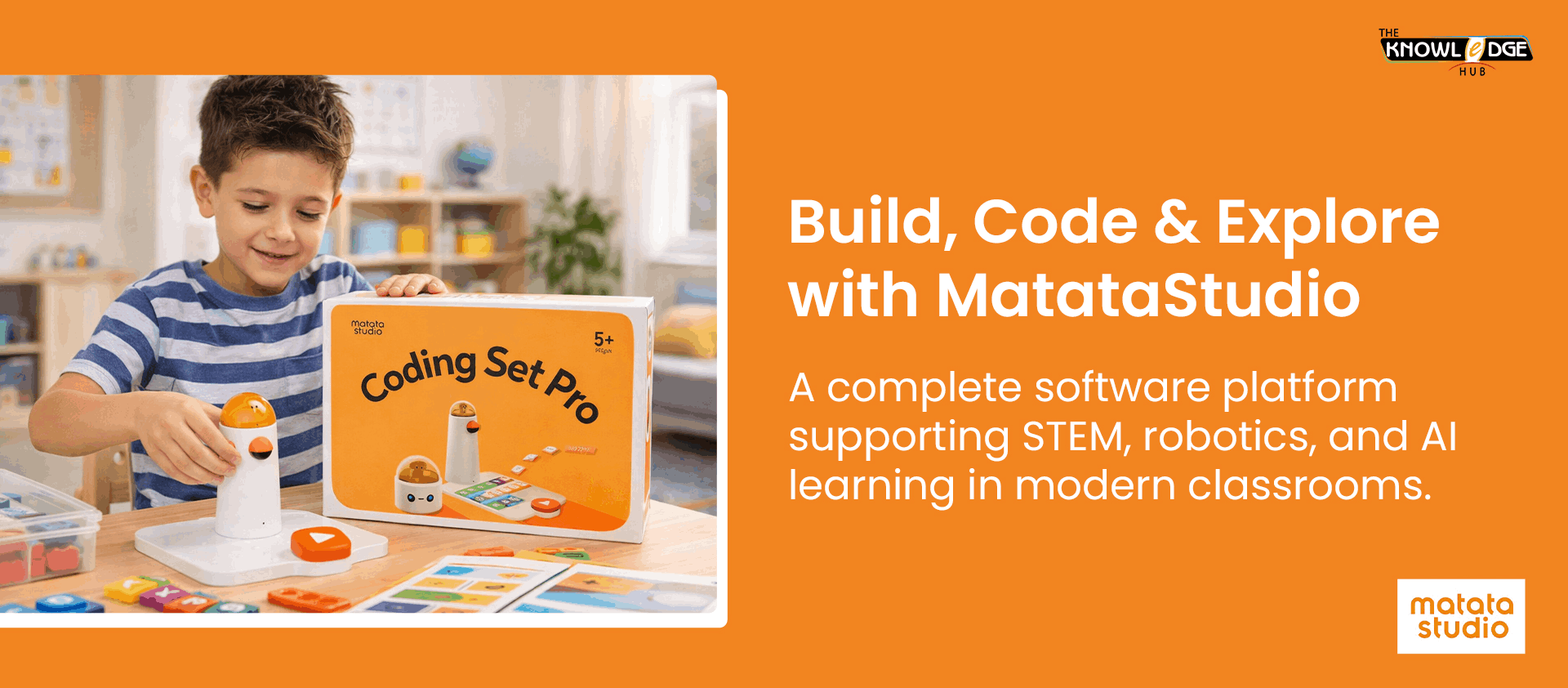
As schools integrate coding, robotics, and artificial intelligence into their curriculum, the need for structured and age-appropriate software becomes essential. The MatataStudio coding software for schools is designed to support students in their programming journey while working seamlessly with hands-on learning tools.
Developed to complement MatataStudio’s robotics and STEM ecosystem, the software enables students to explore coding, control robots, and build creative projects using intuitive and progressive learning platforms. It bridges the gap between physical learning and digital programming experiences.
A Complete Software Ecosystem for STEM Learning
MatataStudio offers a range of software solutions designed to work with its different products, ensuring a smooth and integrated learning experience.
Key software platforms include:
- MatataCode (Nous) – Designed for the Nous AI Set, offering programming capabilities with Blockly and Python, along with embedded machine learning features.
- MatataCode (VinciBot) – Enables control, programming, and AI-based applications for VinciBot using graphical programming and machine learning modules.
- MatataCode – Supports coding for Coding Set, Pro Set, and Tale-Bot Pro with graphical programming suitable for beginners and advanced learners.
- MatataXplore – A dedicated software for digital microscopes that allows students to explore the microscopic world and develop scientific curiosity.
This ecosystem ensures that students can progress from basic coding concepts to advanced AI and programming applications.
Supporting Both Beginners and Advanced Learners
One of the strengths of MatataStudio software is its ability to cater to different learning levels.
Students can begin with graphical programming, where they use visual blocks to create programs. As they advance, they can transition to text-based programming such as Python, enabling deeper understanding of coding concepts.
This gradual progression helps students build confidence while developing computational thinking and logical reasoning skills.
Integrating AI, Robotics, and Real-World Learning
MatataStudio software is designed to work closely with hardware components such as robots, sensors, cameras, and AI modules.
Students can:
- Program robots to perform tasks
- Use sensors and cameras in their projects
- Explore embedded machine learning concepts
- Build interactive and real-world applications
By combining software and hardware, students gain a practical understanding of how technology works in real-world scenarios.
Encouraging Creativity and Project-Based Learning
Beyond coding, MatataStudio software encourages students to create their own projects and ideas.
The platform allows learners to:
- Design interactive programs
- Build creative robotics projects
- Experiment with AI and automation
- Explore storytelling and scientific concepts
The inclusion of teaching cases, resources, and help centers ensures that both educators and students can easily get started and progress effectively.
Designed for Schools and Educators
MatataStudio software is developed for classroom use and supports structured learning environments.
It provides:
- Easy-to-use interfaces for students
- Teaching support materials for educators
- Progressive learning pathways
- Compatibility with multiple MatataStudio products
This makes it suitable for various educational settings, from early learning to advanced STEM and AI education.
Conclusion
The MatataStudio coding software for schools plays a crucial role in enabling modern STEM education. By combining graphical programming, AI capabilities, and robotics integration, it provides students with a comprehensive platform to learn, explore, and create.
Aligned with classroom needs, MatataStudio software helps students develop computational thinking, creativity, and problem-solving skills—preparing them for the future of technology and innovation.