

Virtual Reality Lessons by Kai’s Clan is Changing the Way Kids Learn

Virtual Reality Lessons by Kai’s Clan is Changing the Way Kids Learn

Virtual Reality Lessons by Kai’s Clan is Changing the Way Kids Learn

Coding is a way trendy hotspot among students these days. Nowadays, the schools have shifted towards learning based on STEM approach.

This is helping children by keeping them abreast with technology. Inclination towards VR learning had increased these days. Before moving ahead, let’s have an idea about Virtual Reality (VR).


What is Virtual Reality?

Virtual Reality is a technique through which the user gets a touch base with the 3D world. We can say the user of this technology gets a chance to connect with the 3D world. The computer acts as a storehouse of senses like touch, view, and listening.

This computer-based technology creates a 3D image that serves as a medium to connect with the user by using tools like helmets or gloves with sensors attached to them.

How does Virtual Reality help students?

Virtual Reality is a perfect combo of fun and learning for the students. VR offers a complete and better learning experience to the children. It doesn’t matter how old the child is, VR amuses just about everyone. We have penned down a few benefits of Virtual Reality:

  1. It is aptly said that practical knowledge is the best in comparison to book knowledge. From VR, the teachers can impart practical experiences to the student daily without stepping out of the classroom.
  2. Curbing distractions leads to more attentive learning, thereby increasing knowledge.
  3. As we know today kids, are techno-lovers; this ensures total engagement. Therefore, the kids learn faster when they are amused by the virtual wonders.
  4. Learning becomes easy, and the concepts that seem rather difficult, are easily understood by involving VR-based approaches.
  5. The retention capacity of the children gets enhanced, as they recall experiences more than they remembers definitions from a textbook.

What is Kai’s Clan?

Kai’s Clan is a coding and robotic base platform where students can connect anywhere in the world. It is the world’s most conversant medium to learn coding by the students from various parts of the world. It is like a virtual playground for the children, which keeps them glued, offering an extraordinary learning style.

The coding is done through robots using virtual 3D spaces which makes the learners more zealous. Therefore, terming Kai’s Clan as a yellow robot is not enough. It is much more beyond that. Countries like Dubai, GCC, Middle East, and UAE use this modern learning style to break the traditional gateways to impart knowledge among students.

Kai’s Clan associative feature to access variegated locations because of its multiple cloud platform makes it a popular learning forum.
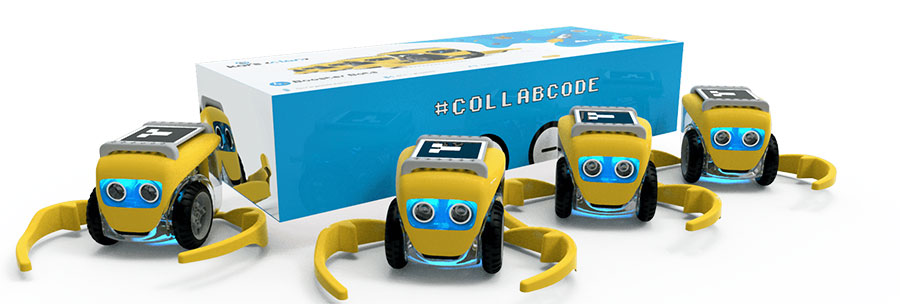
Kai’s Clan Lessons:

  1. Mars Discovery: These are fun graphics depicting Mars. Students show up as a team, and develop strategies to visit the virtual planet.
  2. Automated Warehouse: The adventure mat is a blend of AR, VR, and 3D learning. It gives clarity on logistics and warehousing. Thus, having access to the current gadget. It is crafted for hassle-free handling. Easy to use, keep, and lasts long.
  3. Smart City: Smart people think smartly. Like the Automated Warehouse mat, smart city is yet another activity powered by VR, AR, and 3D data. Through the use of sensors and smart reasoning, it assists in answering futuristic questions. It allows smart city coding lessons through reasoning and planning. It is also compatible with Android and iOS devices.
  4. Rescue Run: The Rescue Run AR VR mat renders a fun-based gaming experience. It ignites scientific and logical reasoning. Action struck activities like ‘Capture the Flag’ is the show stopper of this learning program. Thus we conclude, the only way for children to learn coding is through the playful methodology.

Are Kai’s Clan Virtual lessons beneficial?

Students who show keen interest in virtual lesson, learn a great deal, although, it is looked upon as a part of the entertainment. It gives them a break from bookish knowledge and gives them the opportunity to have an immersive learning experience.

The amusement of landing into outer space or defeating a team of co-learners across the globe at a Virtual game-like project, is doubled thanks to Kai’s Clan. The child’s creative thinking capacities are stimulated and his imagination takes wings. It also helps overcome some language barrier and challenges old-school cultural biases & beliefs. No matter from whichever place you dwell, learning is unstoppable with Kai’s Clan.

Contact us

Benefits of drag and drop coding for kids

Benefits of drag and drop coding for kids

Benefits of drag and drop coding for kids

Block-based coding uses “blocks” of code which can be dragged and dropped onto a work environment and pieced together to make meaningful programs. It requires no tedious typing of memorization of syntax which makes it especially suited for children. It is an entry-level activity, where children can gain a foundation in computational thinking through visuals as opposed to coding that is based on text. Some schools in Dubai have started to teach their kids Block-based coding, especially from the age group of 10 to 12 years of age, for development to further its usefulness. The “blocks” mentioned above are “chunks” or “pieces” of instructions a user is putting together in order to tell their creation what to do.

Drag and Drop coding allows the coder to drag blocks or icons containing concise commands that are easy to understand. The blocks are usually colour-coded, allowing your child to group blocks with similar functions together. With block-based coding in a program like Scratch, kids can let their imaginations run wild, and bring what they create to life with animation and storytelling. For example, in Scratch, kids can make Clicker games, Chase games, Pong games, Make-It-Fly games and Adventure games. Schools in the Middle East, especially UAE and other GCC members, have become initiators in educating their children in Drag and Drop coding early on in their childhood, as it has demonstrated significant mental growth and shown benefitting their lives all-round.

Advantages of Block Coding

Creative/Logical thinking

Children who start to learn coding and programming at a young age, they can easily get bored by the tedious syntax-based programming, but with Drag and Drop coding, they are given a free medium to channel their imaginations into a more visual product that keeps them focused. Drag and Drop programming is more straightforward compared to text-based programming, hence reducing the need for your child to understand syntax. This gives your child more brain space and time to strengthen their logical thinking and programming concepts. Logical and analytical thinking is an essential skill of a good programmer, and it is applicable no matter what programming language one decides to use in the future.

Helps save coding time

Usually, the process of coding seems lengthy and tedious since any one writing the code has to write every single line of it and also memorize the rules of writing code. However, with Block-based coding, this process becomes much easier and quicker as the visual aspect of it also helps in making the process smoother and crisper when it comes to programming lengthy projects. Since these coding languages are made by engineers for use by other engineers, many people with no formal training can now have a way to learn coding in a short time, to work on small applications. Block-based coding is the solution, as it is very intuitive and needs no formal training to be good at. It is simple and any first-timer can pick it up in a matter of days.

Visual is better than text-based coding

Block-based programming, which is visual in nature, offers relief from worrying about syntax errors since the only kinds of mistakes that can be made are conceptual ones. This feature allows a shorter development time and the software can be easily maintained. Visual Programming makes use of blocks that demonstrate easy programming concepts. Syntax and simulation are easily shown through Block-based programming, which can be compared to the pieces of a jigsaw puzzle. Hence, Block-based programming is beneficial for children to start with. It makes the application of logic very intuitive and there is no need to learn difficult concepts that are required by other high-level programming languages. Children can quickly and very easily learn to run programs and unleash their creative endeavours.

In conclusion, Block-based programming, which has a visual way of teaching kids, has shown to be the more child-friendly programming language as compared to syntax-based coding. Many people are now starting to realise the benefits of learning Block-based coding, and have begun to adopt in their school’s ways to teach their children the programming language. If you are interested in getting your child started on block programming, here are some resources you can use:


  • Scratch Jr
  • Code Monkey
  • Kodable
  • Codemoji

The ever-famous LEGO® Education too makes use of block-coding to power Robots and make vehicles move through easy programming languages. Even a child who is just starting to get familiar with computers, can now build a railway network scene and set the wheels of the train in motion through Lego’s Coding Express using easy drag and drop code features.

Contact us

Tips for making Children Use Technology Prudently in the Digital Age

Tips for making Children Use Technology Prudently in the Digital Age

Tips for making Children Use Technology Prudently in the Digital Age

There was once a stone age and now there is the digital age. It is absolutely commendable how mankind has evolved across centuries. Our ancestors had simple living yet had fulfilled lives. Presently we thrive in this fast-paced digital revolution where technology and advancement are limitless. Take Dubai, UAE, or the Middle East for example, how it has progressed rapidly over the years. There have been frequent inventions, small or big either here or in some part of the world.

It is the era of modern machines, gadgets, applications, smart software, and the internet and social media. Our life routines are synced with these devices that we have access to with just a tap of a finger. There is a lot to be grateful for, the facilities, opportunities, knowledge, and learning. Often even a short while without these gadgets make us feel incomplete. However, the ability to use digital tools efficiently while controlling and regulating the screen time lies in our hands.

The online world brings people closer virtually and engages on a personal, educational, and professional front. Everyday tasks are executed with the help of websites and apps. The webspace is extremely attractive and apps are addictive although everything has its pros and cons. However digital we may get; we must never undermine the importance of an in-person interaction which also has immense impact. So, it is perfectly okay to be offline at times as well and not have the pressure to always connect digitally. Let us not forget that the person next to us is as crucial as the one on our screen. Below are tips that can be implemented by parents for their children in this ever-growing digital age.

Digital Etiquette

In actual, where children are taught manners to interact with people, the same applies to them in the digital scenario as well. Virtually too there is a way to greet, use the right language, engage, exchange information, be dressed appropriately, have the correct posture and facial gestures and the topmost, being punctual and following meeting timelines and adhering to rules set out by the person across the screen. Parents must instil these values in their children for them to create a strong impression in every sphere.

Effective Scheduling

Parents can carefully plan the day of activities for children whether it is a school day or a holiday rather than completely letting them be on their own. Not only study time but play time and digital usage must be monitored. It should all be slotted well so that they have sufficient proportions of being digitally active, participate in outdoor play, bond with family, have healthy meals and get adequate rest.

Set Limits

It is imperative to give freedom to the children so that they have their own personal space and not feel choked by compulsions. Much as this is given to them, it should also be clearly ingrained in them that the freedom comes along with a lot of responsibility and the trust that parents have on their children must not be broken. Certain limits must never be crossed and guidelines laid out by parents must be observed by children.

Active Involvement

Parents must not get too busy and tied up with their work and home chores. Just because you give the children digital tools and gadgets to keep them occupied, does not mean that you can be away from them owing to your work. Parents must actively and very lovingly spend time with their children with the littlest of any activity. Make them learn and let them make mistakes and rectify them too. Do not be overly harsh or critical. Be along their side and that beautiful parent-child relationship will only nurture and grow stronger with time.

Subtle observations

Children generally do not like parents invading their space. Parents must give the children the little privacy they seek but at the same time they have to be vigilant about who the children are interacting with online, the sites they visit and the apps they use. Parents must explain the perils of chatting with unknown people. This can only happen if parents have friendly conversations with children, so that the children open up to them, share some details with parents rather than hiding things from them. Not only online but also offline it is important to know who the children meet and what their friend circle is like and where they hang out. Their body language has to be observed and whereabouts need to be known, all while not being very intrusive.

Dedicated Family Time

Each one in the family is always up to doing some tasks or the other, finishing everyday duties whether parent or child. These days, it is tough to even have meals together. So, parents must chalk out dedicated family time, either on a particular day of the week or a weekend when the entire family gets together, switches off digitally, doing nothing else but being with each other. It may be watching a movie, cooking a fancy meal, playing board games, or going on a long drive with great music.

Be a Role Model

Children emulate their parents. It is vital for parents in today’s day and age to be tech savvy and to be abreast with the latest happenings in the digital space. They have to take active interest in the basic operations of certain apps and websites that help the family as a whole to undertake several tasks. Having said that, it is super critical to also detach from them when required from time to time. Once the right balance is achieved, the children too feel motivated to follow along their parents’ able footsteps.

Get started with ‘TechnoKids’ and learn how the computer curriculum that they offer can be used in your child’s classroom, learning center or home. ‘TechnoKids’ publishes a collection of technology projects with ready-made lessons available in the Middle East, Including GCC Countries. Each project includes a teacher guide, student workbook and customizable resources. They have primary, junior, intermediate and senior levels. So, the key of moderation is in your hands. Using technology prudently is the way forward!

Contact us

How Helpful is Assigning Homework to Students and How Much of It is Too Much?

How Helpful is Assigning Homework to Students and How Much of It is Too Much?

How Helpful is Assigning Homework to Students and How Much of It is Too Much?

School homework has been an ongoing topic of debate with no clear winner or conclusion on whether it is a ‘boon’ or a ‘bane’. Some parents feel children should not be burdened by studies post-school hours and extra homework adds to the stress levels of students. Others feel homework is very essential as it helps learners practice and reinforces concepts that are taught in school. And yet others feel homework is important, but when allocated in moderation.

Benefits for homework to students

  • Homework gives the student a chance to gain confidence by independently trying to solve a sum or write down an answer to a question asked.
  • Homework ensures that children don’t go back home and forget the concepts taught in class, but invest time in practicing the same for better recall.
  • Students would find it difficult to appear for their quarterly exams, if they weren’t regularly revising their studies. Homework gives them a chance to keep the revision ongoing even when there are no exams.
  • Parents get to know what the school is currently teaching by helping & observing their kids do the homework.
  • Submission of homework within the deadlines teaches children the importance of time management and commitment towards work.

Barriers that may arise by assigning homework to students

  • If children are burdened by homework, they wouldn’t have time for play or extra-curricular activities, which is absolutely essential to rejuvenate their minds & bodies.
  • It robs them of having fun in their golden years of life. Socialization with neighbors and friends after-school hours goes a long way in developing their personalities.
  • Too much homework, leads to malpractices like cheating. Students are in a hurry to finish the homework and simply copy the answers from their textbooks to get over with it
  • Sometimes parents who are involved in helping their child finish the homework may confuse the student further by teaching them their own method, which might be different from what they learnt in school.
  • Having to deal with studies all the time creates fatigue and children may lose interest in learning.

Strategies for Assigning Homework

In the above paragraphs, we have seen the pros and cons of assigning homework to students. However, we feel that moderation is key. While curating homework strategies, the important point to remember is; focus on quality over quantity. If you are an educator, here are some helpful tips:

  • Keep every student’s requirements in mind. Ask yourself, what topic does the student need to focus on the most in order to be in sync with the learning in class. Nowadays, there are ERP platforms that are integrated within the school’s curriculum to assist the educator in creating homework assignments. One such popular tool used by schools in the Middle East is NLP (Next Learning Platform). NLP’s homework management and reporting program enables teachers to customize homework according to the learning capacities of the child. It even tracks the submission and notifies the teacher when the student has finished the assignment. NLP is indeed a handy integrated learning platform used widely in Dubai and GCC countries.
  • Support classroom learning by asking children to watch educational videos on the topic as homework and then ask them oral questions in school the next day, to gauge their level of understanding. Asking learners to watch videos is less time- consuming and drives down the concept more effectively through audio-visual aids.
  • Instead of individualized homework, divide the class into groups and allocate project work. This solves dual purposes. Children learn to interact which develops their social skills, and they get to learn from each other while doing their own research. Project work and group presentations also prepare students for college life and most IB schools in UAE prefer this hands-on approach to learning.

Homework Tips for parents

  • Set an allocated time for homework as per the child’s convenience. Some students prefer finishing their school work as soon as they get back home, while others may want to relax and do their homework late in the evening. Leave it up to them to choose the time, but make sure they do not cheat by skipping the schedule.
  • While doing the homework, children may have queries or doubts to be resolved. Parents need to be passive participants in the child’s homework routine and help them wherever required. However, the idea is not to do the homework on behalf of the child.
  • Just like the child is not allowed to eat or play with the mobile phone in a classroom environment, parents must keep all distractions at bay at home too. Do not make food available on the table when the child is engrossed in homework and keep all toys away.

Contact us

Incorporating Structured Role Play Enhances the Child’s Skill Development

Incorporating Structured Role Play Enhances the Child’s Skill Development

Incorporating Structured Role Play Enhances the Child’s Skill Development

We know that children enjoy their free time and are the most active during activity or games period. Have you ever thought why? Of course, because it’s fun, and they can choose to do what they want to. Don’t be surprised if you got to know what children share with their parents when asked, “how was your day at school?”. The answer usually is, “Our team won the football match”, or “I had a lot of fun during speech & drama class.” So, we can safely conclude, that children love to indulge in games & play time. Now the question is can children be made to learn important skills through play? Read through the Blog to get your query answered.

What is role-play and how does it work?

You may have noticed your preschooler sometimes dress up like their class teacher and pretend to teach phonics to an imaginary audience. It’s very common for children to mimic actions of elders and visualize themselves as playing the same role as an adult. Essentially, role playing is this act of behaving as someone who is different from yourself. That means the child puts himself or herself in another person’s shoe and imagines to be like them. Dedicating a weekly session on role-play at the preschool or elementary grader’s level, adds variety to classroom studies and throws open a unique opportunity for children to express themselves. All play and no regular studies, could help in improving the child’s skills!

Benefits of role-play to Early Learners

  • Develops language skills while children enact the part
  • Builds social skills, as children get and receive feedback from their friends
  • Allows children to be creative and they learn to express their ideas with clarity
  • Widens the child’s perspective, as they get to know more about the person’s role or function while they enact
  • Children recognize their own potential and become more confident individuals
  • Sets a foundation for eliminating stage fright or fear of public speaking

Examples of gigs for children

I cook I toil in the kitchen, with pot and pans I cook wearing my adult mittens. Guess who am I? Well, of course it’s a chef. Now let’s look at some of the role play activities that you can explore with kids.

Doctor’s Helping Hands

Allow children to become doctors and let them mimic all that the doctor does at his clinic or in a hospital. To make the scene authentic, arrange for white shirts and ask children to wear it over their uniform. Make the child suspend the stethoscope around his neck, and have a writing pad in his hand. We recommend not to encourage using the plastic tools that come along with the child’s doctor’s play set, and instead use the real stethoscope. Now it’s time to enact. The child has to ask the right questions to the patient who walks into the clinic and then do a check-up by placing the stethoscope on the patient’s chest. Now they need to write a prescription and hand it over to the patient, just as a real doctor would do.

What children learn

Knowing what a doctor does and how helpful they are to the society, children could do-away with their fear while having to visit the doctor for their scheduled check-ups. Moreover, they learn about the different kinds of doctors by playing the role of a dentist, vet, ophthalmologist, etc.

At the Farm House

Teaching children about farm animals is more fun when you actually take them to a farm house. Well, if it’s not logistically possible, why not bring the farm house to school? Children get an opportunity to spend their day by performing various activities that a farmer does on his farm house. Like milking cows and feeding hay to the horses. For this you might have to convert the classroom into make-do barns, stables, and pigsty with mini figures of farm animals or dressing children up as them. Then take them to an outdoor space around your school premise, and allow them to get their hands dirty. Ask them to sow seeds, cut extra branches, and water plants in the garden area.

What children learn

They learn where their food comes from. Children don’t take the food on their tables for granted and become appreciative of blue collared wage earners. Educators can explain the process of germination and then highlight the importance of taking care of plants and animals.

Reporting News

All our budding news reporters & journalists have an important task for the day. They need to rush to the site to report a recent news on how the firemen saved casualties from a fire at a factory. Appearing in front of the camera and holding a mike in hand is something they get to experience for the very first time.

What children learn

Though it is just role play, children learn to face their fear of speaking into the cameras and grow more comfortable conversing about a topic.

Kutubee is a reading platform that is popularly available in the Middle East, including Dubai and GCC countries. Kutubee offers over 1500 books to encourage the habit of reading. With every book the child grows fonder, learns new words, sparks imagination, and sharpens his literacy skills. This helps students to be better role-players and communicate more effectively in class. Many schools across the UAE dedicate 30-40 minutes of library time, where children are free to do their research and read upon a topic before they take Centre stage for their role-play acts.

Contact us

Benefits of ERP based School Bus Transportation Management System

Benefits of ERP based School Bus Transportation Management System

Benefits of ERP based School Bus Transportation Management System

We live in the 21st century’s modernized era that has technology at its peak. Gone are the days where we to use to operate most of our daily tasks manually. Today it is the world of gadgets, apps, and software galore, and everything is accessed at a click of a button. It has become extremely helpful, super-fast, user-friendly and hassle-free.

In this digital age, practically everything is online, so schools could not be left behind. ‘ERP’ or ‘Enterprise Resource Planning is one such brilliant system in the current times. It is a software that benefits schools to efficiently oversee their day-to-day management such as admissions, students’ fees, student information and attendance, homework, examinations, staff recruitment, payroll management, employee information, library management, and many other school activities. There are schools in Dubai and in other parts of UAE as well as across other Middle East countries that have the ERP software for their day-to-day management functions.

School bus transportation management is yet another integral function of the ERP system. It is an effective tool that helps the school’s management, staff, teachers, parents to keep a track of the bus transport facility for the children. This system makes sure that each student who is traveling by the school-organized bus is safe and secure at all times. Much as we are advanced technologically, there are perils that come along with progress. Any mishap or an untoward incident could unfortunately happen anytime. So, to avoid or come out of any drastic situation, this tracking is done in real-time using GPS trackers. The parents and the authorities can thus remain peaceful and stress-free. The benefits of this system are mentioned as under.

Vehicle & Driver Details

The software maintains the complete record of the driver and the attendants of the school bus along with the registration details of the vehicle. All the important information is updated from time to time and is notified to the school authorities and the parents so they can keep a track of it. It also tracks whether the driver is following protocols with regards to the speed limits and other safety precautions that he is instructed to adhere to.

Schedules

Along with every student a pickup and drop off place is registered. Moreover, the timings of both are notified to parents so that they can respond to the exact notification and be present at the correct time while leaving the children to the bus stop in the morning and while picking them up at the designated spot after school in the afternoon.

Student Updates

This system keeps an attendance record of every student from the minute they hop onto the bus, till the time they are dropped off at school. Once they reach school safely, the parent and the school authorities get notifications for the same. So, it is all well tracked that God forbid no student ever goes missing.

Route Change Alert

The driver is expected to maintain the particular route and pick up points for the children. Should the driver require to change the route due to any sudden reason be it a road diversion due to construction or traffic congestion then all authorities concerned with the children get the respective updates on their handy devices

Bus Change Alert

Apart from the route, if the entire vehicle is suddenly replaced and the students are made to shift into another bus on the way to school or while returning home, then all parties concerned would be alerted immediately. This situation could happen in case of a tyre puncture or any malfunction with the bus.

Bus Fees

The monetary aspect of fee collection is also managed through the ERP based bus transport system. Parents pay the relevant fees for their children travelling by the school bus. The school management can keep a track of the same and should there be late payment in fees by any parent, the same is sent by reminders to them so that the required amount could be paid off.

A centrally controlled software and all multiple authorities concerned are notified. Such is the amazing aspect of having an ERP based system. The ‘Next Learning Platform’ is one such system available for schools across most countries, including the GCC members in Middle East. It is a one-stop cloud-based integrated platform for a school’s administrative and academic processes. It creates a virtual school infrastructure supporting online, blended, investigative learning, and an efficient school bus management protocol to ensure utmost safety, which is the current need of the hour.

Contact us