
Simple Practices to Improve your Child’s Reading Fluency

Simple Practices to Improve your Child’s Reading Fluency

Simple Practices to Improve your Child’s Reading Fluency

Does your child fumble when asked to read? Are you able to comprehend the mumbling words & sentences your little emergent readers utter when attempting to read aloud from a book? Well, if you have been trying to improve your child’s reading fluency, but not been too successful with it, we are here to help.

What exactly is reading fluency?

Reading fluency is when the child is able to read accurately, using proper pronunciations without faltering in the middle. Fluent reading feels smooth, almost as if someone is conversing with you. A fluent reader understands punctuations and knows where to pause for a bit, before resuming the sentence. With some practice, the child even learns to add expressions and voice modulations to reading. This stage is reached only when the readers are able to comprehend the meaning of words and make sense of the printed characters before them. As they read, they need to be able to apply their existing knowledge and concentrate on the comprehension. Even the pace at which the child reads is important to note. Reading too fast or too slow won’t solve the purpose. So here are a few tips that can help you as parents of educators to improve upon the child’s reading skills

Here are a few tips to help your child read more fluently:

Read Aloud to Your Child Daily

We are aware that children mimic adults and hence one needs to be at their best behavior especially when your child is watching you. The same is applicable for reading. When you read with fluency, the child observes and tries to copy the same. Chalk down a schedule and allocate 15 to 30 minutes each day to sit by your young reader and read a story aloud. As you read aloud the child picks up new words, thereby increasing his vocabulary. And as the pool bank of words increases, the child will be in a better position to read accurately sooner than others. To make this daily reading session more participative, take turns to read. Maybe you could read a page aloud, and then ask the kiddo to read the next page aloud. Parents can use the Reading Eggs App or subscribe to physical copies which features numerous kid-friendly books and increase the level of difficulty as per the pace of the child. This multi award-winning app also features a read aloud option where the audio recording helps children hear fluent, expressive reading.

Allow the Reader to Choose a Book

No one likes to read a novel that is of interest to them! Similarly, children have their set of preferences. Some like to read about adventure, some like stories that teach a moral, while others like to escape into fantasy land. Give the child a book he wants to read and you will notice how engrossed he gets. The Reading Eggs App and book packs spoils them for choice, as there are dozens & dozens of age-appropriate books which capture the reader’s interests right away. Do not worry about the authenticity, as many Schools across the Middle East including UAE, Dubai, and GCC, recommend Reading Eggs to parents to improve their student’s reading skills. Developing an interest in a particular genre at first, may positively impact the child’s interest in learning to read correctly.

Use Echo Reading Technique

Echo reading is a technique where you read a sentence aloud to you child and then ask him to read it for you. Run your finger under the word that you are reading, so that your child replicates the same and develops a habit to do so. Start with short sentences, and then proceed to echo read paragraphs. While you read ensure to take pauses wherever required, and use correct expressions, because this is what your child is going to pick up. The way you read is creating a foundation for your child, so make sure it is a strong one.

Keep the Excitement Alive

Anything that becomes mundane, is no fun! Even reading can become boring at some point. So, bring about variation by introducing games and activities to spice things up. For example; If you are using the Reading Eggs App, the child can be asked to solve a word puzzles, challenge their classmates by competing over educational games, and solve worksheets. By this the child develops confidence and proactiveness. Another recommendation is to record the voice of the child as he practices reading and then play it aloud to him. This helps the student become aware of his own glitches and the adult can recommend suggestions to improve the level of fluency.

Practice and Repetition is Key

Practice makes a man perfect, and definitely does greater good for kids! Fluency comes with practice and the most fluent readers weren’t born in a day. So, do not skip even a day of reading. Encourage your child to read sign boards when you go out with him. Get them to help you shop at a supermarket, by asking him to read the label on various products. When reading from a book, practice reading the same passage twice-trice or even ten times, until your kid gets comfortable reading it without any breaks. The ultimate goal is to make reading as effortless as possible.


Contact us

Team Building Activities with LEGO®

Team Building Activities with LEGO®

Team Building Activities with LEGO®

What is LEGO® to begin with? The LEGO® Group is a Danish toy production company best known for the manufacture of LEGO® brand toys. They consist of multi coloured interlocking plastic bricks which can be assembled to construct figurines called as minifigures, well known monuments and iconic structures and various other objects. The brick pieces have a unique connective grip. LEGO® products are considered to be safe and durable. Playing with LEGO® offer numerous benefits to young minds. It sharpens the brains of children and adults alike. It benefits children in the areas of Math and it enhances their motor skills and early engineering skills. It increases their ability to move quickly and easily and strengthen their finger grip along with hand and eye coordination. Children love playing with these LEGO® because it unleashes their adventurous side. Schools across Middle East, UAE, Dubai, and GCC promote working with LEGO® and even have dedicated after-school classes where different aspects of the curriculum are integrated with LEGO® lessons. It lets them imagine and experiment and build on their ideas. They learn how to cooperate and solve the puzzle with team building which brings us to the main topic as to what team building activities can be performed with LEGO®. Let’s look at some of them below.

Tower-up Challenge

We have all at some point in time enjoyed constructing tall towers using colourful LEGO® bricks. This time we give it a twist. Divide children into 2-3 groups and allocate 5-7 minutes for them to creatively build a LEGO® tower. The team that manages to construct an impressively tall structure wins the challenge. However, the condition is also that the LEGO® Bricks should withstand the test of time. It should not collapse under 1 minute. Different criteria for judging can be applied. For example; points for creativity and team work makes it even more competitive for children to push themselves to use their skills effectively. The same activity can be done by asking children to blindfold themselves to add a level of excitement.

Speed Racer Competition

Children are amused by fast cars and often pretend to be race-car drivers by dragging their toy car swiftly all over the house. LEGO® presents an opportunity to construct, design, and power vehicles that fascinate young learners. The speed racer competition is a chance for every thrill seeker to unleash their creativity and put their capabilities to test. The LEGO® MINDSTORMS® EV3 kit sets the right pace for some serious competition. Divide the class into two teams with 3-5 children per group. The teams need to device a strategy to construct a vehicle from scratch and device a robust coding program to power up the batteries to gain enough speed to beat the other team-mates. Here children are applying principals of force, motion, and energy as well as experimenting with various design engineering concepts & problem-solving techniques. The team-building activity promotes brainstorming of concept & allocation of roles in order to complete the activity within time. A sort of race track is designed and the team whose car finishes fastest wins the competition.

Depict a Fascinating Storyline

Children have vivid imagination and are always looking for an outlet to release emotional catharsis. Their dreams are limitless and at this stage they need to be given every opportunity to display it creatively. Lego® Bricks provide unimaginable prospects so that young learners can wear their construction hats and start to build great things. Do a random chit selection in class and group children in teams. The team can pick a name for themselves like; mighty achievers, or inventive storytellers, etc. Now the team has to present a ‘themed story’ with LEGO® construction toys, something on the lines of an amusement park, playground, or a vacation resort, etc. To materialize ideas, the team delves on different topics, discusses details, and uses imaginative techniques to create and present the ideas in front of the jury. Add an element of fun by making boats sail or swing the ride. The group that displays the most creativity is declared as champion.

These are just a few ideas to promote team spirit and inculcate the habit of working in a task force, much like an office set-up. At early ages children learn to co-operate, be open to ideas, solve problems-together, and share recognition equally. As the saying goes ‘Great things in business are never done by one person. They’re done by a team of people.’

Contact us

Secure Payment Gateway for Smart Schools

Secure Payment Gateway for Smart Schools

Secure Payment Gateway for Smart Schools

Education has been able to evolve with the rapid advancements in technology, and that has given birth to a number of smart schools. Now smart schools all across the globe with technology to make the learning experience better and more effective for the students. What if we told you it can be better for the school management and administration as well? Technology can and is making the experience for school management and administrators across the globe and here’s how Next Learning Platform is making it happen.

The Next Learning platform is not just a solution to digitize learning for the students but is a tool to digitize all the school’s operations and processes. The cloud-based solution integrates planning and delivery of teaching content with administrative processes of the school, making it a hassle free and streamlined experience. With the fee management module, Next Learning Platform integrates the payment management also into this great eco-system.

The benefits of it are:

Simplifying payment and ease of setup

Payment gateways have a single job to do; delivery error free operation. Since the Next Learning Platform is a complete ecosystem, the payment gateway through the fee management module is able to integrate well with existing systems and operations. Giving the seamless transition and operation a payment gateway requires. The Next Learning Platform also provides end-to-end assistance and guidance in setting up and management of the module. Digitising payment of fees makes it a hassle-free experience for the guardians by providing a one-stop solution, while also being a tool for the administration for its ease of usage and management.

Easy to use for users

The interface of the Next Learning Platform is designed to be user friendly. With the cloud-based system that can be accessed at the user’s convenience at any time and place, the platform creates a seamless user experience for payment and fee management. This ensures a high value experience and eliminates any fraudulent or malicious activities. The tracking mechanisms created for the platform also help keep a continuous track on the fees and its management of the payment.

Transparency

A digitized payment platform allows a greater degree of transparency in the payment mechanisms of the smart school and enables the institution to maintain its standards of conduct. All the parties involved in the institutions are able to be involved with greater efficiency when such a degree of transparency is maintained. Since all transactions are linked to a unique ID, that is further linked to transaction details and other information regarding the fee and payment mechanisms. The same unique ID is also used to create a receipt for the payments made, completing the cycle of the transaction, all while maintaining a high degree of transparency.

Access to guardians or parents

The digitized system ensures there are multiple login accesses to the system, which I turn gives parents and guardians of the students direct access. This role-based access system allows the parent or guardian to make payments seamlessly on the same platform, either via the website or even the mobile application.

Data security

The encrypted payment gateway makes fee payment safe. The PCI DSS compliant gateway ensures the industry standards of payment gateway is maintained. Bringing the school’s administration to the safest alternative in online payments.

The Next Learning Platform’s payment gateway integration in school management software enables the school to be completely digitized. Right from content delivery to management and even fee management, all of it gets taken care of with the software. With the current global situation, several schools across the Middle East have digitized in places like Dubai, GCC, and other cities in the UAE.

Having an integrated payment system doesn’t just make the operations easier but also makes the experience friendly for the parents and guardians of the students of a smart school. In turn helping the school be more technology driven and more up to date with the current times.

Contact us

Educational Benefits of Solving Mazes for Kids

Educational Benefits of Solving Mazes for Kids

Educational Benefits of Solving Mazes for Kids

Mazes! What is the happiest memory that we first associate with it? It’s surely the one that takes us straight to our childhood where we would have tremendous fun getting lost in the garden in the Hedge Maze or keep colliding into glass frameworks in the maze of the House of Mirrors. Discovering our way out would mean absolute glee compelling us to jump with excitement. It’s certain, mazes are an enjoyable activity to indulge in for both adults and children alike. So, these were the actual large structural mazes that we were referring to.

Mazes are essentially the puzzles that we initially have on paper which we often see children solving from a small age. They are created and made available to children in various patterns, drawings and designs to attract them so that they get hooked onto them. It is interesting to note that practicing mazes not only benefit children but these also aid therapists to address and highlight a variety of abilities amongst children. So, this brings us to the main question. Why are these mazes so important and why should a child solve them? They do love it as a leisure activity but there is immense logic and technicality behind making them solve those mazes. Let’s look at some of those aspects below.

Enhance Cognitive Skills

Mazes improve the cognitive skills of children. They work like brain boosting exercises. While solving them, it makes them think, reason and remember. Simultaneously achieving all of these, sharpens their memory, builds their focus and increases the concentration level of their minds to a great extent.

Fine Tune Motor Skills

Mazes require the children to navigate the right path through the narrow passages without hitting their pencils or markers to the black lines which are the borders of the maze passages. They have to go slow with the strokes and not rush to complete the puzzle. So, it is their motor skills that are working to prevent them from bumping into the black lines. This controlled movement also helps them to produce readable handwriting later.

Strengthen Visual Skills

Before they begin to solve the maze, children do plan out their moves. Whether they realise it or not but they organically scan their eyes over the maze circuit to decide how to go about with the same. That expands their visual power and the ability to scrutinize complex settings and triumphantly come out of them.

Hand Eye Coordination

While concentrating meticulously with their minds and working with their little fingers to locate the track in the mazes without touching the black lines requires children to be very careful and precise. This is only possible when excellent hand and eye coordination is implemented by the child and it definitely gets finer with practice.

Find Effective Solutions

Children devise their own strategies to solve mazes. Whether they find their way from the start point or work backwards from the end point is up to their imagination. While at it, mazes are constructively helping them to be problem solvers since they are learning to deal with tricky situations.

Virtue of Patience

We have to agree that mazes are a tad complicated and children do take their time to solve them. While doing so, it teaches them the value of persistence that they got to stick around and not give up and that patience will yield good results and their genuine hard work put into something will never be futile.

Build Confidence

A child solving an easier maze or a difficult one, whatever the level may be, just the very fact that they were able to solve it gives them a sense of pride and accomplishment and it lifts their spirits to do more and better the next time.

Parents and teachers, we urge you and recommend you to consider investing or looking through “Highlights International”. They have an entire section dedicated to Maze Books. Based on interesting themes, these puzzle books range from; Farm Mazes, to Halloween Puzzles, and even Travel themed. They are a veteran family media brand that cater to the needs of early childhood. For 70 years they have been publishing content and creating experiences for children that engage, delight and foster joyful learning. Parents all over the world trust the brand. Many schools in the Middle East, Dubai, GCC, and UAE recommend parents to subscribe for Highlights Magazine to promote learning through fun activities. Their wide variety of “Fun with a Purpose” magazines and books are dedicated to helping children become their best selves – creative, curious, caring and confident.

Contact us

Ways in which Educators use 3D printing to make Math & Science Interesting

Ways in which Educators use 3D printing to make Math & Science Interesting

Ways in which Educators use 3D printing to make Math & Science Interesting

Maths and Science aren’t considered the most interesting subjects by many students. And it’s due to the nature of these subjects. They are demanding subjects and require a lot of practise, which is something students rarely enjoy doing.

For several decades it has been a challenge for teaching professionals to make Mathematics and Science a little more appealing to learners across the world, luring them with pictures at first, and then came in videos. And now with the 3D printing technology becoming accessible, teaching can finally be more than just observing.

3D printed models allow students to interact with them, resulting in a more direct approach to learning. An atom does not need to be imagined by the student if a 3D model is used to actually depict it. A curve on a graph doesn’t sound interesting to a student, but a 3D printed curve does. And this is just the cherry on the tip of the various advantages of using 3D printed models in education. Here are some reasons it’s a great idea to use models to teach Mathematics and Science:

The wow factor

By the stage of development at which 3D printing technology is by now, it is easily possible to 3D print just about anything. This ability to create induces a wow factor to whatever subject or topic a student is learning. It not only increases their interest in the subject, but also helps them throughout the learning process as a motivation to learn. Much of the motivation to learn in young students is not application based. If they are having fun while learning, they will learn well, and if they’re not having fun, the chances of them retaining the same information is far lower. Keep the learning interesting with 3D models, increasing how much and how well the student learns.

Visual cue

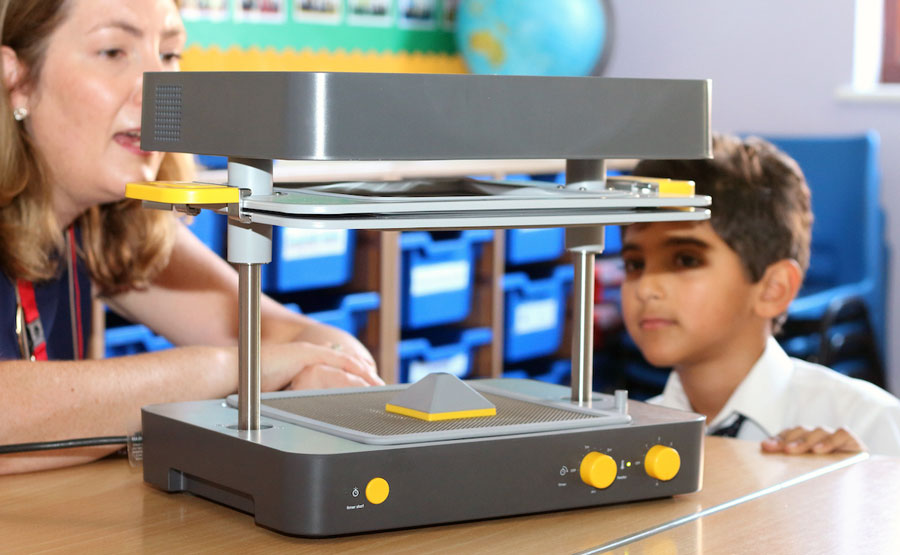
Introducing new concepts to children is sometimes challenging, specifically the younger ones have trouble relating what they learn in classrooms to the real-world scenario. And this problem is solved in an instant manner with the visual cues a 3D model provides. Maths really benefits from this, since a lot of mathematics concepts are abstract. The 3D model makes the learning tangible and simple. When students are able to touch and experience object for themselves, rather than just learning about them, the idea solidifies. For example, everyone knows that the Pythagorean theorem is proved to be true. Now the students can verify for themselves with a right-angle triangle in their hands constructed using the Mayku 3D student’s printer

The world of design

Creating anything requires a degree of creative expression. 3D printed models, and the process with which they’re made commands the student’s undivided attention and promotes creativity amongst them. Getting involved in the designing process allows students to get into the shoes of a creative professional and work their way with real life problems. Finding real solutions to real problems, promotes critical thinking in the students and helps their learning curve.

Layer of learning

We’re all 3-dimensional beings and for the longest period of time, we have learned through 2D mediums like books, pictures, videos and more. 3D models add the required 3rd dimension to the learning of the students and in turn improves the way students perceive concepts. With 3D models of mathematics functions and scientific chemical bonds, students are able to see what they otherwise would not be able to. This added layer of experience brings quality education to the table that translates into information the student can use.

Mayku creates solutions that meet with all these benefits a 3D model provides. Being a revolutionary way to teach, the technology is being accepted by several schools across urban landscapes in the Middles East, such as Dubai, GCC, Abu Dhabi, and more. With even greater advancements in the 3D modelling world, it’s getting more and more simpler for the learning of students to go 3D.

Contact us