
How to assess a child at preschool level

How to assess a child at preschool level

How to assess a child at preschool level

Early Childhood Assessment is a tool used to gather and provide educators, parents, and families with critical information about a child’s development and growth. Dubai, and some other cities in UAE, licensed early childhood programs are required to include a child assessment component in their programs.  

1. Observe: To observe a child’s performance at school or at home is the best way to learn more about the child’s development. Educators are free to observe the child through all facets of development such as intellectual, linguistic, socio-emotional, and physical development on a regular basis. Through observation, an educator or even a parent can better understand the child’s behavior and mind in certain facets of development and their advantage or disadvantage in any of the developmental areas. 

 2. Make notes: Making notes regarding the child is a helpful way of keeping track through classes. It is a way to record data that is collected through the work, the child has produced over a period of time. The notes can clearly show progress made by the child and is a brilliant way to be constantly up to date with the class happenings on a day-to-day basis. It also helps in creating a bond and understanding between the parents and the teacher, which is ultimately beneficial to the young learners. 

3. Test the children: At the end, all comes down to the performance of the child, and this is objectively remarked upon only by standardized tests administered to the children which clearly show the progress of the child or lack thereof. These tests are scored in a standard manner so every child has equal odds at it, and are often used to assess the performance of children in a program. Many schools in the Middle East, including the GCC regions, have started to organize standardized tests for all grades. 

Assessments provided to children in the early years of their academic life can go a very long way. It offers clarity and evidence to the child’s need for additional support or the intervention of a special educator, to help him cope in school. Also, based on the cumulative performance of all students, educators can plan their lessons more strategically and alter their teaching methodologies.   

 Next Learning Platform or NLP, founded in 2007, is a fast-growing, SaaS-based, technology-driven company revolutionizing the education system. Every day, their innovative products and solutions transform the lives of 10% of India’s private-school-going children. More than 12,000,000 students from various socio-cultural backgrounds study in 12,000 NLP partner schools across the country.  

 NLP’s innovative NextAssessment is a comprehensive assessment management solution that enables teachers to evaluate students on the basis of their ability. It enables periodic assessments from formative to competitive exams for all classes. 

Contact us

Few Tips to Raise Curious Learners

Few Tips to Raise Curious Learners

Few Tips to Raise Curious Learners 

The world of young children is all about wonder. As they discover new things around them, they ask questions. If you are a parent to a young preschooler, you would know what we mean. It’s very common to be asked questions like; ‘Why is the sky blue?’ or ‘where did the water in our oceans come from?’ or even ‘why does the ball come back to you when thrown in the air?’ Well, thank God for Amazon Alexa, most of your kiddo’s questions would be justified by an answer!   

Asking questions and seeking answers, is a trait of positive development. Never discourage your child to ask questions. In fact, curiosity makes learning more effective and enjoyable. Let us take an example- When the teacher gets a ‘tortoise’ to class, children will admire the little creature and start asking questions. It’s more fun when children enquire ‘why does the tortoise have a shell?’, ‘why did it take its head inside the shell? ‘where does it live?’ and so on. If the teacher had to narrate the characteristics and features of the tortoise one by one without getting the creature to class, the session would be rather boring.  

Curiosity stimulates the brain to learn effectively, however, only when the ‘right questions’ are asked. Do you remember the proverb ‘curiosity killed the cat’! Well, unnecessary questions, and going to the bottom of everything may be a waste of time, and therefore only positive curiosity should be encouraged.  

Happy kids at elementary school

Here are a few tips that help foster curiosity: 

1. Conduct Excursions and Field Trips 

Learning theoretically in the classrooms is one thing, but actually getting to know more about the ‘place’ or a ‘monument’ by visiting it in person, is a different experience altogether. Schools curriculum has subjects like; History, Geography, Arts and Culture, which can be combined with excursions & trips, so that the child’s curiosity is automatically satisfied by actually visiting the place. At the preschool level, it isn’t uncommon to schedule a visit to the fire station, hospitals, factory, post office, to teach them about community helpers and in turn get their fair of understanding by asking questions to the professionals themselves.

2. Setting-up Classroom Environment 

Decorate the classroom as per the theme you are teaching that particular month. For example, if the theme is ‘farm animals’ have models of ‘cows’, ‘horses’, ‘pigs’ and others in their respective shelter homes ‘cow shed’, ‘stable’ and ‘pigsty’. Also, stick different farm equipment used by the farmers; ‘tractors’ and ‘plows’, to transform the indoor environment into a farm-like surrounding. By going around looking at these elements, children naturally get curious and start asking questions.   

3. Invite Guests to Speak  

Invite someone who is influential and has made a mark in life. Probably ‘an author’ can be invited to speak in class about – how he discovered his passion for writing and what keeps him motivated. A ‘pilot’ can elaborate about how he made it to the ‘cockpit’ and what were the challenges he faced while training and appearing for exams. Meeting successful people and interacting with them, may give children a different dimension to think about and start visualizing what they want to be when they grow up, thereby starting to get more curious about these professions and researching on the same. IB Schools in Dubai and across the Middle East, also have webinars where parents are welcomed to attend the sessions, to promote an inclusiveness culture within the school’s community.   

4. Playing with Constructive Toys  

Toys that can be assembled together to design a workable model, are often referred to as constructive toys. We all remember how our parents gave us a set of blocks, to design a ‘car’ or ‘build a bridge’ using attractive toy sets. And who wouldn’t know the famous LEGO toymaker? LEGO® Education introduces amazing kits that add to the child’s curiosity and thereby motivate them to become inventors. The LEGO® Education SPIKE™ Essential engages children to use hardware like motors and sensors to device ‘smart solutions’. In the process of constructing models, children ask many questions and need someone to answer their queries, thereby starting to understand different concepts of engineering and how ‘things are made’. To learn more about the availability of LEGO® Education’s kits in GCC and UAE regions, visit our website.

le_spike-essential_lifestyle_2hy21_45345_15

 Therefore, curiosity indeed opens doors to possibilities! Allow your children to be curious explorers and gain confidence as their doubts turn into clarity.  

Contact us

Problem Solving Techniques Helps Students Become Better At Math

Problem Solving Techniques Helps Students Become Better At Math

Problem Solving Techniques Helps Students Become Better At Math 

Mathematics has been one of the most elusive subjects to teach for teachers and instructors. Primarily owing to the fact that the subject gets a pretty bad reputation. Mathematics is nothing but the quantification of things and ideas. The only primary requirement of Mathematics is for the practicing individual to have a free-flowing thought process that is efficient at problem-solving. This is why problem solvers are good at Maths and vice-versa. It is also of no surprise that Maths and problem solving both are such fundamental skills that everyone, no matter where you’re from or what you do, you needs an understanding of both the skills to a certain degree to function.

Problemsolving has simple steps that help the process and makes it streamlined; 

Understanding the problem: 

While seemingly obvious, understanding and identifying a problem accurately is the first step. Diving into the problem requires a degree of assessment on the problem-solvers part. Exploring the problem itself requires a particular outlook that is pragmatic and investigative. This is where curiosity plays an important role and helps the problem-solver become adept with the problem at hand. Once the problem at hand is completely understood, various approaches to solve it can be devised and then based on these, a strategy can be made. So, the first step towards solving any problem is first completely and fully understand it. 

Find a strategy: 

Strategy is key in finding any solution to a problem. Based on how the problem is identified and explored, the strategy can then be devised for an optimal solution. Building a strategy also is dependent on the resources available, including; information and tools. For example, in Mathematics, if a solution of a problem requires say a tool such as a calculator, and it is not available to solve that particular problem, then an alternate method has to be devised to solve the complex problem. This helps the problem-solver derive a usable and functional strategy that can be executed and used to obtain a final solution. Once the execution of the strategy begins, arriving at a solution is fairly a matter of delivery.  

The ‘Mathletics app’ for School helps develop these methods for young students that can be applied across all kinds of domains while building a true problem-solving mentality in the young students.  

Here’s how Mathletics does it: 

Simplified lesson planning: 

A simplified and structured lesson plan goes a long way in communicating the right ideas to the students while ensuring they absorb the ideas and are able to use them in the real world. Bench-marking assessments, grouping, and curriculum alignment are some of the tools used to deliver a lesson plan to the students thereby meeting their needs. 

 Hundreds of problem-solving and reasoning activities: 

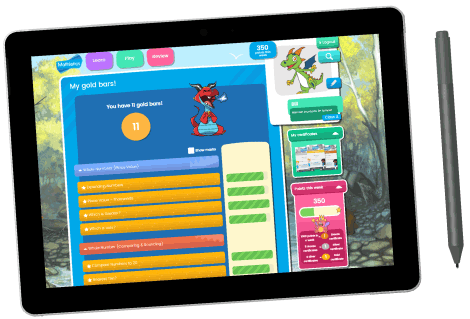
Mathletics PSR Questions consist of 700+ problem-solving activities that are available to the students right at their fingertips. This enables them to reason and think critically and solve creatively. 

 Easy student progress tracking: 

Knowing how far you’re out in your progress, helps give students a larger perspective into their problem-solving skills. An instructor can track the progress of the entire class, maintaining a detailed report of how the performance of a student has improved or decreased. This ensures a long-term planning for the development of the young students. 

Mathletics is a comprehensive mathematics learning tool that has effectively changed how several schools and instructional institutes teach Maths in Dubai and other Middle East countries. Mathletics has achieved this by building its platform to benefit both; students and instructors, making learning and teaching more fun. To learn more about integrating the Mathletics platform in your institution across GCC or UAE countries, visit our website: Click here

Contact us

Classification of Ecosystem and The Concept of Food Chain

Classification of Ecosystem and The Concept of Food Chain

Classification of Ecosystem and The Concept of Food Chain

What is an Ecosystem?

Imagine a bubble where the living and non-living co-exist and work together to get things going. Essentially, an ecosystem is an area where plants, organisms, animals, and other abiotic or non-living things thrive in a landscape under the influence of weather, temperature, and humidity.

Interdependency is an important factor that enables the ecosystem to function and continue its perpetuity by benefiting all the inhabitants. In a scenario where the temperature in the ecosystem changes, it directly has an impact on the plants, and when plants are adversely affected, animals depending upon plants for food and shelter are in-turn influenced negatively or positively. The only option to thrive in an ecosystem is to continuously adapt to the changes or move to another ecosystem, instead of perishing.

Types of Ecosystems

An ecosystem is based on the type of region, especially land or water. Majorly it can be classified as;

  • Terrestrial Ecosystem
  • Aquatic Ecosystem

Terrestrial Ecosystem –

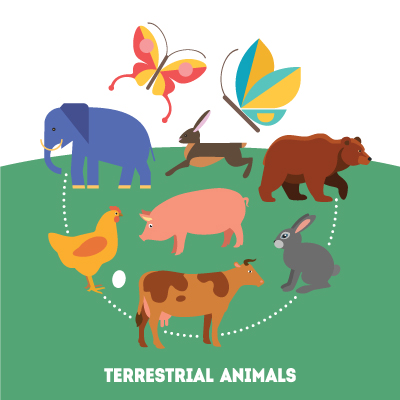
Forest: Almost 1/3rd of Earth’s surface is covered in forests and they flourish under different weather conditions such as; dry, wet, and cold. This terrestrial ecosystem includes deciduous forests, plantation forests, and tropical rain forests, as they are home to different birds, animals, and other diverse species of plants and animals.

Grasslands: Grasslands occur where there is not too much rainfall to culminate a forest, but neither too scanty a rainfall that it becomes a desert. So, it is somewhat in-between a desert and a forest. Grasslands are covered with shrub-like vegetation and are found all across the world. Many types of wild animals such as; lions, zebras, elephants, etc. are found in grasslands.

Tundra: Cold regions of the Arctic and other high-altitude mountainous areas feature the tundra ranges. Tundra has large patches of bare grasslands with rocks and low vegetation such as moss, lichens, herbs, and shrubs. The surface is mostly covered in snow all through the year.

Desert: A desert, as we know it, is a region that has very scanty vegetation. The temperature in the desert area can be either extremely hot or extremely cold, or hot during the day and chilly at night, thereby making it unfavorable for vegetation to thrive. The most common desert plants that survive in these harsh conditions include; cactus, acacia, and date palm. Reptiles such as snakes and lizards are usually found in deserts.

Terrestrial Animals
Sea-Animals

Aquatic Ecosystem –

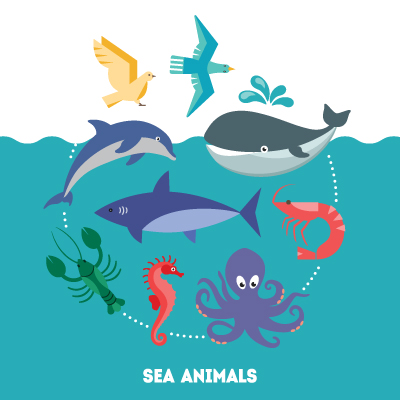
This includes water bodies such as; lakes, oceans, seas, rivers, which are home to amphibians, fish, sea creatures, and aquatic plants. Since 71% of the Earth’s surface is covered with water, the aquatic ecosystem is larger than the terrestrial ecosystem. An aquatic ecosystem is further classified into two categories namely; marine ecosystem and freshwater ecosystem. The marine ecosystem includes oceans and seas where sharks, seals, walrus, and other sea creatures thrive. The freshwater ecosystem is made up of rivers, lakes, ponds, and water bodies that are fresh or non-salted. The most common freshwater fish are; rohu, prawn, hilsa, and Indian carp, amongst others.

The Food Chain

A food chain is nothing but the transfer of energy in the form of food from one organism to the other. Green plants are capable of producing their own food with the help of photosynthesis. Hence, plants are classified as producers in the food chain. Humans and animals have to depend upon plants and other animals for their food, and hence this area is categorized as consumers. Decomposers such as fungi, bacteria, insects, break down the waste products and tissues of plants & animals which are absorbed in the soil and serve as nutrition to the plants. Hence the food chain is basically the unison between producers, consumers, and decomposers, providing nutrients to each other. The Food Chain can be further classified into three categories; grazing food chain, saprophytic or detritus food chain, and parasitic food chain.

What Students will learn with Carolina’s Building Blocks of Science® 3D: Life in Ecosystems (©2019) 1 Literacy set:

  • Students make models discover that organisms have unique and diverse life cycles, but what’s common amongst them is birth, growth, reproduction, and death.
  • Analyze data to find evidence that plants and animals have traits inherited from their parents and some variation of traits exists in a group of similar organisms.
  • Experiment and support evidence that traits can be influenced by the environment.
  • Analyze and interpret data from fossils to trace their existence long ago.
  • Find out why in a given habitat some organisms can survive well, others struggle to survive, and yet others perish.

Carolina has specially designed this kit for Grade 3 students and offers 5 lessons across 15 class sessions under the Building Blocks of Science® 3D unit Life in Ecosystems kit. Schools that follow the k-12 curriculum and IB culture benefit manifold from the kit and most institutes in GCC Countries in the Middle East avail the lab kits for students to practice hands-on lessons. The unit includes the following – a teacher’s guide, on-grade student readers, access to online digital resources, apparatus, and lab supplies sufficient for a class of 30 students, amongst other support materials.

To learn more about other such interesting Building Blocks of Science® 3D unit kits by Carolina for those in the UAE, including Dubai, head to our website.

Contact us

Basic Guide to Trying Your Hands at Animation

Basic Guide to Trying Your Hands at Animation

Basic Guide to Trying Your Hands at Animation 

When we hear the word animation, doesn’t it magically transport us into the imaginary world of our most loved characters? Thinking of some of our favorites like Aladdin, Alice, Chip and Dale, Cinderella, Donald Duck, Mickey Mouse, Peter Pan, and plenty more, they truly take us a trip down memory lane as we relive our childhood.

The world-renowned animator and the magnificent creator of these characters, Walt Disney once said, “Animation offers a medium of story-telling and visual entertainment which can bring pleasure and information to people of all ages everywhere in the world.” Animation does get one to dream and build a zillion illusions. 

So, what does it actually do that gets us fascinated? Animation is a technique in which still figures are made to move at certain frames per second that lead to an illusion of continuous motion. Earlier, animations were initially shown in analogue mode through TV and video players, and Flash and Gif techniques were used. Since the time animation has been invented, it has progressed by leaps and bounds and has evolved digitally.  

Now the electronic instruments play the animation in the digital mode. Presently, most of the animation work is done through CGI which is computer-generated imagery. 2D computer animation is used for low bandwidth and faster real-time renderings.

3D animation is much advanced and is done with a heavy amount of detailing. Usually, cut-outs of paper, clay figurines, and puppets are used and these objects in 2D and 3D are recorded and then played in a sequential manner.

The animation effect is applied to them by moving them in that desired sequence but the transition between the images is extremely quick and it is so fast that the human being cannot possibly make out that transition with the naked eye. Under the animation umbrella, there is tremendous more to learn such as animation through motion graphics, stop motion animation, collage imagination, rotoscoping, etc.

Animation is widely consumed in Dubai, UAE, in the Middle East and GCC countries, across the West and Asian zones, and basically almost across the globe mainly for entertainment purposes. Children are crazily excited when an animated show or movie is about to be released. Likewise, adults too love watching animated content.

Animation is a booming business and is present in areas of advertising, architecture, creative arts, education, engineering, entertainment, gaming, in scientific visualization, manufacturing, marketing, medicine, retail, simulations and many more.

Hence there are now a considerable amount of bright young people getting into animation to build their fantastic careers and further ignite their creative geniuses and churn out amazing creations. Does this give you a spark to explore and learn animation?

Firstly, let us get you acquainted with commonly used terms in animation which are:

1.      Timeline

This is the major element that depicts the animation’s progress with time and it largely depends on the software of the user that utilises the timeline to make changes to the timing used in the animation according to the placing of the objects.

2.      Frame Rate

This is an adjustable setting in any animation software but the usual animation is done in 24 frames per second which is better known as FPS. It is basically the number of images or frames that are shown over the period of that one second.

3.      Working on One’s and Two’s

The first is making a new drawing over every single frame of animation and the second is holding any drawing for two frames, so one second of animation at 24 frames per second would only be 12 drawings, not 24.

4.      Shots and Scenes

This refers to one specific continuous piece of animation in between camera cuts.

5.      Keyframes

These are also referred to as keys in the animation drawings which are important poses that define a particular scene.

6.      Breakdowns

These come between keys and define what the motion from key to key will be.

7.      In-betweens

These are all the frames that come in between to smooth out the motion.

8.      Timing

This means the total number of frames that will be used for a movement.

9.      Spacing

This is the amount of change that comes between each frame. Decreasing the spacing makes an object slower, while increasing the spacing makes it look faster.

10.  Easing

This is how spacing is controlled, usually through a motion graph on the timeline.

11.  Onion Skinning

This lets the animator see semi-transparent representations of the frames behind or ahead of the current frame one is working on.

12.  Compositing

It is the process of putting all the individual pieces of a scene together to create the final visual output.

Now let us look at the major guidelines in animation which are:

1.      Squash and Stretch

Squash means the object is getting compressed by an impact of an opposing force. Stretch means when the object is expanded by something pulling on it, or by moving quickly.

2.      Anticipation

This describes a smaller movement that comes before a major one, and signals that the major movement is going to happen.

3.      Staging

It is presenting the shot in such a way that makes the content of the shot as clear and strong as possible.

4.      Straight Ahead in opposition to Pose to Pose

Both use different approaches to animation. While the former means to create each new frame in a sequence from beginning to end and the latter means to create the key poses for each action first, and then filling in the in-between poses.

5.      Follow Through and Overlapping Action

Both of these refer to the tendency of different parts of an object to move at different speeds.

6.      Slow in and Slow Out

This refers to the nature of the objects to gradually accelerate and then decelerate when moving from one position to another.

7.      Arcs

Under the rule of arcs, it is usually understood that living things do not move in straight lines, but rather in a curved fashion. When the arcs are elegant and clear it uplifts the animated item and shows the proficiency level of the animator.

8.      Secondary Action

This refers to the smaller movements that make the shot clearer by laying emphasis on the goal behind the movement. They support the primary actions of an object.

9.      Timing

This controls the speed of the action through the number of frames that are used to represent it.

10.  Exaggeration

This represents an object in the most extreme manner rather than being realistic to the animation.

11.  Solid Drawing

In this step, the objects are positioned in such a way that it creates a sense of volume, weight, and balance.

12.  Appeal

This describes the qualities and design of the character that makes it riveting to watch.

‘TechnoKids’ integrates technology into the curriculum using technology projects. They have published a collection with ready-made lessons. Each project includes a teacher guide, a student workbook, and customizable resources. The instructional materials are ideal for computer instructors, classroom teachers, home school educators, media specialists, and librarians. They blend the project-based activities into an existing curriculum unit, combine technology projects to form a course or teach a set of lessons as part of a workshop series. In their senior curriculum for high school students, they have ‘TechnoAnimate’ as a program that helps to create an animated space story with Adobe Animate CC lessons which is animation for beginners. They use motion tweens, shape tweens, motion paths to make scenes come alive.

Contact us