
Learning to Write is Not Rocket Science

Learning to Write is Not Rocket Science

Learning to Write is Not Rocket Science

Reading and writing go hand-in-hand. When you read more, you can write well.

A website that is highly regarded in the Middle East and encouraged by most schools is the ‘Reading Eggs’ website. It is an online library of over 3000 books with comprehension quizzes at the end. It is a very popular platform, especially with most schools in Dubai as it recognizes that reading is an integral part of children’s development, and it facilitates the user by making it available anywhere and anytime. Reading Eggs uses facts based on scientific research and tools that suit every child’s interest. Using the Reading Eggs library is a good start for budding writers right from the age of kindergarten. It will help your children remain engaged and build a vocabulary that will help in the writing thought process.

Children from a very early age display emergent writing skills; from scribbling on walls in their toddler years to writing short paragraphs as soon as they can spell. You as parents can foster a writing habit by encouraging them with activities and tasks. Reading aloud to them, dancing to nursery rhymes and ensuring writing and coloring materials are freely available to them are a few things that one can easily do. Sharing their world and asking them questions will also fuel their imaginations and inspire their creativity.

Even if they haven’t learned how to write yet, you can help by writing what they narrate to you. It could be about their day at school, their visit to grandma or even to the local store.

Writing for children begins in stages.

The first is pictographs or visual representations of what they create in their minds. This is the pre-literate stage or the scribbling stage and forming of lines that almost resemble alphabets. At this stage applaud all and any efforts to write.

Ask them what their creation means and they will be excited to tell you the elaborate ideas and fantasies behind the simple artwork.

After steady progress at school with words and spelling, they graduate to the Emergent Stage where they are able to write words such as their name or mom and dad. At this point, they begin to associate the letters with sounds and their meanings. During this stage reading to your child proves to be helpful for him in recognising certain words. For instance, if he were to see the word dog over and over again in a book, he may learn it faster than any other and may also think about writing his own story about a dog.

After the Emergent stage comes the Transitional stage where they graduate to forming rudimentary sentences. Celebrate his writing and communication and ignore the grammatical errors he is bound to make. Encourage him to write more by making writing a part of his play, such as writing a menu card or stop and go signs for when he is playing traffic policeman.

Finally, all children will move on to the Fluent Stage where they will better their spelling and write anything between a few sentences to a short paragraph. Encourage them to write beyond a fictional story such as in a journal about their day, a letter or even a greeting card. It is okay for you to help share the writing work at this stage as some children think fast but write slowly. So offer assistance to alleviate any frustration creeping into their work.

Contact us

Fill in your details below or send us an email on info@knowledge-hub.com

What Exactly is Metaverse and Some Interesting Facts About It

What Exactly is Metaverse and Some Interesting Facts About It

What Exactly is Metaverse and Some Interesting Facts About It

We’ve heard and read about Metaverse in the news and all-over social media, but what exactly is it? In simple words, Metaverse is a world that is virtual. Any ideal scenario that you wish to adopt can be transported into Metaverse. It is in a 3D format, and you can take it as far as your imagination can soar. Even Facebook rebranded its name to Meta and made a huge announcement to enter the metaverse market.

Just as you would communicate with a friend in real world, in the Metaverse, an artificial Universe is created, allowing users to interact with their buddies and coded Characters or Avatars. This seemingly interesting parallel world is used for different purposes, such as, online gaming, education, and even for difficult training purposes.

Here are some fascinating facts about Metaverse:

  • According to stats, there will be a time in the near future (2026), when a quarter of our population will spend at least an hour daily in Metaverse by 2026.
  • Corporates will start selling their products to consumers vis Metaverse.
  • Facebook, the tech giant has already invested around $10 billion in the Metaverse business.
  • Metaverse has limitless potential and biggies like; Microsoft, and Google are setting a higher benchmark to evolve their own version of Metaverse.
  • They say marriages are made in heaven! Well, not anymore. Even marriages happen on Metaverse. Yes, this is for real! In India, a couple got married via the Yug Metaverse and many such events are underway to scale their social circle.
  • Dubai’s Ruler Sheikh Mohammed bin Rashid Al Maktoum declared that they are well on their way to creating a Metaverse ecosystem and the investment of $4 billion will be made by 2030. They also reported doubling the number of blockchain companies and creating 40,000 jobs.
  • There’s something called as Metaverse coins and just like you invest in Bitcoin, investors will find their share of profits by investing in this $800 billion industry (by 2024).
  • Sci-fi movies can be streamed on Metaverse World. And for this you do not need to invest heavily in any expensive device, simply buy a pair of VR headsets.
  • Another astonishing story is about Gucci – the Luxury Fashion Brand that everyone knows about. Gucci made a digitalized version of its most famous Signature Bag and auctioned it on Metaverse. And guess how much it got sold for? A whopping $4,115 is what it made. Would you pay that much to not even have a bag in your hand, but just own it virtually? Well, only time will tell where the world is heading!
  • What one experiences, becomes one’s reality! Binding this concept together, corporate training is now being preferred on Metaverse as the 3D phenomena offers a realistic scenario to employees or trainees who need the necessary induction and training. For example, if someone needs technical skills to perform work on heavy machinery, the Metaverse provides a safe space for trials without the fear of any hazards.
  • Conferences between different nations across the globe can take place virtually, all thanks to Metaverse. So, a summit between leaders of the Middle East can hold a conference with American delates, seamlessly without spending on travel.
  • The Covid-19 Pandemic did leave numerous countries devoid of tourism, including the GCC regions. What if another such scenario happens in the future? Is the tourism industry ready to take a big hit again? However, Metaverse is here to give tourists an authentic experience of a famous destination, before actually booking a ticket to get there. Similarly, hotels and 5-star luxury properties will benefit by putting up their project on exposure, so that guests get a feel of what it is like to experience such Luxury and get enticed to actually take the decision of booking the hotel for a night stay or a plot of land in UAE.

Now that you are aware of what Metaverse is and how technology is rapidly evolving, it is essential for Schools to catch up with changing times. Tech courses are not uncommon in IB Schools that abide by the STEAM curriculum. Technokids is one such learning platform that delves deep into teaching kids the basics of Computer Technology and even offers multiple projects to K-12 students to test their tech abilities. The biggest investment in your child’s future today would be gifting them courses on Technology so that they don’t feel left out when they Graduate from School.  

Contact us

Fill in your details below or send us an email on info@knowledge-hub.com

Tips to Follow While Giving Instructions to Children

Tips to Follow While Giving Instructions to Children

Tips to Follow While Giving Instructions to Children

The Parent-Child relationship is a partnership and a two-way street. All parents strive to teach their children good values and discipline. Effective parenting skills aid in filling up the generation gap. When the parent understands the balance between enforcing limits, and where to encourage and discourage, he displays positive parenting and reduces the distance between parent and child.

Every parent is as old as his child and grows and evolves with his child. Sometimes, it is easy for parents to slip into ennui as being a parent is no easy feat. But such things are easily remedied as there is nothing love and attention cannot fix.

However, sometimes despite your best efforts, you may hear from your school teacher that your child is having difficulty following instructions. Rest assured that it does not reflect on your parenting as children are intrinsically curious and have short attention spans. They want to explore so much in such little time. Dubai school teachers amongst others report that children tend to drift into fantasy worlds or have such an active imagination that they struggle to keep up with the speed of their thoughts. With gentle coaxing and conditioning, you can help them overcome this as following instructions within their everyday environment helps them to make friends, learn and stay safe.

When interacting with children it is best if we bend to or sit down at their level and maintain eye contact. This helps them feel connected. Use their name and keep the instructions short with minimal distractions around. Use minimal words with maximum effect. For eg: instead of saying “It’s 9 pm and time for dinner, let’s sit together and eat.” try saying, “It’s time for dinner now”. Too many instructions in a sentence confuse and distract the child and he ends up following none of them.

Keep instructions positive and do away with the negative ones. Instead of telling him what he cannot do, try telling him what he can do instead. Instead of saying “Don’t stand next to the window” try saying “Please, come sit on the couch with me” instead.

Using non-verbal cues and gesturing offers added help to your child to understand what you are asking of him. Pointing, hand gestures and facial expressions will cover the gap in your communication with your child. Children are visual learners so visual cues such as pictures or a colourful schedule will help them to understand what you need them to do.

Children also need to be taught that instructions must be followed the instant they are given. If you think that you can repeat it two or three times before they obey, then you are conditioning them to learn that they need to comply only after the first two requests. In the Middle East, this is something we tend to do unconsciously but have to keep in mind to avoid it consciously.

Interactive entertainment options available on every device in the home, make it difficult for the outdated games we used to play but it is up to us to ensure that screen-free time is not completely abandoned. A healthy balance of both will provide the best of both worlds to children who require physical activity, social skills, creativity, imagination, competition, and camaraderie.

As technology permeates every sphere of life in the UAE, with this too we have a technology-aided solution brought to you by Matatalab. Matatalab uses STEM learning to help students develop essential social-emotional skills with tools that require the use of devices as well as offline play and screen-free coding. To use Matatalab robots or the MatataBot, children need to step out of their comfort zones and work cohesively in groups while brainstorming and problem-solving. Through this, they also learn to follow instructions given not only by the teacher but to also listen to their peers as they collaborate. Working with Matatabots involves:

Decomposition which is breaking down the complex problem into smaller parts,

Pattern Recognition which involves finding similarities and differences,

Abstraction is where the child can ignore unimportant details and

Algorithms where you take calculated steps to meticulously solve problems.

With these four computational thinking skills, children can sharpen their listening skills.

Within the GCC countries, group activities with Matatalab, entail working together and building on productivity. The tasks usually involve having specific roles such as a leader and a speaker etc. Students learn how to cooperate with the group as a whole and be flexible and open to constructive feedback. This greatly influences their listening skills.

Contact us

Fill in your details below or send us an email on info@knowledge-hub.com

Introducing Children to Zoo Animals Is Now Made Magical, With The Newest- Rugs Alive

Introducing Children to Zoo Animals Is Now Made Magical, With The Newest- Rugs Alive

Introducing Children to Zoo Animals Is Now Made Magical, With The Newest- Rugs Alive

Technology has been embraced in so many ways and it has proved to be very beneficial and convenient. It has grown from strength to strength, especially in the field of education.

Online technology is reshaping the classroom experience. Teachers have new tools at their disposal which allow them to offer a quicker, standardised teaching experience to the children than pen and paper. Digitalization offers myriad options for tailor-made educational solutions for each student’s strengths and weaknesses, interests and pace of learning. These kinds of online tools make the learning environment flexible and less daunting for the child as learning is made fun with the use of characters and games and he can pick up from where he left off from school as well as home.

Augmented Reality is one such feature that is taking the education world by storm, especially in Dubai and becoming more and more popular in the learning experience for children. Visual cues have always led to a better understanding of the concept than just reading it in a textbook. Earlier videos were used with textbooks and now characters or environments are brought to life using virtual reality to give an almost real-life experience.

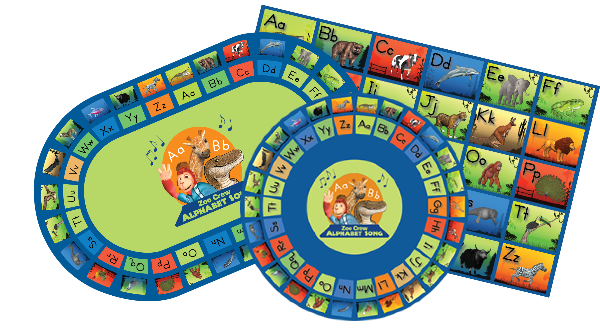
Alive Studios Zoo is a company run by Cynthia and Ron Kaye that has developed 3D-reality technology to create an unbelievable learning experience for early learners. This patented technology requires no 3D glasses to have the 3D experience. Their goal is to use technology to increase engagement and knowledge. Resources from Alive Studios are being used widely across America and even Middle East regions, have spread to 26 other countries worldwide. It is fast becoming one of the favoured apps for digital learning. An ingenious offering by Alive Studios Zoo is the Rugs Alive App. This app is created to help pre-schoolers in UAE with collaboration, communication, and concepts of STEM.

Rugs Aline is a colourful classroom rug that comes to life when paired with the Rugs Alive Mobile App. The Kit contains the Rug, Habitat cards for the animals and Magical Zoo Coins. Classroom rugs are available in different sizes and shapes to suit your classroom.

You will find 26 zoo animals on this rug with matching habitat cards and coins. You can download the mobile app on any device and bring to life these animals and learn about their habitat. All you need to do is scan the habitat card and you will find an augmented-reality version of the animal on the rug right in front of you. By scanning the Magical Zoo Coins, you can view a smaller version of the animal standing right on your palm. Children can learn about how this animal moves, what it eats and other various information about the animal. The most exciting part for the children is to be so close to the animal and take fun pictures with them. The rug also includes the alphabet song through which they can learn the alphabet. Rugs Alive entertainingly enlightens children and teaches them about animals and their habitats around the world, upper case and lower-case letters and collaborating with their peers over their findings. They can enjoy other STEM and SEL-related activities as well in the GCC region. This app is the perfect complement to other apps such as the Journals and Letters Alive app.

This app is found to have increased student attentiveness and involvement and encourages learning. Children are motivated to learn and are excited to be with the animals every day.

Contact us

Fill in your details below or send us an email on info@knowledge-hub.com

Traditional Games vs. Programming Games

Traditional Games vs. Programming Games

Traditional Games vs. Programming Games

Children all over the world including in the Middle East have grown up playing outdoor and indoor games with their friends or even alone. Children not only relax their minds while playing with their peers but also learn interpersonal skills, creativity, sporting skills and get good exercise. Earlier in Dubai, children spent at least 2 to 3 hours outside in the evenings playing games or simply tossing a ball around. Today, given the change in the climate children prefer to spend more time indoors and perhaps even play games on their devices or social media. Albeit, every child will enjoy playing the games that have entertained so many generations before, if they are taught how to play them. These traditional games elicit intellectual as well as physical growth and help them forge friendships that could last a lifetime.

Most of our favourite games do not need any special equipment barring the stray stone and a willingness to play. They usually do not require any adult supervision as they are safe apart from the occasional fall or bump.

Cops & Robbers, Hide & Seek, Dodgeball and Catch, are just some of the evergreen games that we have all enjoyed at a young age.

Learning coding through games can be fun and educational. A very popularly used online platform in the UAE to learn coding is CodeMonkey. This is an award-winning online platform that teaches kids real coding languages like ‘CoffeeScript’ and Python through block-based and text-based coding. CodeMonkey’s engaging game-like environment is specially designed by Jonathan Schor (Founder and CEO) for the K – 8 curriculum. Realizing the weight coding will carry into the next generation, the team of experts at CodeMonkey devised games such as Dodo does Math (where students will use a real coding language to solve diverse math puzzles and use code to help a Dodo bird find its eggs), Coding Adventure (where students can learn programming basics with the help of a greedy monkey and Wrap up the course with learned concepts that will be applied with logic and skill to complete tasks assigned.) and many more. The GCC countries favor Code Monkey as it facilitates parents, teachers, and kids alike and because it is a browser-based application that does not require the use of any special software or hardware except your personal device. It is easily accessible and affordable.

Because of these reasons, children now seem to deviate towards playing games on their devices rather than in the outdoors or board games. The visually appealing games on the computer lure young minds away from the traditional cardboard and plastic games. However, nowadays, these kinds of online games have evolved into learning-based applications which tie up with school curricula and offer players the opportunity to practice, learn, and compete in coding contests. Some platforms support over 25 programming languages such as CSS, CSS Flexbox, Scratch, JavaScript and much more. Unique tasks present challenges that allow you to become familiar with the language while at the same time enjoy learning it. Working your way through the different levels of the games, hone your tactical skills, critical thinking, and cognitive development.

Interactive entertainment options available on every device in the home, make it difficult for the outdated games we used to play but it is up to us to ensure that screen-free time is not completely abandoned. A healthy balance of both will provide the best of both worlds to children who require physical activity, social skills, creativity, imagination, competition, and camaraderie.

Contact us

Fill in your details below or send us an email on info@knowledge-hub.com