

What happens when students are given more than a textbook to learn technology?
They build.
They experiment.
They test ideas, solve problems, and create something of their own.
A STEM lab for schools can transform technology education from passive learning into an active experience where students explore concepts through real projects. This is the thinking behind TechnoKids Lab Studio—a practical learning environment designed to help students move from understanding technology to creating with it.
Why Schools Need Hands-On STEM Learning
Learning technology is no longer limited to understanding computer concepts or writing basic programs. Students are growing up in a world shaped by artificial intelligence, automation, IoT, software and connected devices.
To prepare them for this environment, schools need learning experiences that encourage students to ask questions and find solutions.
A well-designed school innovation lab gives students the opportunity to experiment safely, learn through trial and error, and develop skills that go beyond technical knowledge.
Instead of simply asking, “What is a circuit?” students can build one.
Instead of only learning programming concepts, they can create an application or game.
Instead of discussing artificial intelligence theoretically, they can experiment with AI-powered projects.
This shift from learning about technology to learning through technology is at the heart of effective STEM education.
What Can Students Do in a STEM Lab?
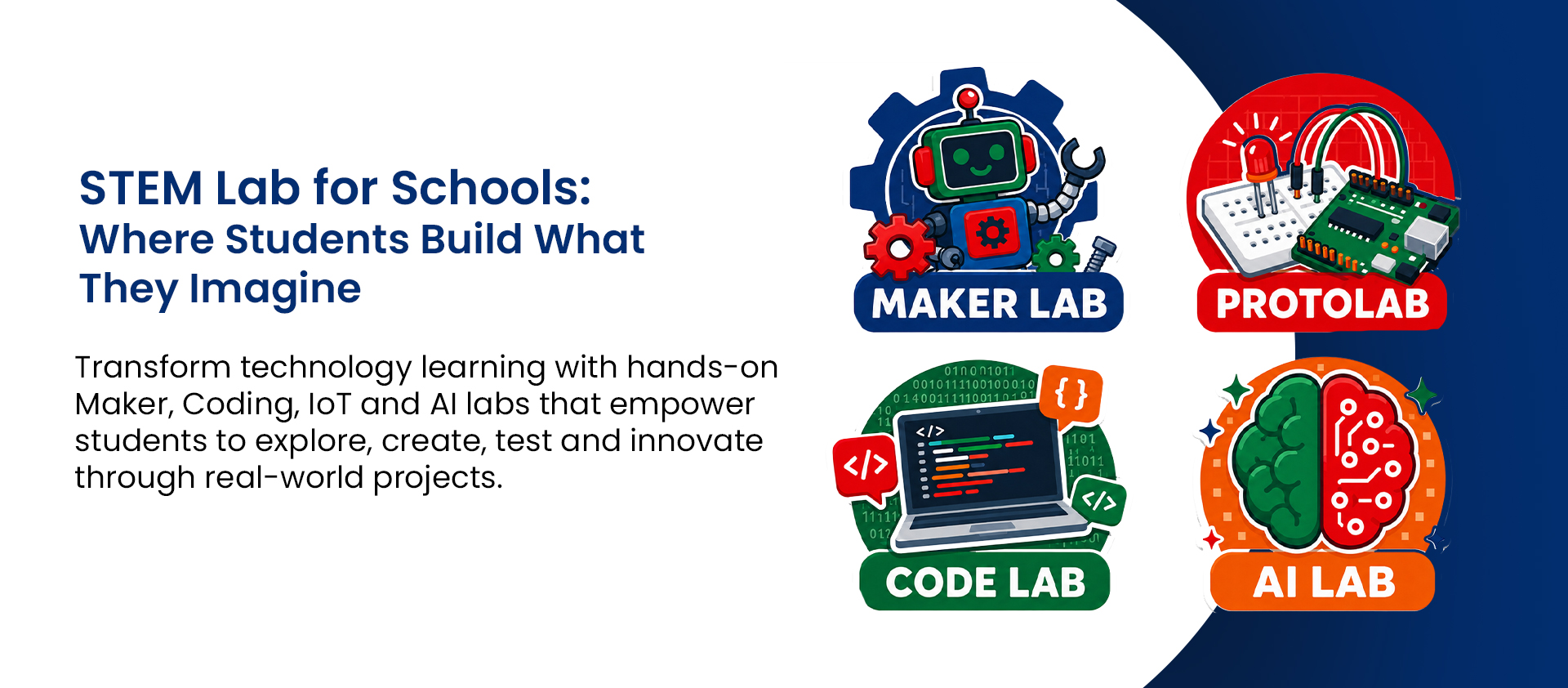
TechnoKids Lab Studio brings different technology experiences together through specialized learning environments, including Maker Lab, Proto Lab, Code Lab and AI Lab.
Maker Lab: Explore, Create and Build
The Maker Lab encourages students to turn ideas into physical projects.
Students can design hardware projects, explore sensors and smart devices, build virtual circuits and experiment with automation. They can test their ideas, identify what doesn't work and improve their designs.
This hands-on approach helps develop creativity, problem-solving and engineering thinking.
Proto Lab: From Design to Prototype
The Proto Lab takes experimentation further by introducing students to electronics, microcontrollers and IoT applications.
Students can design electronic circuits, program microcontrollers and work with sensors, motors and displays. They can test projects in real time and debug their work as they develop.
The experience introduces students to the process used in real-world technology development: design, build, test, and improve.
Code Lab: Turn Ideas into Software
Coding becomes more meaningful when students use it to create something they can see and interact with.
In the Code Lab, students learn programming fundamentals while developing websites, applications, games, simulations, and software projects.
More importantly, they learn that coding isn't simply about getting the right answer. It is about thinking logically, identifying errors, debugging, and continuously improving a solution.
AI Lab: Explore the Technology of Tomorrow
Artificial intelligence is becoming an important part of education and the future workplace.
The AI Lab provides students with opportunities to explore areas such as text, images, speech, machine learning, and neural networks.
Through AI-powered projects, students can begin understanding how intelligent systems work while developing the curiosity and critical thinking needed to use AI responsibly and creatively.
From Experimentation to Innovation
The real value of a STEM lab for schools is not just the technology inside it. It is the learning process that technology enables.
Students can follow a continuous cycle:
EXPLORE → CREATE → BUILD → TEST → IMPROVE → SHOWCASE
This encourages students to see mistakes as part of the learning process. A failed prototype isn't simply a failure—it becomes an opportunity to understand what happened, make changes, and try again.
That mindset is essential for innovation.
Building Future-Ready Skills
A practical technology environment can help students develop a combination of technical and transferable skills, including problem-solving, computational thinking, creativity, collaboration, experimentation, and communication.
When students design and present their own projects, they also gain confidence in explaining ideas and turning concepts into tangible outcomes.
For schools, this makes a STEM lab more than a technology room. It becomes a space where students can think like creators, work like problem-solvers, and learn like innovators.
Empowering Students to Build What They Imagine
The future of education isn't simply about giving students access to technology. It is about giving them meaningful opportunities to use it.
TechnoKids Lab Studio brings together making, prototyping, coding and artificial intelligence to create a learning environment where students can explore ideas and turn them into projects.
Because innovation doesn't begin when students are given the perfect answer.
It begins when they are given the opportunity to build.