

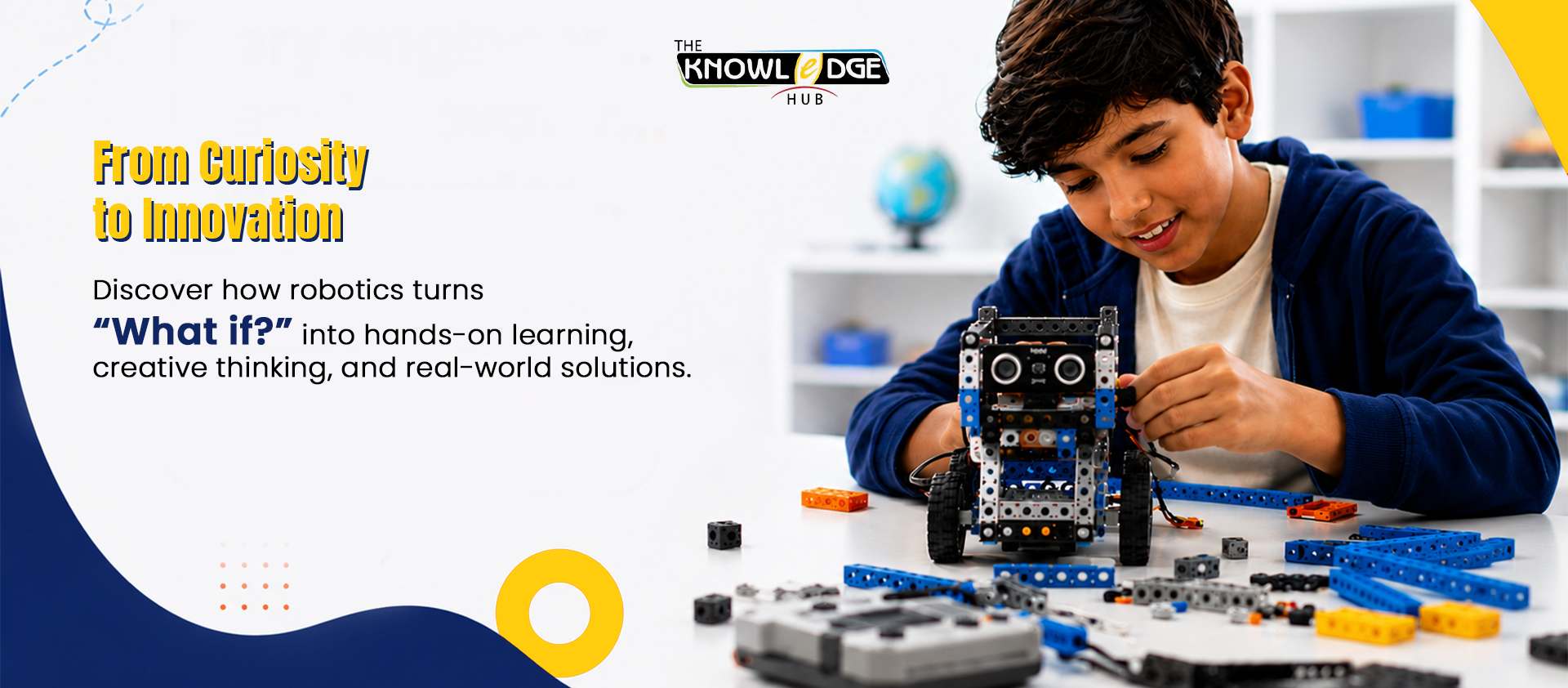
Every engineer, innovator, and inventor starts somewhere.
Often, it begins with a simple question:
“What if?”
What if a machine could solve this problem?
What if a robot could perform this task?
What if an idea could be turned into something real?
Curiosity is the foundation of innovation. When students are given the opportunity to explore these questions through hands-on experiences, learning moves beyond textbooks and becomes an opportunity to create, experiment, and solve.
This is where robotics education for students can make a meaningful difference.
By combining technology, engineering, creativity, and problem-solving, robotics gives students a practical environment where they can turn curiosity into action.
What Is Robotics Education?
Robotics education introduces students to the concepts and skills involved in designing, building, programming, and controlling robots.
But robotics in education is about more than building machines.
It encourages students to think critically, test ideas, identify problems, make improvements, and learn from failure. Students can move from simply asking questions to developing solutions.
This makes robotics a powerful component of modern STEM education.
Why Is Curiosity Important in Robotics Learning?
Curiosity encourages students to explore instead of simply accepting information.
When students encounter a robotics challenge, there may not be one obvious answer. They have to ask questions, experiment with different approaches, and determine what works.
For example, a student may ask:
- How can I make this robot move faster?
- Why isn’t the robot following the instructions?
- How can I make it avoid an obstacle?
- Can I redesign it to perform the task differently?
Each question becomes an opportunity to learn.
Instead of seeing mistakes as failures, students begin to understand them as part of the process of discovery.
How Robotics Education Develops Problem-Solving Skills
One of the biggest benefits of robotics education is its ability to turn abstract concepts into practical challenges.
Students are often required to:
- Understand a problem
- Develop an idea
- Build or program a solution
- Test the solution
- Identify what went wrong
- Make improvements
- Test again
This process develops persistence and structured problem-solving.
Students learn that complex challenges rarely have an immediate solution. They need to analyse, adapt, and try again.
These are skills that extend far beyond the robotics classroom.
Robotics Connects STEM Concepts to Real-World Applications
Science, technology, engineering, and mathematics can sometimes feel abstract when taught only through theory.
Robotics provides students with a way to see these concepts in action.
For example, students may use:
- Science to understand movement, forces, and energy
- Technology to explore sensors, programming, and digital systems
- Engineering to design, build, and improve solutions
- Mathematics to understand measurements, patterns, angles, and calculations
This integrated approach makes STEM robotics for schools a valuable way to connect classroom learning with real-world applications.
Robotics Encourages Creativity and Innovation
Robotics is not only about following instructions.
The most engaging robotics activities encourage students to design their own solutions.
Two students may receive the same challenge but develop completely different approaches. They can experiment with different designs, mechanisms, code, and strategies.
This creates an environment where creativity and technical thinking work together.
Students begin to understand that innovation isn’t simply about having a great idea. It is about taking that idea, testing it, improving it, and turning it into something that works.
Learning Through Experimentation
Hands-on learning can make educational experiences more memorable.
When students physically build, program, test, and modify a robot, they become active participants in the learning process.
They can immediately see the relationship between their decisions and the outcome.
If the robot doesn’t work, students can investigate why.
If it works, they can ask how it could be improved.
This cycle of build → test → learn → improve encourages a growth mindset and helps students become more confident problem-solvers.
Robotics Helps Prepare Students for the Future
Technology is rapidly changing the way people live and work.
Automation, artificial intelligence, robotics, and digital technologies are becoming increasingly important across industries.
Students don’t necessarily need to become professional roboticists or engineers. However, developing an understanding of technology and computational thinking can help them become more confident in a technology-driven world.
Robotics education can help develop skills such as:
- Critical thinking
- Computational thinking
- Creativity
- Collaboration
- Communication
- Problem-solving
- Logical reasoning
- Persistence
- Design thinking
These transferable skills can support students across many future academic and career pathways.
The Role of Schools in Building Future Innovators
Schools have an important role to play in creating environments where students feel comfortable asking questions and exploring possibilities.
Providing access to robotics and STEM learning can give students opportunities to move from passive learning to active creation.
A well-designed robotics programme can encourage students to ask:
“Why does this happen?”
Then:
“How can I change it?”
And eventually:
“What can I create?”
That progression—from curiosity to experimentation to creation—is at the heart of innovation.
Robotics Education in the UAE
As schools in the UAE continue to strengthen STEM, technology, and future-skills education, robotics can play an important role in creating engaging, hands-on learning experiences.
Schools can introduce robotics through classroom activities, STEM programmes, innovation labs, coding sessions, competitions, and project-based learning.
The goal is not simply to teach students how to build a robot.
It is to help them develop the confidence to explore problems, test ideas, collaborate with others, and create solutions.
From “What If?” to “What’s Next?”
Innovation begins with curiosity.
A student who asks “What if?” today could become the engineer, designer, researcher, entrepreneur, or technology leader who asks “What’s next?” tomorrow.
Robotics provides students with a space to explore that journey.
Through hands-on robotics and STEM learning, schools can transform curiosity into experimentation, experimentation into understanding, and understanding into innovation.
At Knowledge Hub, we empower schools with hands-on robotics and STEM solutions designed to engage students, develop future-ready skills, and inspire the innovators of tomorrow.
Because every great invention starts with a question.
And sometimes, that question is simply: “What if?”
Conclusion
Robotics education gives students more than technical knowledge. It gives them the opportunity to think, create, experiment, collaborate, and solve problems.
By encouraging curiosity and providing hands-on opportunities to explore ideas, schools can help students develop the mindset and skills needed for a rapidly changing future.
The next generation of innovators may already be sitting in your classroom.
All they need is the opportunity to ask the question—and start building the answer.