

Introducing Engaging Science Activities To Predict Motion

Introducing Engaging Science Activities To Predict Motion

Engaging Science Activities To Predict Motion

In the vast realm of engaging science activities, prediction reigns supreme. It’s the bridge between observation and understanding, the cornerstone of experimentation and discovery. And when it comes to motion, the ability to predict an object’s future path isn’t just a scientific skill; it’s a fundamental cognitive ability ingrained into the fabric of our daily lives.

From judging a thrown ball’s trajectory to anticipating traffic on the road, we constantly engage in this mental exercise. It’s an unconscious process honed through experience, but understanding the underlying principles elevates prediction to a powerful tool for scientific exploration.

Why is predicting motion so crucial in science?

Think of it as a story. We observe the “scene” – the object’s initial position, the forces acting upon it (pushes, pulls, friction, gravity) – and use our knowledge of physics to piece together the puzzle. We solve the mystery by predicting the object’s future motion, validating our understanding of the forces at play.


This act of prediction serves several critical purposes:

  • Deepens conceptual understanding: Formulating and testing predictions forces us to delve deeper into the underlying physics principles. It solidifies our grasp of concepts like momentum, inertia, and acceleration through engaging science activities.
  • Fosters critical thinking: Predictions are rarely perfect. Analyzing discrepancies between predicted and observed motion leads to critical thinking, encouraging students to question assumptions and evaluate evidence.
  • Sparks curiosity and inquiry: The thrill of making predictions through engaging science activities and witnessing the outcomes ignites curiosity. It motivates students to ask further questions, design new experiments, and delve deeper into the world of motion.

How does LEGO® Education BricQ Motion Essential cultivate this crucial skill?

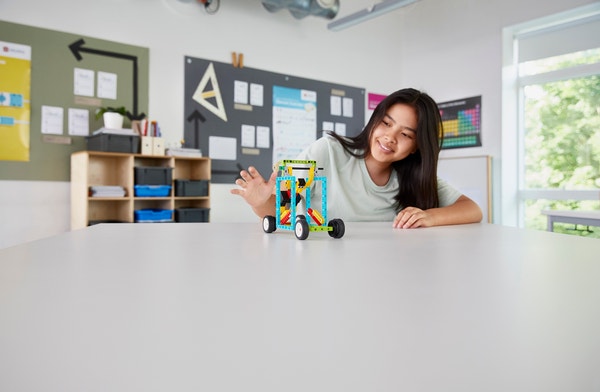
This innovative LEGO® Education curriculum goes beyond rote learning, transforming classrooms into dynamic hubs for hands-on exploration. By engaging students in building, experimenting, and analyzing the motion of their LEGO® creations, the following is possible with BricQ Motion Essential:

  • Provides a tangible learning experience: Students aren’t just memorizing formulas; they’re physically experiencing forces like friction and gravity through their LEGO® models.
  • Encourages inquiry-based learning: The curriculum fosters a spirit of investigation, guiding students to ask questions, conduct engaging science activities, and collect data. This active involvement empowers them to take ownership of their learning and make connections between observations and predictions.
  • Integrates predictive modeling: Students don’t just observe; they actively predict! They analyze past motion patterns, identify relevant forces, and use their understanding to predict future trajectories and stopping distances or even design their own LEGO® creations for optimal performance.

The impact extends far beyond the classroom:

The skills honed through LEGO® Education BricQ Motion Essential set to transcend the realm of science, equipping students with valuable tools for life:

  • Problem-solving prowess: By predicting outcomes and analyzing discrepancies, students develop the ability to approach challenges systematically and anticipate potential solutions.
  • Critical thinking edge: They learn to question assumptions, evaluate evidence objectively, and adapt their thinking based on new information – skills essential for success in any field.
  • Confidence and agency: The act of making predictions on engaging science activities fosters a sense of empowerment and self-belief, encouraging students to take ownership.

In conclusion, predicting motion isn’t just a scientific pursuit; it’s a gateway to critical thinking, problem-solving, and a deeper understanding of the world around us. With LEGO® Education BricQ Motion Essential, elementary students can embark on this exciting journey, transforming LEGO® creations into springboards for scientific discovery and growth. So, unleash the power of prediction in your classroom and watch your students become not just scientists in the making but confident thinkers and lifelong learners, prepared to tackle any challenge the future holds.

Contact us

Fill in your details below or send us an email on info@knowledge-hub.com

Best AI Courses for Beginners with Transparent Licensing

Best AI Courses for Beginners with Transparent Licensing

Best AI Courses for Beginners with Transparent Licensing

AutoAuto emerges as a groundbreaking platform in the dynamic realm of education, offering one of the best AI courses for beginners. Tailored for students from 3rd grade to college levels, AutoAuto delivers over 180 hours of interactive lessons and projects. This innovative approach allows learners to engage actively in AI, honing their programming skills and experimenting with virtual AutoAuto cars. The platform’s design facilitates learning at various levels and provides a hands-on experience that is invaluable for beginners venturing into the exciting world of Artificial Intelligence (AI) and Computer Science (CS).

Q: What is AutoAuto, and who is it designed for?

Ans: AutoAuto is an innovative platform designed for students from 3rd grade to college. It brings AI and Computer Science education to life through over 180 hours of interactive lessons and projects across schools in Dubai and other Middle Eastern regions.

Q: What are the advantages of AutoAuto’s fully virtual course?

Ans:

  • Accessibility: AutoAuto requires no hardware, making it cost-effective and eliminating geographical limitations.
  • Safety: Virtual environments allow risk-free experimentation, ideal for beginners and young learners.
  • Scalability: Large groups can engage simultaneously in collaborative activities.
  • Flexibility: Students can learn at their own pace, anytime, anywhere, with the option to replay lessons and rewind simulations.
  • Focus on the Core: Without hardware setup, students can concentrate on understanding core concepts and honing programming skills.

Q: How does AutoAuto’s virtual learning platform work?

Ans: Students eager to embark on one of the best AI courses for beginners can seamlessly register on the AutoAuto Learning Platform at labs.autoauto.ai. Within this virtual space, they gain entry to a private cohort, immersing themselves in personalized, self-paced learning enriched with individualized content, collaborative projects, and stimulating challenges. The platform’s unique feature lies in its direct connection with physical AutoAuto cars through Wi-Fi, enabling students to implement their coding skills directly from their personalized learning accounts. This distinctive blend of accessibility and hands-on experience makes AutoAuto a top choice for beginners exploring the exciting realms of Artificial Intelligence.

Q: What is included in the physical AutoAuto car kit?

Ans: Each meticulously crafted physical AutoAuto car kit, an integral component of one of the best AI courses for beginners, boasts essential features. This package includes a long-lasting battery and charger, providing up to 4 hours of uninterrupted exploration. Backed by a 6-month warranty, students receive the hardware and a range of accessories for diverse projects – from cones to pedestrian figurines, a stop sign, and colored paper for engaging color detection projects. With car color options like Blue, Red, or Green, this comprehensive kit elevates the learning experience, offering functionality and creativity to beginners delving into the fascinating world of Artificial Intelligence.

Q: How can educators track student progress on the AutoAuto Learning Platform?

Ans: AutoAuto’s commitment to facilitating seamless education extends to educators through a dedicated teacher’s portal. This robust platform empowers teachers to track and manage student progress, streamline assignment grading processes, and maintain efficient classroom management. With intuitive tools, educators can ensure a personalized and practical learning experience for each student, enhancing the impact of AutoAuto as one of the best AI courses for beginners.

Q: How long does it take for students to complete each unit on AutoAuto?

A: The student-centric design of AutoAuto ensures an engaging learning experience, with an average completion time of approximately 4 hours per unit. However, this timeframe remains flexible, accommodating variations based on individual student backgrounds, prior experience, and the inherent complexity of each learning unit. Such adaptability contributes to AutoAuto’s effectiveness as one of the best AI courses for beginners, catering to diverse learning styles and pacing preferences.

Q: Is any training available for educators to start with AutoAuto?

A: AutoAuto goes the extra mile in supporting educators by providing comprehensive resources. This includes teacher onboarding training, ensuring instructors can harness the platform’s capabilities. Additionally, free bi-annual live professional development sessions are scheduled to keep educators abreast of the latest advancements. For schools seeking a tailored approach, private training options are also available.

Q: How are security measures implemented on the AutoAuto device to prevent unauthorized access and tampering?

A: Security measures include unique device passwords, encrypted and delayed secure shell access, one-shot entropy codes for pairing, and unprivileged user accounts for student code, limiting write access. Physical security is the responsibility of the device owner.

Q: Can licenses be reset yearly, and how can educators check the number of available licenses?

A: AutoAuto maintains transparency in licensing, clarifying that licenses cannot be reset annually. To keep educators informed, the platform provides a user-friendly feature: by clicking on the star symbol, situated to the right of the gear symbol, instructors can easily access and review the number of available unused licenses.

Q: Does AutoAuto provide an optional physical upgrade for students seeking hands-on experience?

A: Yes, for those who crave hands-on experience, AutoAuto offers a physical car add-on. This allows students to bridge the gap between the virtual and real world, applying their learned programming skills to a tangible robot car.

In conclusion, AutoAuto stands as one of the best AI courses for beginners, offering accessible learning experiences for students from 3rd grade to college levels. The fully virtual course provides numerous advantages, including accessibility, safety, scalability, flexibility, and a focus on core concepts. The platform’s unique way of delivery combines virtual lessons with the option of a physical AutoAuto car kit for a hands-on experience. With personalized learning, collaborative projects, and a robust teacher portal for tracking progress, AutoAuto exemplifies innovation in education, preparing students for the future of technology and programming.

Contact us

Fill in your details below or send us an email on info@knowledge-hub.com

Interesting Artificial Intelligence Projects for Students with TechnoFuture

Interesting Artificial Intelligence Projects for Students with TechnoFuture

Interesting Artificial Intelligence Projects for Students with TechnoFuture

Are you ready to guide middle school students on an educational journey into AI-powered possibilities? Enter TechnoFuture by TechnoKids, an innovative science fiction project designed to empower students to envision the impact of Artificial Intelligence on daily life. In this blog, we’ll explore how TechnoFuture seamlessly blends interactive storytelling with cutting-edge tech, providing hands-on Artificial Intelligence projects for students of middle school grades. The project goes beyond traditional teaching methods, offering a dynamic and engaging learning experience.

Interactive Storytelling Meets Cutting-edge Tech:

Picture middle school students crafting a ‘choose-your-own-adventure’ story within a world brimming with AI wonders. Each decision unfolds a unique and personalized experience through interactive buttons guiding their choices. TechnoFuture melds creative storytelling with the exciting world of AI, sparking curiosity and igniting young minds.

Hyperloop Adventure-Navigating AI Horizons: 

Here’s an example of the fun adventure’s students can create in the TechnoFuture project. Imagine our young storytellers diving into a Hyperloop Adventure, facing a unique commuting choice with two AI-driven options. Imagine zipping through a super-fast tube to school or cruising on a hoverboard! Participants are free to pick their super cool commute and craft the story according to their choice! Zoom in a flash with the Hyperloop Express, but the AI may predict some safety issues. Or glide on your hoverboard with amazing views, but watch out for unexpected weather! Every choice leads to a different adventure, showing how AI could change our travel. This scenario is a good example that can be integrated as a narrative while working on artificial intelligence projects for students.

Hands-on Exploration of AI:

TechnoFuture goes beyond passive learning by motivating students to research emerging AI technologies in real-time. From intelligent assistants to self-driving cars, students incorporate these innovations into their stories, inventing futuristic gadgets and solutions. This practical approach fosters critical thinking, problem-solving, and a deeper understanding of AI’s potential impact. Imagine a world where you can chat with your dog using a talking dog translator, decoding your furry friend’s thoughts. Envision a personalized news feed that tailors stories specifically to your interests. The possibilities are limitless, and your imagination has no bounds! In TechnoFuture, students bring such futuristic ideas to life, which makes it an ideal choice for artificial intelligence projects for students.

Beyond the Traditional Canvas: Unleashing Creativity:

TechnoFuture empowers students to unlock their creativity through innovative tools like PowerPoint or Google Slides. As designers, they craft visually stunning story slides adorned with captivating images, dynamic videos, and even immersive sound effects. This project encourages students to express their unique visions and enables them to translate their stories into a presentable format. By utilizing these platforms creatively, students develop essential digital literacy skills and gain first-hand experience in blending visuals through technology. This immersive approach makes TechnoFuture an ideal platform for artificial intelligence projects for students, turning their imaginative ideas into multimedia adventures that come to life.

A Treasure Trove of Resources for Educators:

TechnoFuture offers educators a comprehensive learning experience with many resources, including a teacher guide, student workbook, assessment tools, and extension activities. This holistic approach ensures a seamless implementation, providing clear instructions, engaging activities, and valuable assessment tools to gauge student progress in artificial intelligence projects for students effectively.

Key Benefits of TechnoFuture:

  • Develop crucial 21st-century skills: Critical thinking, problem-solving, creativity, collaboration, and digital literacy.
  • Deepens understanding of AI: Students explore AI technology’s real-world applications and potential impact.
  • Boosts engagement and motivation: The interactive storytelling format and futuristic theme captivate students’ attention.
  • Promotes self-expression and communication: Students develop storytelling skills and learn to communicate their ideas effectively.
  • Effective teamwork: TechnoFuture encourages students to collaborate in crafting stories, fostering essential collaboration and communication skills.

Ready to Get Started?

TechnoFuture, available in Dubai and other Middle East regions, invites educators to embark on a journey into the future. Visit TechnoKids Computer Curriculum to explore more about TechnoFuture and bring the power of AI storytelling to your classroom!

Additional AI Project Ideas:

Looking for more Artificial Intelligence projects for students? Here are a few ideas to explore:

  • Build a chatbot: Create a simple chatbot that answers questions or provides information.
  • Develop an AI-powered game: Design and code a game that uses AI for opponents or challenges.
  • Analyze data with AI: Use AI tools to analyze real-world data and draw conclusions.

Educators, be mindful that the opportunities in AI projects for students are limitless. Now, are you ready to transform your classroom into a space where young futuristic visionaries explore the realms of AI-powered learning?

Contact us

Fill in your details below or send us an email on info@knowledge-hub.com

How to Conduct Creative Math Activities With LEGO® Coding Express Set

How to Conduct Creative Math Activities With LEGO® Coding Express Set

How to Conduct Creative Math Activities With LEGO® Coding Express Set

In the dynamic landscape of early childhood education, integrating technology and play can transform abstract concepts into tangible learning experiences. This blog dives into an engaging lesson plan that utilizes the Coding Express app by LEGO® Education to teach young minds about measuring distance, comparing lengths, and applying basic math concepts. The focus here is not just on numbers or creative math activities but also on hands-on exploration and collaboration. In the dynamic landscape of early childhood education, integrating technology and play can transform abstract concepts into tangible learning experiences. This blog dives into an engaging lesson plan that utilizes the Coding Express app by LEGO® Education to teach young minds about measuring distance, comparing lengths, and applying basic math concepts. The focus here is not just on numbers or creative math activities but also on hands-on exploration and collaboration.

‘Math – Distance’ Lesson Plan by LEGO® Education Coding Express Set

Learning Objectives:

  • Understand the concept of measuring distance.
  • Compare and contrast different distances.
  • Apply basic math skills in a coding context.

Setting the Stage for Learning:

The lesson starts with an engaging discussion focused on the concept of distance. Let’s take a moment to chat about something familiar – our journeys to school! How did you get here today? Was it a walk, a bike ride, or maybe a bus trip? Let’s explore why individuals opt for different modes; perhaps walking lets you enjoy the fresh air while a bus whisks you away quickly. Drawing parallels with the varying distances between walking and bus rides sets the stage for the day’s exploration.

Engaging in a Classroom Game:

The lesson incorporates a game to make the learning experience even more enjoyable. Teachers take the lead in designating specific spots in the classroom as “train stops” and encourage students to walk between them, counting their steps. This hands-on activity introduces the idea of measuring distance and sets the stage for comparing lengths.

Exploration with LEGO® Bricks:

The heart of the activity involves students working together to build models using LEGO® bricks. First, they team up to construct interesting train models and a special track with two ends. Then comes the exciting part – the Coding Express app, which is available in Dubai and other regions across the world! Use it to control the train and watch it zip and zoom along the track. But there’s a twist! To reach each train station, students need to choose the right numbers in the app. It’s akin to a puzzle that needs to be figured out, adding an element of fun to creative math activities. This magical app helps children understand how far the trains can travel, which sets the base for learning the concept of distance. So, get ready to build, experiment, and solve puzzles with your friends on this LEGO® Coding Express train adventure!

Encouraging Creativity and Exploration:

After mastering the train stations, the fun explodes! Build extra stops wherever students want, deciding how far apart they are – a quick bakery hop or a beach adventure? Become the train conductor, narrating your journey: where it started, which stops it passed, and its final destination. Did it cross bridges or zoom through tunnels? Let your student’s imagination run wild, and describe the whole adventure! This open-ended play sparks creativity, spatial awareness, and storytelling skills, serving as a prime example of creative math activities, all while solidifying your understanding of distance and how far your train can travel!

Assessment through Guided Questions:

Teachers will ask some fun questions to ensure everyone’s on the same track! They’ll want to know if children can remember the train’s order at each stop, just like telling a story. They’ll also ask the participants to ponder & infer where the train might go next and if one stop is closer or farther than another. Don’t worry; these questions help students understand how far the train travels and ensure they have the best train adventure ever!

More Ideas for Future Lessons:

Envision an added dose of excitement with more numbers! Picture extending tracks to explore greater distances, reaching destinations like mountains, forests, or neighboring towns. By constructing longer tracks, educators can introduce larger numbers in the app, observing their impact on how trains travel extended distances. Initiating discussions about comparing journeys becomes a key element, with questions such as, “Whose train covered the longest distance?” or “How many numbers were needed to reach the mountain?” This adaptability, essential for engaging in creative math activities, empowers educators to tailor subsequent lessons to the evolving needs of their students.

Objectives achieved:

  • Vocabulary Expansion: While the plan mentions introducing terms like “measure” and “step,” consider incorporating additional distance-related vocabulary like “near,” “far,” “short,” and “long” for richer understanding.
  • Assessment Variety: In addition to observation, consider incorporating short exit tickets or quick quizzes that align with creative math activities to assess individual student comprehension of key concepts.
  • Real-World Connections: The lesson could benefit from expanding on the real-world applications of distance measurement, perhaps by discussing distances during outdoor play class.

The ‘Coding Express Math Adventure’ provides an engaging approach to teaching distance, comparison, and basic math skills through a blend of technology, hands-on activities, and discussions, fostering a holistic learning experience. LEGO® Education’s Coding Express app, a beloved classroom companion, not only introduces coding concepts but also reinforces fundamental math principles through creative math activities. Ultimately, this lesson exemplifies how play, exploration, and technology converge to create a memorable and enriching learning journey for young minds.

Contact us

Fill in your details below or send us an email on info@knowledge-hub.com

How To Explore Chain Reactions with LEGO® Education’s STEAM Activities

How To Explore Chain Reactions with LEGO® Education’s STEAM Activities

Exploring Chain Reactions with LEGO® Education’s STEAM Activities

In the intricate tapestry of science, a chain reaction emerges as a captivating phenomenon. It’s a domino effect, where one event, much like a gentle nudge, triggers a cascade of subsequent events. This self-perpetuating sequence can intensify and expand, weaving its magic across vast arenas, be it the explosive energy unleashed in a nuclear reaction or the delicate interplay of molecules during a chemical transformation. Chain reactions are the hidden engines powering some of nature’s most awe-inspiring displays, reminding us of the interconnectedness and dynamic nature of our world. Incorporating this concept as one of the STEAM activities unveils the nature of scientific processes, making learning an awe-inspiring journey across various disciplines.

Introduction to Chain Reaction module:

Explore the world of cause and effect with LEGO® Education’s STEAM Park’s ‘Chain Reaction’ module designed for early learners. Through STEAM activities, students dive into the concept of chain reactions via a captivating story, sparking hands-on exploration.

Lesson Overview:

  1. Connect: Begin by showing an inspirational photo of the Free Fall ride and encouraging students to describe what they see. Introduce the concept of cause and effect by reading a story about two adventurous characters experiencing a chain reaction on the ride.
  2. Construct: In pairs, students are tasked with creating their own chain reactions. They are prompted to think about how an event can trigger another event without direct contact. Inspiration photos are provided to guide their creativity. Students can build separate components and combine them to form a complete chain reaction.
  3. Contemplate: After constructing their chain reactions, students share their creations with the class. Encourage discussion by asking questions such as what triggered the first event, what was the first event, and if their chain reaction unfolded as predicted. This step promotes critical thinking and reflection.
  4. Continue: Take the lesson further by having students combine their chain reactions into one long sequence. Assign a designated area in the classroom for assembling and testing the collective chain reaction. Students can draw and number the events for a visual representation.

Tips for Teachers:

We advise teachers to consider the following tips before commencing STEAM activities in class:

  • Pre-teach Vocabulary: Ensure students understand key terms like cause, trigger, effect, chain reaction, and sequence of events.
  • Differentiate Instruction: Consider students’ diverse abilities and backgrounds when introducing and differentiating lesson content.
  • Encourage Collaboration: Emphasize teamwork during the construction phase of the STEAM activities, promoting collaboration and communication skills.

Observation Checklist:

To assess student progress, use the following checklist:

  • Does the investigation plan include a method for observing and collecting data about the strength and directions of pushes and pulls in the chain reaction?
  • Can students predict the effect of a push or pull on an object?
  • Are students able to describe the object(s) that move without being touched and explain the cause of the push or pull?
  • Do students use positional words when describing events in the chain reaction?

By immersing students in the world of chain reactions through a captivating story and hands-on activities, the STEAM activities-based lesson plan not only introduces the concept of cause and effect but also encourages creativity, collaboration, and critical thinking. The culmination of combining individual chain reactions provides a dynamic and interactive learning experience, making STEAM Park by LEGO® Education an exciting destination for young minds across schools in Dubai and other regions of the world.

Contact us

Fill in your details below or send us an email on info@knowledge-hub.com

Learn to Code By Exploring Simple Frontend and Backend Development Tips

Learn to Code By Exploring Simple Frontend and Backend Development Tips

Learn to Code By Exploring Simple Frontend and Backend Development Tips

Introduction: In the realm of app development, two integral components collaboratively ensure a seamless user experience: the frontend and the back end. The frontend represents the visible user interface, while the back end operates behind the scenes, functioning as the engine propelling the app’s operations. Aspiring developers and students looking to learn to code can gain a comprehensive understanding of both frontend and backend processes, unlocking the key to creating user-friendly and functional applications.

Frontend Development:

Frontend development focuses on crafting the user interface (UI) that users directly interact with, providing an excellent opportunity for individuals looking to learn to code. Developers employ specialized languages such as HTML, CSS, and JavaScript, using these tools to structure content, control aesthetics, and introduce interactivity. Beyond aesthetics, frontend developers prioritize usability, aiming to create an intuitive and responsive UI across various devices. Frameworks like React, Vue.js, and Angular streamline development and ensure consistency, extending the applicability of frontend development beyond websites to include mobile apps, desktop applications, and smart TV interfaces. Frontend Development is a rapidly Evolving Field:

  • Frontend development is not just about appearance; it emphasizes usability and responsiveness.
  • The global frontend development market is expected to reach $262.9 billion by 2026.
  • JavaScript is the most popular programming language in the world, used by over 70% of developers.
  • 47% of users judge a company’s credibility based on its website design.
  • 88% of online shoppers abandon a purchase if they have a poor user experience.

Backend Development:

In contrast, backend development, crucial for those aiming to learn to code, operates as the hidden infrastructure, handling data processing, user requests, and database interactions. Backend developers are fluent in server-side languages like Python, Java, and PHP. They design and manage databases, safeguarding user data through robust security measures. APIs (Application Programming Interfaces) serve as messengers, enabling seamless communication between different systems. Backend development ensures the reliability and security of an app’s operations. The Dynamic Landscape of Backend Development:

  • Python is the most popular backend programming language, used by 41% of developers.
  • 85% of organizations adopt a multi-cloud strategy, requiring backend developers with cloud expertise.
  • Cybersecurity threats are increasing, making security a top priority for backend development.
  • The key responsibility of the developer is to write codes that handle user requests, process data, and interact with other systems.

Integration:

Frontend and backend function as integral partners, collaborating to deliver a cohesive app experience. When users interact with the front end, such as tapping buttons or scrolling, a request is sent to the back end. The backend processes the request, ensuring data integrity, and returns the information for the front end to display. Understanding this intricate correlation is essential for those looking to learn to code, as it unveils the synchronized nature of frontend and backend development in creating a seamless app experience. Why Both Matter: Both frontend and backend development are indispensable for a well-functioning app. The front end ensures visual appeal and user-friendliness, while the back end manages complex operations, safeguarding data integrity and facilitating smooth functionality. The synergy between these two components is critical for delivering a flawless app experience. Understanding frontend and backend development is essential for those looking to learn to code, as it provides insight into the collaborative nature required to create a seamless app experience.

Additional Insights:

Full-stack developers possess frontend and backend development skills, allowing comprehensive contributions across an entire app.

AutoAuto: Revolutionizing Education with Self-Driving Cars and Coding Mastery

AutoAuto is spearheading a transformation in Computer Science and Artificial Intelligence education by integrating self-driving cars into the classroom. The revolutionary curriculum, spanning 180+ hours, caters to students from the 3rd grade through college, providing hands-on project-based learning intricately tied to both physical and virtual cars. This innovative platform, featuring a browser-based interface, video-based content, and auto-graded exercises, eliminates the need for installations. AutoAuto offers flexibility in learning options, including entirely virtual courses and an optional physical upgrade, guaranteeing an immersive educational experience. Notably, the curriculum encompasses Python programming and AI concepts, aligning seamlessly with standards for various grade levels. This comprehensive approach ensures that students not only delve into cutting-edge technology but also gain a holistic understanding of frontend and backend development processes. For those aspiring to learn to code, AutoAuto provides an exceptional opportunity to explore these advanced concepts in a practical and engaging manner.

In conclusion, the intricate dance between frontend and backend development is vital for creating the apps we use daily.

Contact us

Fill in your details below or send us an email on info@knowledge-hub.com