


Essential Tips To Become a Good Radio Presenter

Essential Tips To Become a Good Radio Presenter

Essential Tips To Become a Good Radio Presenter

Radio is such an up and coming subject in the current academic landscape. However, not many students feel confident about their voice and end up refraining from participating in activities related to radio. Manier times students struggle to find their ‘radio voice’ and fail to create a tight bond with the listeners. If you have seen your child or students struggle with radio presenting then you are in luck as this article will talk about a few essential tips that have proven to help kids become good radio presenters and develop a strong bond with their audience.

School radio _blog header

1 Use Platforms Like School Radio

This platform is widely popular among schools, parents and teachers all across Dubai, UAE, GCC and the Middle East. Through their multiple radio packages and years of experience in this field, they help students build more confidence, find their radio voice, develop speaking and listening skills, become more inclusive and help showcase their work in the most engaging and fun manner. The radio engineers not only install the radio equipment but also explain its usage and give a free demo to the school.

#2 Understand Your Listener

Knowing your audience is the first step to becoming a good radio presenter. You must know why are they listening to you? What do they like? Etc. Only after getting a holistic understanding of your target audience will you be able to curate your content and script that appeals to your audience and is relatable. Moreover, once you understand them, you will be able to form a stronger and more loyal connection with them, which in turn, will help increase your fan base.
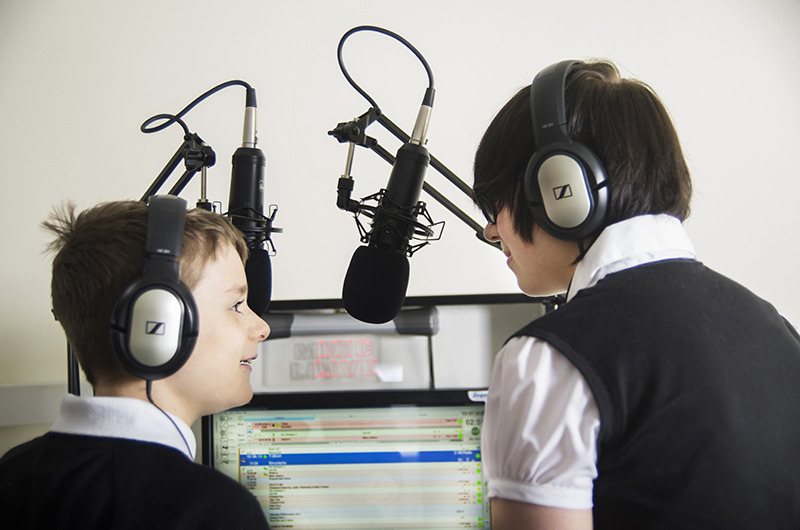
image005 1

#4 Guide Your Listeners

You’re in charge of your radio show. So, it is your responsibility to guide your listeners with your energetic and confident voice modulation. It is best to maintain a concise script and stay focused on your content while maintaining an equal balance of information and engagement with the audience. Always remember, that a few strong words can have a more long-lasting impact than a lengthy rant. To score extra brownie points from your listeners, practise voice modulation in front of the mirror before you actually present your set in front of the audience.

#5 Familiarize yourself with the mic

If a student wishes to be a good radio presenter then the mic is their best friend. You need to familiarize yourself with the features of the mic and its best position to capture your voice perfectly. It will capture every sound you make so make sure you pronounce your sentences clearly in order to give your listeners an enjoyable radio experience.5. Familiarize yourself with the mic If a student wishes to be a good radio presenter then the mic is their best friend. You need to familiarize yourself with the features of the mic and its best position to capture your voice perfectly. It will capture every sound you make so make sure you pronounce your sentences clearly in order to give your listeners an enjoyable radio experience.

While there are hundreds of ways to improve your skills as a radio presenter, these essential tips will help you kick-start the journey. With dedicated rehearsals and continuous practice, students will soon be able to present confidently and be able to create a quality radio show for their listeners. Moreover, this is a new-age skill in the current educational scenario and would help young learners gain an edge over others.

Contact us

Fill in your details below or send us an email on info@knowledge-hub.com

Fast Phonics by Reading Eggs

Fast Phonics by Reading Eggs

Fast Phonics by Reading Eggs

Reading is an essential skill that improves memory function as well as attention, It Is essential skill to be learned as a child however a lot of kids refrain from doing so, most of them are extremely fussy when it comes to reading, however companies like Reading eggs are coming up with amazing online reading games and activities, Reading Eggs makes learning to read fun and engaging for youngsters.

Our online reading programme for children ages two to thirteen, Reading Eggs, was created by a team of highly experienced educators, animators, and web engineers and launched in 2008. Over 20 million children in 169 countries have benefited from the initiative. The Middle East has especially shown a large interest in the activities Reading Eggs has to offer. Across GCC, in Dubai and other cities of UAE, there has been a strong adoption for the same.

With carefully created online reading games and activities that are easy to follow, self-paced, and extremely interesting for young children, the multi-award-winning early learning resource supports your child’s reading journey.

By introducing Reading Eggs into your child’s daily routine, you’ll be assisting them in preparing for the organized learning they’ll need to succeed and feel confident at school. Children enjoy the games, songs, golden eggs, and other rewards, which, in addition to making them feel proud of their reading, encourage them to continue exploring and learning.

So much of your child’s learning takes place at home. It’s where they’re most at ease, content, and supported. Children who grow up in families where reading is valued are already far ahead of their peers, according to studies. The home is an excellent location to start laying the foundation for long-term reading and academic success.

Reading Eggs is an educationally sound and extremely pleasurable learn to read programme for your child that is not only fun and successful, but also simple to include into your everyday routine.

Fast Phonics is an online synthetic phonics curriculum that teaches kids how to read effectively.

Fast Phonics leverages the proven efficacy of systematic phonics training to increase reading skills quickly, based on strong scientific evidence. The programme has 20 stages in which children learn important phonics abilities such as letter sound recognition, blending, and spelling. Each level is a Mountain Peak, with over 20 fascinating activities covering one set of letters.

Why do kids enjoy playing Fast Phonics games?

Fast Phonics is ideal for children ages 5–10 who are learning to read, as well as older students who are having difficulty in school. The high-interest phonics activities, along with enticing incentives, keep students on track and motivated to improve their skills.

Hundreds of animated videos are included in Fast Phonics.

Systematic synthetic phonics training is reinforced by entertaining learning films. Letter-sound films provide effective visual mnemonics (memory aids) that have been shown to improve letter-sound recognition.

Hundreds of incredibly engaging interactive activities are included in Fast Phonics.

Letter sound identification, blending throughout the word, spelling skills, non-words, syllables, reading captions, and longer text are all skills that children practise.

Hundreds of decodable books are included in Fast Phonics.

Each peak contains decodable books with beautiful illustrations. After reading each book, your child will take a comprehension quiz.

Assessment and reporting are included in Fast Phonics.

Quizzes are given on a regular basis to check phonics skills and track your child’s growth.

Hundreds of printable worksheets are included in Fast Phonics.

Easy-to-follow worksheets and handwriting pages for each peak are included in the bank of downloadable resources, allowing your kid to practise crucial phonics skills offline.

Fast Phonics is a motivating and enjoyable programme. It’s a hit among kids!

Children are more interested and driven to learn when they are given exciting rewards. Fast Phonics is full of colourful characters, including a fun Yeti avatar, as well as intriguing upgrades, collectible gems, and Yeti coins.

Contact us

Fill in your details below or send us an email on info@knowledge-hub.com

Most Common Equipment in School Labs

Most Common Equipment in School Labs

Most Common Equipment in School Labs

School labs are a great and an essential way of practical education, in countries like Dubai school labs are given great importance as they enable hands-on learning for the students. The entire middle east is heavy on this concept of education.

One such corporation is doing extraordinary work in this field to provide cutting edge tools to aspiring science enthusiasts to help them in their research.

We began as a vision of what a science supplier could be, and we still exemplify that forward-thinking visionary attitude 90 years later. At Carolina, we are continually working to improve and innovate in order to be the best we can be, with the goal of achieving excellence in everything we do. With more than 37 distinct divisions, each person is critical to our success. If you were to take a tour of our facilities, you would most certainly be enthralled by the incredible things you’d see.

Carolina is a fantastic company. We are lucky to have a diverse set of skills, ranging from technical science to business and leadership. Many of our staff have educational backgrounds, which we use to produce effective goods and learning tools that get results.

You’ll be attracted by the colourful atmosphere and bustle of activity as you walk about our campus, wondering what great surprise will be revealed next. We are proud to be the first company to offer a low-toxicity electrophoresis gel that does not require UV illumination to see through. FlyNap was created to anaesthetise fruit flies so that they could be studied. We were also the first company to create and distribute an easy-to-use fruit fly feeding supply.

On the East coast, we have the largest single butterfly species production. Our butterfly construction (yes, construction) is a terrific experience. The numerous stages of the butterfly life cycle surround you as you wander through this utopia.

For students what are the most common equipment’s in school Labs across GCC?

One of the most typical sources of excitement for students during their school days is the discovery and introduction to laboratory equipment in school labs. Between the fifth and eighth grades, students learn about fundamental laboratory apparatus and how to use them. All of these devices are essential in every lab, whether in schools, universities, research labs, or medical labs.

Microscopes

In a biology lab, a microscope is an essential piece of equipment. A basic light microscope (compound microscope) is one that is commonly used in schools and colleges to study a small specimen using natural or artificial light and a succession of magnifying lenses.

Test tubes

The test tube is the next most frequent device. They are typically glass cylinder pipes with a circular entrance on one side and a rounded bottom on the other. They come in a variety of sizes, but the most popular is 18*150 mm. Test tubes are one of the most significant pieces of equipment since they can be used for everything from storing reagents to mixing them in chemical and biological reactions.

Beakers

The test tube is the next most frequent device. They are typically glass cylinder pipes with a circular entrance on one side and a rounded bottom on the other. They come in a variety of sizes, but the most popular is 18*150 mm. Test tubes are one of the most significant pieces of equipment since they can be used for everything from storing reagents to mixing them in chemical and biological reactions.

Magnifying Glass

One of the first pieces of lab equipment introduced to students was a magnifying glass. It is used to examine enlarged or magnified images of objects or read the small calibrations inscribed on various devices, as the name implies. It has a convex lens for enlarging objects and is usually held by a wooden handle.

Volumetric Flask

This is one of the most significant pieces of laboratory equipment, made of glass and calibrated to retain a specific volume of liquids at a specific temperature. Volumetric flasks come in a variety of sizes, each calibrated for precise liquid and solution measurement. It is mostly used in chemistry labs to prepare standard solutions.

Contact us

Fill in your details below or send us an email on info@knowledge-hub.com

The Beginner’s Guide To Microsoft Excel

The Beginner’s Guide To Microsoft Excel

The Beginner’s Guide To Microsoft Excel

As the world moves towards a highly advanced way of life, the education system is rapidly transforming. Today, it is vital for school going children to learn the foundations of technology. However, not many schools offer modules on the same. As parents or guardians, you must have noticed that multiple school assignments include the usage of Microsoft Office, predominantly Microsoft Excel and Word. But unfortunately, schools do not teach something as important as Microsoft Office Suite in detail. This is why people across Dubai, UAE, GCC and The Middle East are opting for TechnoExcel by TechnoKids. This holistic project allows school children to understand Excel at length and helps them navigate seamlessly around various tools, features, design elements and formulas. Contrary to what many people believe, it is often difficult for children to fully understand the functions of Microsoft Excel. This is why lessons for the same are highly recommended.

technokidslogo

How does learning Excel help children?

  1. Excel is one of the most used tools from the Microsoft Office suite. It is widely adopted by schools and colleges globally. Hence, your child will gain a competitive advantage among its peers in the near future.
  2. It will help kids deeply understand raw data and how to convert it into properly formatted, meaningful information.
  3. Excel helps kids improve their financial planning. This is a life skill that is often ignored in conventional school modules.
  4. Since Excel involves functions like formulas, numbers, pivot charts, VLOOKUP etc., It dramatically improves a kid’s analytical skills.
  5. It helps make mathematics more interesting with a wide range of formulas and features. Moreover, its autocorrect feature helps improve their calculation skills over time.
  6. One of the most important reasons behind learning Microsoft Excel is that it is widely accepted as a standard format to share and exchange data across the globe. Today, employers and university educators expect kids to take full advantage of this powerful data analytics tool.

What will the TechnoExcel kit include?

This special program is built by TechnoKids so school-going children can seamlessly navigate through Excel and extract its potential to the fullest. Since it aims to provide a comprehensive view of this program, here’s a list of things you and your child will get access to:

  1.  A student’s workbook
  2. A teacher’s guide
  3. A wide array of resources that can be customized basis the learning ability of the child
  4. Multiple assessment tools
  5. Extension Activities
  6. Sample files, usable templates, parent letters and certificates

This holistic program also offers advanced Excel tasks and various methods to integrate Excel data into a PowerPoint Presentation. These are exactly the kind of skills your child needs to gain the much needed competitive edge in today’s educational scenario. Moreover, we are moving towards a virtual world, which makes this online program a perfectly engaging lesson for you as well as your child.

Contact us

Fill in your details below or send us an email on info@knowledge-hub.com

15 Interesting Math Trivia – Questions and Answers

15 Interesting Math Trivia – Questions and Answers

15 Interesting Math Trivia – Questions and Answers

Looking to have some fun with numbers? Math doesn’t always have to be boring. The next time your mate at school tricks you into a Math trivia question, be prepared to answer it with confidence. We have compiled a list of interesting brain-wrecking Math Quiz questions & answers for you to memorize.

#1 Is Zillion a real number?

Many get confused about whether zillion is an actual number or just a made-up figure. It rhymes just like million, trillion, and billion, and hence zillion sounds like an actual number. However, zillion is just an informal term to address an enormous or indefinite number. Zillion isn’t actually a number.

#2 How many configurations does a Rubik’s Cube have?

The famous Rubik’s cube is an iconic puzzle toy, and many children struggle to find a correct solution, often feeling frustrated. It’s pretty enthralling to solve this messy-looking colorful cuboid. After a few years of trial & error, it was discovered that the cube can be solved in as many as 20 moves and there are about 43 quintillion possible configurations of the Cube. Wow, that gives us enough motivation to pick up one and get cracking!

#3 What is the longest side of the right-angle triangle called?

The hypotenuse is the longest side of a right-angle triangle and it is always the side opposite to the right angle itself.

#4 Who was considered the fastest human calculator?

Scott Flansburg is a Guinness World Record Holder (2001) for the fastest mental calculation after adding the same number to itself 36 times in 15 seconds.

#5 Which number is spelt with letters in descending order?

‘One’ is the only number that is spelt with the letters arranged in descending order.

#6 What is the smallest perfect number?

A perfect number is a positive integer that is equal to the sum of its proper divisors. Number ‘6’ is the smallest perfect number, as the sum of 1, 2, and 3, together make 6.

#7 Which number is a ‘magic number’?

Number ‘9’ is considered as a magic number, as the sum of the digits of the multiples of 9, is always 9. For example; (18) 8 + 1 = 9, (54) 5 + 4 = 9, (81) 8 + 1 = 9.

#8 How many colors are needed on a map to ensure that no two colors share the same border?

In mathematics, the four-color theorem states that you only require four colors to depict the regions on a map, such that no two adjacent areas share the same color.

#9 Is -40 degrees Celsius equivalent to -40 degrees Fahrenheit?

True. Though Celsius and Fahrenheit are two different temperature scales, -40 always shows the same measurement in °C and °F.

#10 Is Pi a rational or irrational number?

Pi is called an infinite decimal and it’s a real number that cannot be expressed in a simple fraction.

#11 What is zero to the power of zero?

Any number to the power of zero is 1, so (30 = 1) and zero to the power of any number is always zero (02 =0). But when it comes to zero to the power of zero, the answer is undefined (00 =??).

#12 When two circles have the same centre, what is it called?

Concentric circles are circles with a common center.

#13 When something is going to occur, which mathematical term is used to express the likelihood of the event?

‘Probability’ is the extent to which something is likely to happen or be the case.

#14 The number hundred is derived from the ancient word, “hundrath,” which actually means what?

The word “hundred” comes from the old Norse term, “hundrath”, which actually means 120. 

#15 Which number has the most synonyms?

‘Zero’, which can also be addressed as; nil, nada, zilch, zip, nought, and many more.

Mathseeds is an euphoric online Math program that caters to children between ages 3 to 9 years. Schools in Dubai and Middle East Regions, promote Mathseeds and even include activities from this platform into their lesson-plan, to make the session more interesting for kids. The activities are carefully created by educational experts and hence ensures age-appropriateness. It even showcases the Mathematical progress of children and they are encouraged to create a custom Avatar – to keep themselves motivated.

Contact us

Fill in your details below or send us an email on info@knowledge-hub.com