

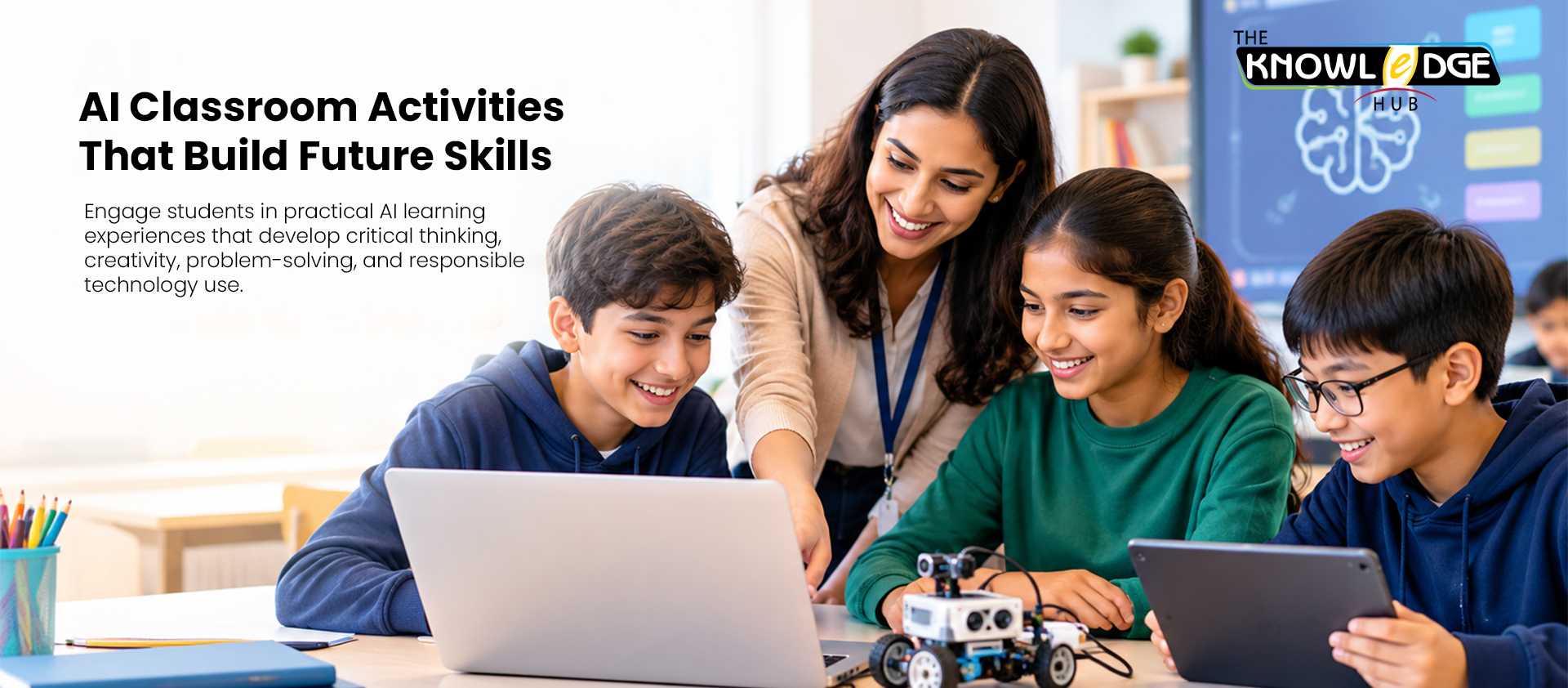
Artificial intelligence is becoming part of how people learn, work, create, and solve problems.
But students do not develop meaningful AI skills simply by using an AI tool.
They need opportunities to question, experiment, analyse, create, test, and reflect.
That is where well-designed AI classroom activities can make a difference.
When AI learning is connected to real questions and hands-on challenges, students can begin developing skills that extend beyond technology. They can practise critical thinking, creativity, communication, problem-solving, collaboration, and responsible technology use.
For schools building an AI education programme, classroom activities can provide a practical way to move from concepts to meaningful learning experiences.
What Are AI Classroom Activities?
AI classroom activities are structured learning experiences that help students explore artificial intelligence through investigation, experimentation, problem-solving, or creation.
These activities do not always require students to build complex AI systems.
Depending on their age and learning level, students can explore:
- How AI recognises patterns
- How data influences AI outputs
- How AI-generated information can be evaluated
- How humans interact with AI systems
- How AI can support creative work
- How AI can be used to solve problems
- How bias can influence AI systems
- How AI should be used responsibly
The goal is to help students understand how AI works, where it can be useful, and where human judgement remains important.
For a broader introduction to the subject, schools can also explore what AI education means for schools through our guide to What is AI Education? A Complete Guide for Schools.
Why Use AI Activities in the Classroom?
AI learning becomes more meaningful when students actively engage with ideas instead of simply learning definitions.
Well-designed activities can help students develop several future-ready capabilities.
Critical Thinking
Students can compare AI-generated responses, identify inaccuracies, ask questions, and decide whether information is reliable.
Problem-Solving
AI challenges can encourage learners to identify a problem, explore possible solutions, test ideas, and improve their approach.
Creativity
Students can investigate how AI can support brainstorming, design, storytelling, visual communication, and other creative processes while retaining human decision-making.
Collaboration
Many AI projects can be designed around group challenges, allowing students to discuss ideas, divide responsibilities, evaluate results, and communicate their conclusions.
Digital and AI Literacy
Students learn that using technology is not enough. They also need to understand how digital systems work, how data influences outcomes, and how technology should be used responsibly.
These capabilities connect closely with the broader goal of AI literacy for students, where learners develop the knowledge and judgement to interact with artificial intelligence thoughtfully.
7 AI Classroom Activities for Students
The best activities should match students’ age, curriculum objectives, and existing technology skills.
Here are seven practical approaches schools can adapt across different grade levels.
1. Can AI Spot the Pattern?
Pattern recognition provides a simple way to introduce students to an important concept behind many AI systems.
Give students a collection of images, objects, numbers, words, or other examples and ask them to identify patterns.
Then challenge them:
What information would a computer need to recognise the same pattern?
Students can categorise the examples, explain the features they used, and discuss what might happen if the data changed.
Skills developed
- Pattern recognition
- Logical reasoning
- Classification
- Observation
- Data thinking
This type of activity can provide a foundation for later discussions about machine learning and AI classification.
2. AI Fact-Checking Challenge
AI systems can generate convincing answers, but convincing does not always mean correct.
Give students an AI-generated response containing a mixture of accurate information and potential errors.
Ask them to investigate the response and identify:
- What appears accurate?
- What needs verification?
- What evidence supports the answer?
- What information may be misleading?
- What sources should be checked?
Students then explain how they reached their conclusions.
This activity turns AI use into an exercise in critical evaluation rather than passive acceptance.
It also builds directly on the skills discussed in AI Literacy for Students: Why Every School Should Teach It.
Skills developed
- Critical thinking
- Research
- Fact-checking
- Information literacy
- Evaluation
3. Design a Better AI Solution
Give students a real-world problem and ask them to imagine how AI could help solve it.
For example:
How could AI help reduce food waste in a school?
Students could investigate the problem, identify the information an AI system might need, propose a solution, and explain how the system could support decision-making.
Other challenges could include:
- Reducing energy consumption
- Improving recycling
- Supporting school transportation
- Helping people access information
- Making public spaces more accessible
The objective is not necessarily to build a complete AI system.
Instead, students learn to think about problems, data, systems, users, and possible solutions.
Skills developed
- Problem-solving
- Creativity
- Systems thinking
- Collaboration
- Communication
4. Human or AI?
This activity encourages students to think about the differences between human and machine capabilities.
Present students with different tasks, such as:
- Recognising an image
- Writing a story
- Solving a calculation
- Understanding emotions
- Finding patterns in data
- Making an ethical decision
Ask students:
Would a human, an AI system, or both be better suited to this task? Why?
Students then discuss the strengths and limitations of each.
The activity can lead to an important question:
What should humans remain responsible for when AI is involved?
That question helps connect AI learning with judgement, ethics, and responsible technology use.
Skills developed
- Critical thinking
- Reasoning
- Communication
- Ethical thinking
- AI awareness
5. Train the Classifier
Students can explore the idea of AI classification through a simple sorting challenge.
Provide examples that belong to different categories and ask students to create their own classification rules.
For example, they could classify objects based on:
- Shape
- Colour
- Size
- Function
- Material
- Other observable features
Then introduce examples that are difficult to classify.
Ask:
What happens when the rules are unclear?
Students begin to understand that the quality of classification depends on the information and criteria being used.
This can provide a simple introduction to concepts such as data, classification, patterns, and bias.
Skills developed
- Data classification
- Logical thinking
- Pattern recognition
- Decision-making
- Understanding bias
6. Build an AI-Enhanced STEM Challenge
AI activities can become particularly engaging when connected with STEM learning.
Give students a practical challenge such as designing a more efficient structure, improving a transportation system, reducing energy use, or solving an environmental problem.
Students can investigate the problem, collect information, explore possible solutions, and consider where AI could support the process.
For example, students might ask:
How could AI help us design a more energy-efficient building?
They can consider what data would be needed, what patterns could be identified, and where human decisions would still be required.
This approach connects AI with STEM learning, engineering design, data, and problem-solving.
Schools can connect these experiences with their wider STEM Curriculum UAE approach rather than treating AI as an isolated technology topic.
Skills developed
- Engineering thinking
- Data analysis
- Problem-solving
- Collaboration
- Creativity
- Systems thinking
7. Create an AI Use Policy for Students
AI education should not only teach students what they can do with technology.
It should also help them think about how they should use it.
Divide students into groups and ask them to create a set of classroom guidelines for responsible AI use.
They could consider questions such as:
- When is it appropriate to use AI?
- When should students complete work independently?
- How should AI-generated information be checked?
- Should students disclose when AI was used?
- What personal information should never be entered into an AI tool?
- Who is responsible when an AI-generated answer is wrong?
Each group can present its recommendations and explain the reasoning behind them.
This turns responsible AI from a theoretical concept into an active classroom discussion.
Skills developed
- Ethical reasoning
- Digital citizenship
- Communication
- Decision-making
- Responsible technology use
How to Make AI Classroom Activities More Effective
The activity itself is only one part of successful AI learning.
Teachers can make these experiences more meaningful by following a simple learning cycle:
Question → Investigate → Experiment → Evaluate → Explain → Reflect
Students begin with a question or challenge.
They investigate information, experiment with ideas or tools, evaluate what they discover, explain their reasoning, and reflect on what they would change.
This approach helps students move beyond simply using AI to understanding and evaluating it.
It also reflects the broader classroom transformation possible when AI is integrated with active and project-based learning. For more context, explore How AI Is Transforming Modern Classrooms.
Keep AI Activities Age-Appropriate
Not every AI activity needs to involve sophisticated tools.
For younger students, activities can focus on:
- Patterns
- Sorting
- Sequences
- Simple decision-making
- Data awareness
- Problem-solving
Older students can explore:
- Machine learning concepts
- Data analysis
- Generative AI
- AI applications
- Bias
- Ethics
- AI-supported projects
The important factor is progression.
Students should gradually move from understanding simple AI concepts to applying, evaluating, and questioning AI systems.
Connect Activities to the Curriculum
AI activities should support learning objectives rather than become additional technology exercises.
Teachers can connect AI experiences with:
- ICT
- Science
- Mathematics
- STEM
- Coding
- Robotics
- Language
- Research
- Design and engineering
This makes AI learning more relevant and gives students opportunities to see how artificial intelligence connects with different areas of knowledge.
For schools developing a broader technology pathway, AI can complement an ICT Curriculum for Schools UAE rather than operating separately from it.
Focus on Skills, Not Just Tools
AI tools will continue to change.
A platform students use today may look very different in the future.
The skills developed through meaningful AI activities are therefore more valuable than learning one specific tool.
Students should leave an activity knowing how to:
- Ask better questions.
- Evaluate information.
- Work with data.
- Solve problems.
- Create solutions.
- Explain their reasoning.
- Use technology responsibly.
These are transferable skills that can continue to support students as AI evolves.
Building Future Skills Through AI Learning
The purpose of AI education is not simply to make students familiar with artificial intelligence.
It is to help them become thoughtful users, creators, problem-solvers, and decision-makers in a world where AI will increasingly influence how people work and learn.
Well-designed AI classroom activities give students opportunities to explore these ideas through active learning.
From pattern recognition and fact-checking to STEM challenges and responsible AI discussions, schools can create experiences that make AI understandable, practical, and meaningful.
When students are encouraged to question technology rather than simply use it, they begin developing the confidence and judgement needed for the future.
For schools looking to build a structured approach to AI learning, explore AI Education Solutions UAE and discover how AI can become part of a broader future-ready learning strategy.