

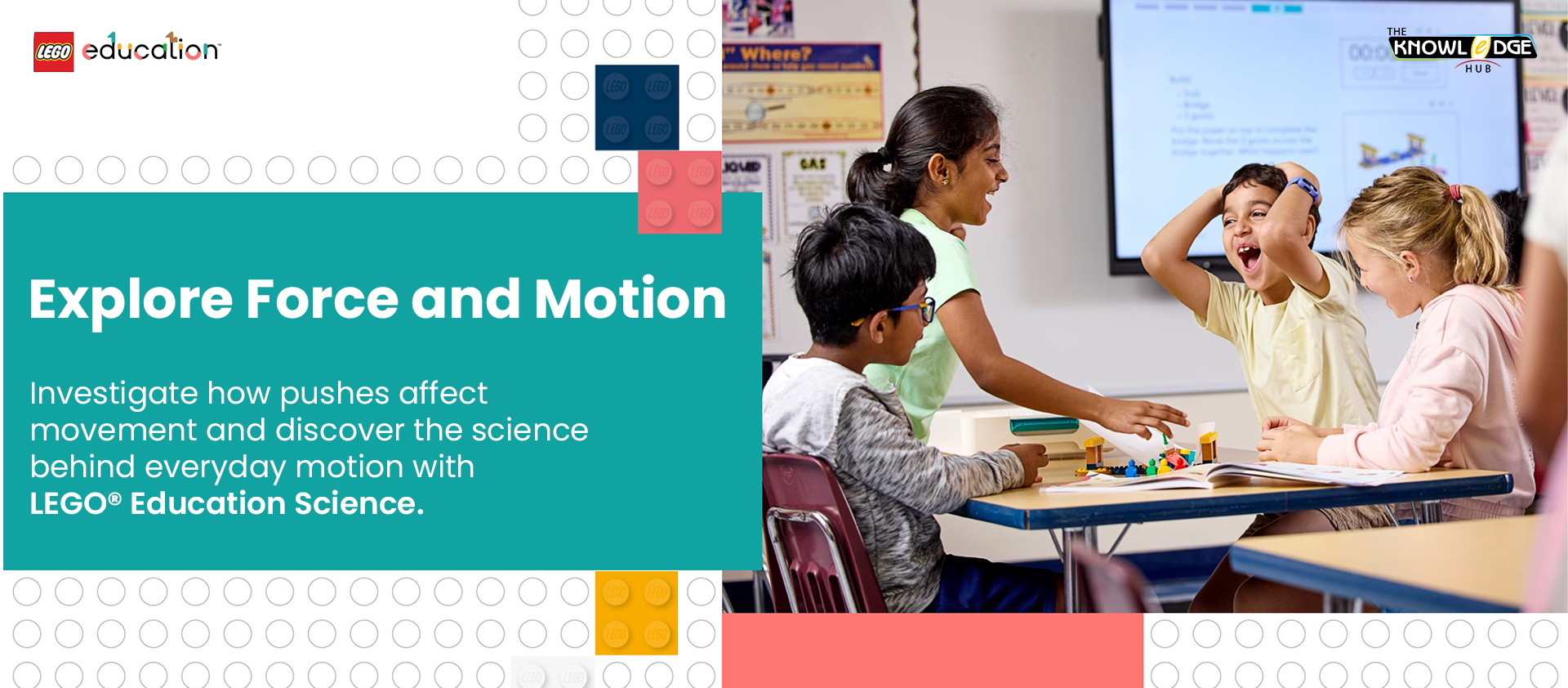
What happens when an object is pushed?
Does it always move in the same way?
These simple questions can open the door to a deeper understanding of force and motion in science. When students investigate how objects respond to pushes, they can begin to explore how forces influence movement and recognise cause-and-effect relationships.
Rather than simply learning definitions, students can develop their understanding by asking questions, making observations, testing ideas, and explaining what they discover.
This is where hands-on science learning can make physical science more meaningful.
What Is Force and Motion in Science?
A force is a push or a pull that can affect the motion of an object.
When a force acts on an object, it can cause the object to start moving, stop, speed up, slow down, or change direction. The way an object responds can depend on different factors involved in the investigation.
For students, these concepts become more meaningful when they can observe them directly.
A simple push can lead to questions such as:
- What happens when an object is pushed gently?
- What happens when the push is stronger?
- Does an object always move in the direction of the push?
- Why might two objects respond differently?
- What can we observe about the object’s movement?
These questions encourage students to investigate force and motion in science through evidence and observation.
Exploring Forces Through Hands-On Investigation
Science is not only about knowing an answer. It is also about understanding how we arrive at that answer.
With hands-on investigations, students can begin with a question and make a prediction about what they think will happen. They can then test their ideas, observe the results, and compare what happened with what they expected.
This creates an active learning process:
Ask → Predict → Investigate → Observe → Explain
Through this process, students can develop a stronger understanding of forces and motion while also practising important scientific skills.
Understanding Cause and Effect
One of the important ideas students can explore through force and motion is cause and effect.
When students change the way they push an object and observe how its movement responds, they can begin to identify relationships between an action and its result.
For example, students might investigate what happens when the conditions of a push change. They can observe differences in movement and use those observations to develop explanations.
Instead of simply saying, “The object moved,” students can begin asking:
“What caused it to move?”
That question encourages deeper scientific thinking.
From Observation to Explanation
Observation is an important part of scientific investigation, but students can go further by explaining what they observe.
After an investigation, students can describe what happened, compare their results, and use evidence to support their ideas.
This helps develop skills such as:
- Asking scientific questions
- Making predictions
- Observing results
- Identifying patterns
- Using evidence
- Explaining cause and effect
- Communicating scientific ideas
These skills can support students as they investigate increasingly complex scientific concepts.
Connecting Science to the Real World
Force and motion are part of everyday life.
A ball changes direction when it is kicked. A door moves when it is pushed. A bicycle slows down when the rider stops pedalling. Objects move, stop, and change direction because forces are acting on them.
Connecting classroom investigations with familiar experiences can help students recognise that physical science is not limited to the classroom.
It is happening around them every day.
Hands-on experiences can give students opportunities to explore these ideas in a way that encourages curiosity and active participation.
Exploring Force and Motion with LEGO® Education Science
LEGO® Education Science provides opportunities for students to investigate scientific concepts through hands-on learning and meaningful questions.
By exploring how objects respond to pushes and other forces, students can observe movement, investigate cause and effect, and develop explanations based on what they discover.
The goal is not simply to tell students how forces work.
It is to give them opportunities to investigate, observe, reason, and explain.
That approach can help turn an abstract scientific concept into something students can explore for themselves.
Start With the Right Question
Understanding force and motion in science can begin with something as simple as a push.
What happens?
Why does it happen?
What changes when the force changes?
And what evidence can help explain the result?
Through LEGO® Education Science, students can explore these questions while developing scientific thinking and a deeper understanding of physical science.
Because sometimes, meaningful science learning doesn’t begin with an answer.
It begins with a question worth investigating.
Explore physical science with LEGO® Education Science.