

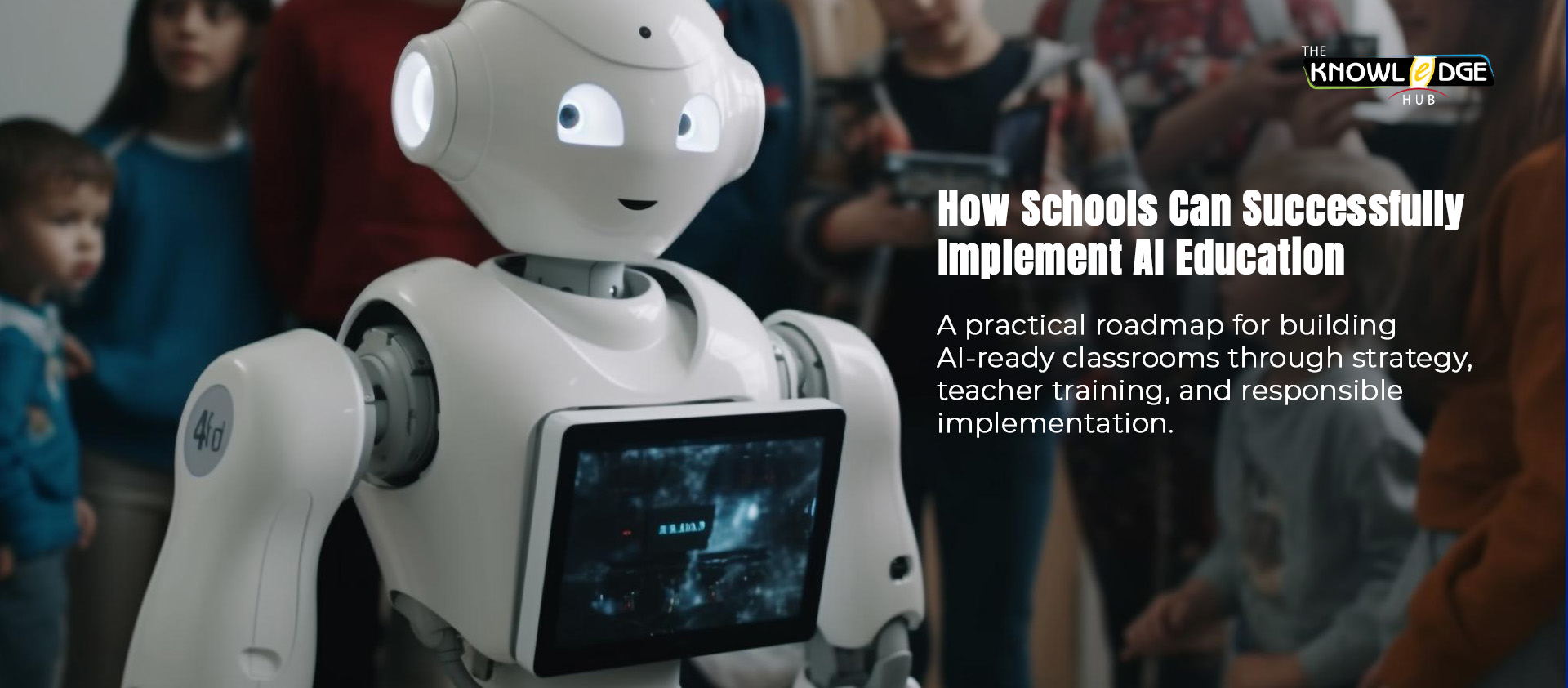
Artificial intelligence is becoming an important part of modern education, but introducing AI into a school requires more than simply adding new technology to the classroom.
Successful AI Education Implementation requires a clear strategy, appropriate tools, teacher preparation, curriculum alignment, and a structured approach to student learning.
Schools that approach AI as a long-term educational initiative can create meaningful learning experiences while helping students develop the skills they will need in a technology-driven world.
So, how can schools move from exploring AI to implementing it effectively?
1. Start With a Clear AI Education Strategy
Before selecting tools or introducing AI activities, schools should establish what they want students to learn and why AI should be part of their education programme.
An effective AI education strategy should consider:
- Student age and learning levels
- Existing curriculum requirements
- Digital infrastructure
- Teacher capabilities
- Available learning resources
- School goals and priorities
- Student progression across grade levels
The objective should not be to use AI simply because it is new. Instead, schools should identify where artificial intelligence can strengthen learning, creativity, problem-solving, research, and digital skills.
A clear strategy gives teachers and school leaders a common direction and helps ensure that technology supports educational objectives.
2. Assess Your School's AI Readiness
Every school will be at a different stage of technology adoption.
Before implementing an AI programme, leadership teams should evaluate their current level of readiness.
This can include reviewing:
- Existing ICT and computing programmes
- Teacher confidence with emerging technologies
- Classroom devices and connectivity
- Digital learning platforms
- Student technology skills
- Current STEM and coding programmes
- Data protection and technology policies
- Professional development requirements
This readiness assessment helps schools identify gaps before implementation begins.
For example, a school with strong coding and digital learning programmes may be ready to introduce more advanced AI projects, while another school may first need to strengthen foundational digital skills.
3. Define Age-Appropriate Learning Goals
AI education should develop progressively as students move through different grade levels.
Younger learners can begin with concepts such as patterns, sequencing, problem-solving, and simple machine behaviour.
As students progress, learning can expand into:
- Data and information
- Algorithms and computational thinking
- Machine learning concepts
- Generative AI
- AI-assisted creativity
- Problem-solving with AI
- AI ethics and responsible use
- AI projects and applications
This progression prevents AI education from becoming a collection of disconnected activities.
Instead, students gradually build knowledge and skills that become more sophisticated over time.
Schools can also connect AI learning with their wider ICT Curriculum for Schools UAE, creating a structured pathway for technology education rather than treating AI as a separate topic.
4. Begin With a Pilot Programme
Schools do not necessarily need to introduce AI across every grade at the same time.
A pilot programme can provide an effective starting point.
Schools can select:
- A small number of grade levels
- Interested teachers
- Specific curriculum areas
- A limited number of AI learning activities
- Clear objectives for measuring results
The pilot allows educators to understand what works in their specific school environment.
Teachers can identify challenges, students can provide feedback, and leadership teams can evaluate the resources and support required before expanding the programme.
This makes implementation more manageable and allows schools to improve their approach before scaling.
5. Prepare Teachers Before Scaling AI
Teacher confidence is one of the most important factors in successful AI integration.
Providing teachers with technology alone is not enough. They need to understand how AI can support learning and how to use it appropriately in educational settings.
Professional development can focus on:
- Understanding core AI concepts
- Using AI learning tools
- Designing AI-supported activities
- Evaluating AI-generated information
- Encouraging critical thinking
- Addressing responsible AI use
- Protecting student information
- Assessing AI-supported projects
Teacher training should also be ongoing.
As AI technologies evolve, educators need opportunities to explore new applications, share classroom experiences, and develop new teaching strategies.
Schools looking to build this capability can explore Teacher Training and Certifications UAE as part of their broader professional development strategy.
6. Integrate AI Into Existing Subjects
AI education does not have to exist as a completely separate subject.
Schools can integrate AI concepts into subjects students already study.
For example:
- Science: Students can explore how AI is used to analyse data, recognise patterns, or support scientific research.
- Mathematics: Learners can work with data, patterns, logical reasoning, and algorithms.
- ICT: Students can explore computational thinking, digital tools, automation, and AI concepts.
- Language: Students can examine AI-generated content, compare responses, and develop critical evaluation skills.
- STEM: Students can use AI concepts alongside coding, engineering, robotics, and problem-solving.
This cross-curricular approach makes AI more meaningful because students see how it can be applied to real-world problems.
7. Use Project-Based Learning
One of the most effective ways to make AI education practical is through projects.
Instead of learning only about AI concepts, students can use their knowledge to investigate a problem, develop an idea, test solutions, and communicate their findings.
For example, students could:
- Design an AI-supported solution to a real-world problem
- Explore how recommendation systems work
- Analyse a dataset and identify patterns
- Investigate how AI is used in healthcare or transportation
- Create a simple AI-based prototype
- Compare human and AI-generated solutions
- Examine how AI could improve sustainability
Project-based learning encourages students to apply knowledge rather than simply memorise terminology.
It also creates opportunities to develop communication, collaboration, creativity, and problem-solving skills.
Once schools establish the right implementation framework, they can explore how AI is already changing the way students learn and teachers deliver instruction in modern classrooms.
8. Establish Responsible AI Guidelines
Technology adoption should always be accompanied by clear expectations for responsible use.
Schools should establish guidelines that explain how students and teachers can use AI appropriately.
These guidelines can address:
- Academic honesty
- AI-generated content
- Fact-checking
- Privacy
- Personal data
- Bias
- Appropriate AI use
- Human decision-making
- Attribution and transparency
Students should understand that AI-generated information is not automatically accurate.
Developing responsible AI habits is closely connected to building AI literacy for students, particularly their ability to evaluate information and use AI thoughtfully.
Teaching learners to question, verify, and evaluate AI outputs is therefore an important part of implementation.
Responsible use should become a consistent part of classroom practice rather than a one-time lesson.
9. Connect AI With STEM and Coding
AI becomes even more powerful when students understand the technology behind it.
Schools can connect AI learning with coding, robotics, engineering, mathematics, and scientific investigation.
For example, students can explore how algorithms control systems, how data influences decisions, or how robots can respond to their environment.
This approach creates a broader learning pathway from foundational digital skills to computational thinking, coding, robotics, and artificial intelligence.
Schools developing this pathway can connect AI initiatives with their STEM Curriculum UAE and Robotics and Coding Programs UAE to create a more integrated future-ready learning environment.
10. Measure Progress and Improve the Programme
AI education implementation should not end when the programme launches.
Schools should continuously evaluate whether the initiative is achieving its objectives.
Useful indicators can include:
- Teacher participation and confidence
- Student engagement
- Completion of AI projects
- Development of digital and computational skills
- Quality of student problem-solving
- Student ability to evaluate AI outputs
- Curriculum integration
- Feedback from teachers and students
Schools can use this information to identify areas that need improvement.
A successful implementation is therefore an ongoing cycle:
Plan → Pilot → Train → Implement → Measure → Improve → Scale
This approach allows schools to develop AI education gradually while responding to the needs of their teachers and students.
Common Mistakes Schools Should Avoid
AI adoption can become difficult when schools focus too heavily on technology and not enough on learning outcomes.
Some common mistakes include:
Introducing Too Many Tools
Using multiple AI platforms at once can overwhelm teachers and students. Schools should prioritise a manageable set of tools that serve clear educational purposes.
Starting Without Teacher Preparation
Teachers need confidence and practical guidance before they are expected to integrate AI into everyday lessons.
Treating AI as a Standalone Technology
AI is most valuable when connected to curriculum objectives, projects, problem-solving, STEM, ICT, and real-world applications.
Ignoring Responsible Use
Schools should establish clear expectations around privacy, accuracy, academic integrity, and responsible technology use from the beginning.
Measuring Technology Use Instead of Learning
The goal is not to see how often students use AI. The real question is whether AI helps students learn, create, investigate, and solve problems more effectively.
Building a Sustainable AI Education Programme
Successful AI Education Implementation is not about adopting the newest technology as quickly as possible.
It is about building a structured learning environment where technology, curriculum, teachers, and students work together.
Schools can begin with clear objectives, assess their readiness, prepare educators, pilot learning experiences, establish responsible-use guidelines, and gradually expand their programme.
With the right approach, AI can become more than a classroom technology. It can become part of a broader education strategy that develops critical thinking, creativity, computational thinking, problem-solving, and future-ready skills.
For schools exploring a structured approach to artificial intelligence education, explore our AI Education Solutions UAE to discover how AI learning can be integrated into a future-ready school environment.
Frequently Asked Questions
What is AI Education Implementation?
AI Education Implementation refers to the process of introducing artificial intelligence learning into a school's curriculum, teaching practices, teacher development, technology infrastructure, and student learning experiences.
How should schools start implementing AI education?
Schools should begin by defining learning goals, assessing their current readiness, identifying teacher training needs, selecting appropriate resources, and starting with a manageable pilot programme before expanding.
Do teachers need AI training?
Yes. Teachers need practical knowledge and confidence to use AI tools effectively, evaluate AI-generated information, design meaningful learning activities, and guide students toward responsible use.
Can AI education be integrated into existing subjects?
Yes. AI concepts can be connected with ICT, STEM, mathematics, science, coding, robotics, languages, and project-based learning rather than being taught only as a standalone subject.
Why should schools start with a pilot programme?
A pilot allows schools to test resources, understand teacher and student needs, identify implementation challenges, and refine their approach before introducing AI education across more grades.
How can schools teach responsible AI use?
Schools can establish clear guidelines covering privacy, academic integrity, fact-checking, bias, appropriate AI use, transparency, and the importance of human judgement.
How can schools measure the success of AI education?
Schools can evaluate teacher confidence, student engagement, project quality, curriculum integration, digital and computational skills, and students' ability to critically evaluate AI-generated information.
Is AI education suitable for younger students?
Yes, but the learning approach should be age-appropriate. Younger students can begin with foundational concepts such as patterns, sequencing, logic, problem-solving, and simple AI-related experiences before progressing to more advanced concepts.