

Technology is transforming the way we live, work, and learn. While coding and artificial intelligence often take center stage, one of the most valuable skills students can develop is computational thinking. It is not just about writing code—it is about learning how to think logically, solve problems effectively, and approach challenges with confidence.
As schools prepare students for an increasingly digital future, computational thinking has become a core skill that supports success across every subject, from mathematics and science to languages and the arts.
What Is Computational Thinking?
Computational thinking is a structured approach to solving problems. It teaches students to analyze complex situations, identify patterns, break large problems into smaller parts, and create step-by-step solutions that can be tested and improved.
The four key components of computational thinking are:
- Decomposition – Breaking complex problems into smaller, manageable tasks.
- Pattern Recognition – Identifying similarities and trends that help solve problems faster.
- Abstraction – Focusing on the most important information while filtering out unnecessary details.
- Algorithm Design – Developing clear, logical steps to reach a solution.
These skills encourage students to think critically rather than simply memorize answers.
Why Computational Thinking Matters
Today's learners will enter careers where adaptability, creativity, and analytical thinking are just as important as technical knowledge. Computational thinking helps students develop these future-ready skills from an early age.
Students who practice computational thinking become better at:
- Solving real-world problems
- Making informed decisions
- Working collaboratively
- Testing ideas through trial and improvement
- Building resilience when solutions don't work the first time
These abilities are valuable not only in computer science but also in everyday learning and future careers.
Computational Thinking Beyond Coding
A common misconception is that computational thinking is only useful for programmers. In reality, it applies across the curriculum.
For example, students use computational thinking when they:
- Break down a science experiment into individual steps.
- Identify patterns in mathematical data.
- Organize information for a history project.
- Plan and revise a creative writing assignment.
- Develop strategies for engineering or design challenges.
This makes computational thinking a universal learning skill that benefits every student, regardless of their future career path.
Bringing Computational Thinking into the Classroom
Hands-on, inquiry-based learning is one of the most effective ways to teach computational thinking. Rather than relying solely on theory, students learn best when they can explore, experiment, and solve authentic challenges.
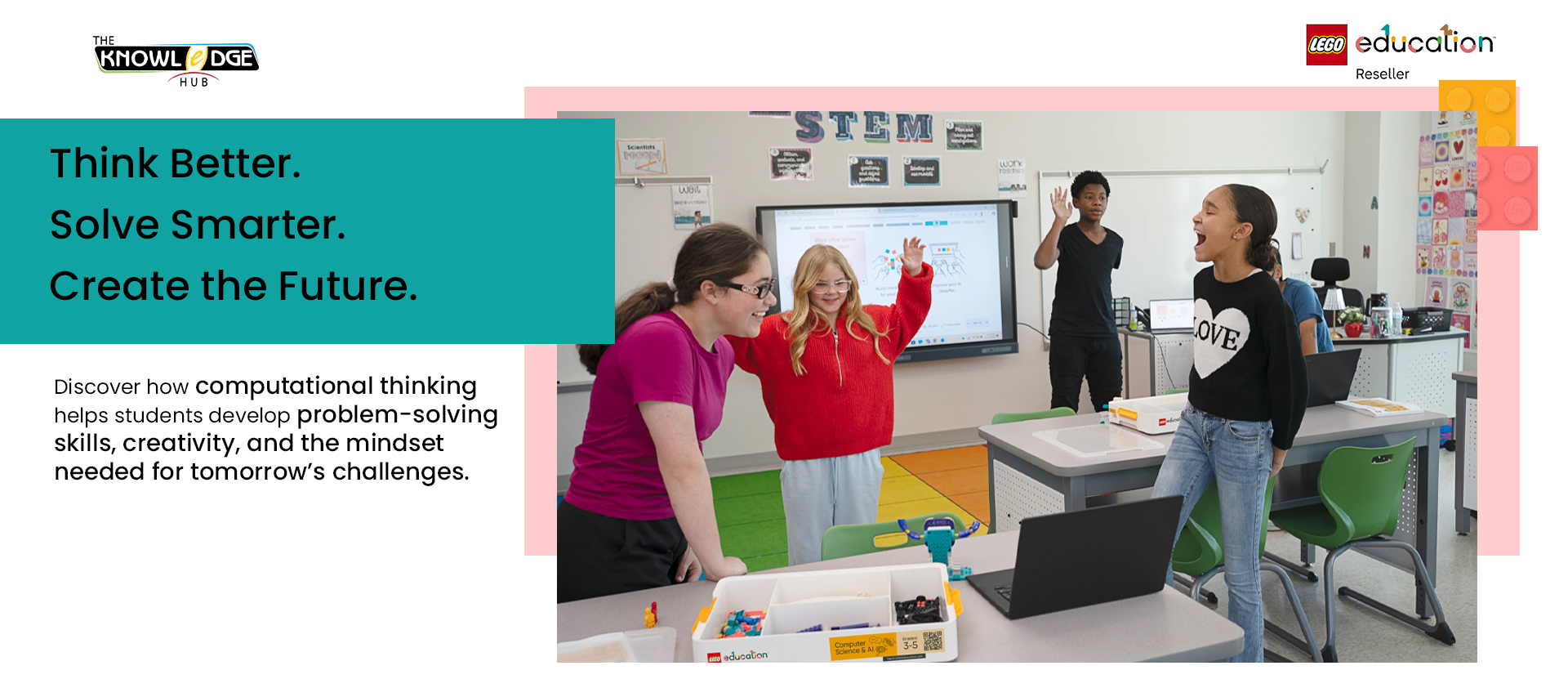
LEGO® Education Computer Science & AI provides engaging learning experiences that help students understand computational concepts through practical activities. Using collaborative projects and real-world scenarios, learners build confidence while developing logical reasoning, creativity, and problem-solving abilities.
Instead of simply learning about technology, students learn how to think like computer scientists—testing ideas, refining solutions, and learning from every iteration.
Preparing Students for the Future
As artificial intelligence, automation, and digital technologies continue to reshape industries, schools have an important role in preparing students with skills that remain relevant for decades to come.
Computational thinking provides a strong foundation for lifelong learning. It empowers students to become independent thinkers, effective collaborators, and innovative problem solvers who can confidently adapt to new challenges.
By integrating computational thinking into everyday learning, educators are not only supporting academic success but also equipping students with the mindset needed to thrive in the future workforce.
Conclusion
At Knowledge Hub, we believe that empowering students with future-ready skills begins with meaningful learning experiences. Solutions like LEGO® Education Computer Science & AI enable schools to transform classrooms into environments where curiosity, creativity, and computational thinking come together—helping every student become a confident problem solver for tomorrow.