

Artificial Intelligence has become a part of everyday learning. Students use AI-powered tools to generate ideas, summarize information, answer questions, and even assist with coding. While these technologies offer exciting possibilities, they also raise an important question for educators:
Are students learning to use AI, or are they learning to understand it?
Knowing how to ask an AI chatbot a question is useful, but true AI literacy goes much further. Students need to understand how AI reaches conclusions, recognize its limitations, and evaluate whether the information it provides is accurate. These are the skills that will prepare them for a future where AI is present in almost every industry.
AI Literacy Is More Than Technology Skills
Many people associate AI education with learning to use the latest AI applications. In reality, AI literacy is about developing the knowledge and mindset to interact with AI responsibly.
Students should be encouraged to ask questions such as:
- How did the AI generate this response?
- Can AI make mistakes?
- What information might be missing?
- Could the results be biased?
- How can I verify the answer?
By asking these questions, learners move beyond simply accepting AI-generated content. They begin thinking critically about how intelligent systems work and how they should be used.
Why Critical Thinking Matters More Than Ever
As AI-generated content becomes increasingly common, critical thinking is becoming one of the most valuable skills students can develop.
Whether researching for a school project, analysing data, or solving real-world problems, students need the confidence to question information rather than accept it at face value.
This approach helps them:
- Identify inaccurate or misleading information.
- Compare multiple sources before making decisions.
- Understand that AI predictions are based on data, not certainty.
- Recognise that human judgement remains essential.
These skills benefit students across every subject, from science and mathematics to language arts and social studies.
Learning AI Through Experience
Understanding AI is easier when students can see it in action.
Hands-on learning allows learners to explore how AI systems recognise patterns, classify information, and improve through training. Instead of reading about machine learning concepts in a textbook, students can experiment, observe outcomes, and refine their ideas based on the results.
This process transforms abstract concepts into meaningful learning experiences while encouraging curiosity and problem-solving.
Bringing AI Concepts into the Classroom
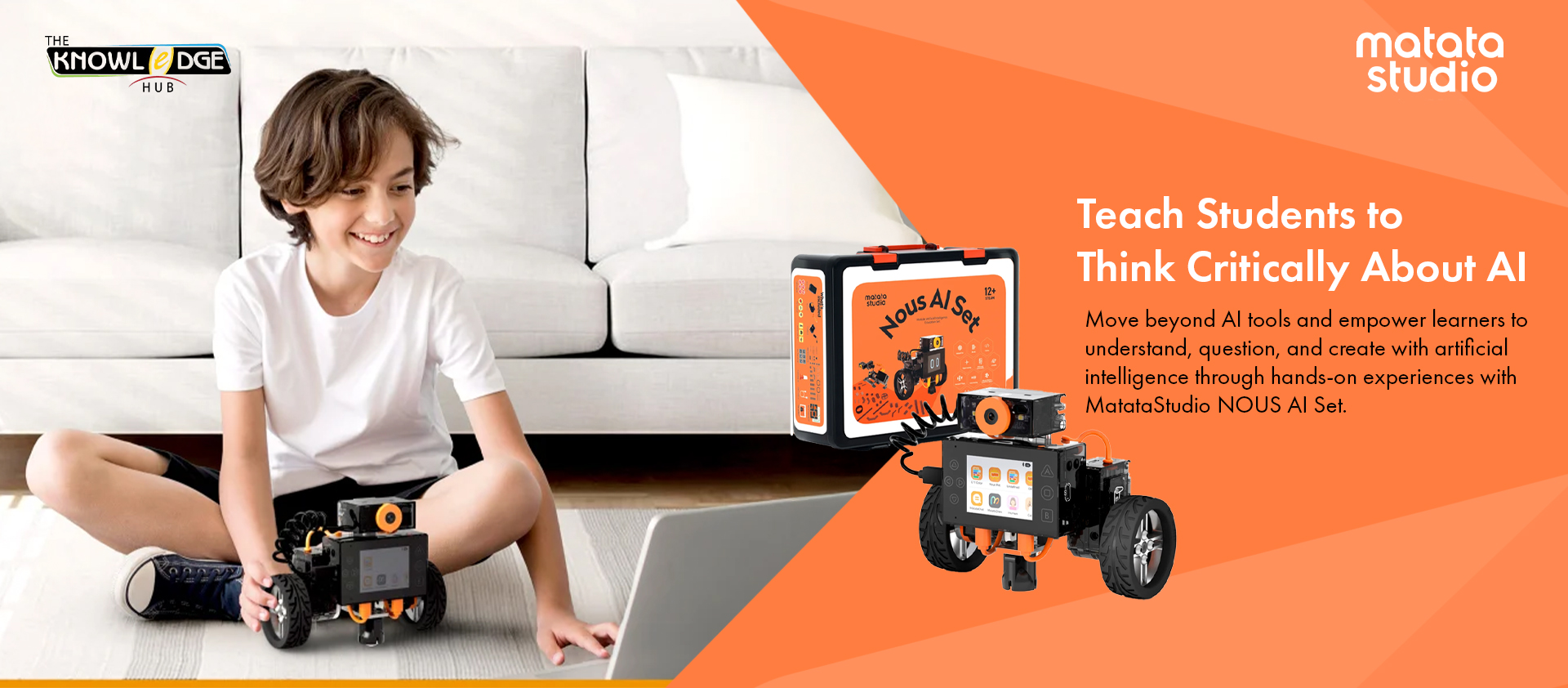
The MatataStudio NOUS AI Set helps educators introduce AI concepts in an engaging and age-appropriate way.
Rather than treating AI as a mysterious technology, students actively investigate how it works through interactive activities that encourage experimentation and discovery.
As they explore AI concepts, learners begin to understand:
- How machines recognise patterns.
- Why AI sometimes produces incorrect results.
- The importance of quality data.
- How improving data can improve AI performance.
- Why human decision-making remains important.
These experiences make AI education practical, memorable, and relevant.
Building Future-Ready Learners
The future workforce will require more than technical knowledge. Employers increasingly value individuals who can analyse information, solve problems, adapt to new technologies, and make informed decisions.
Teaching AI literacy supports these future-ready skills by encouraging students to:
- Think independently.
- Evaluate information critically.
- Collaborate effectively.
- Solve problems creatively.
- Use AI ethically and responsibly.
These competencies will remain valuable even as AI technologies continue to evolve.
Empowering Teachers to Teach AI with Confidence
Many educators recognise the importance of AI education but are unsure where to begin. Effective AI learning does not require advanced programming knowledge or complex technical expertise.
With structured, hands-on resources like the MatataStudio NOUS AI Set, teachers can introduce key AI concepts through engaging classroom activities that are accessible to learners of different ages and abilities.
By focusing on exploration rather than memorisation, educators create an environment where students feel confident asking questions, testing ideas, and learning from their discoveries.
Final Thoughts
The goal of AI education is not simply to teach students how to use AI tools. It is to help them become thoughtful, informed, and responsible users of technology.
As AI continues to influence education and the workplace, students who can question, evaluate, and understand AI will be better prepared than those who only know how to use it.
Through hands-on learning experiences, the MatataStudio NOUS AI Set empowers students to develop the critical thinking, curiosity, and confidence needed to thrive in an AI-driven world. Rather than viewing AI as a black box, they learn to explore it, challenge it, and understand the ideas behind it—building skills that will benefit them far beyond the classroom.