
The Art of Animation: Unlock The Secrets With Motion Tweens

The Art of Animation: Unlock The Secrets With Motion Tweens

The Art of Animation: Unlock The Secrets With Motion Tweens

The art of animation is a captivating realm where creativity meets technology, bringing stories to life and engaging audiences on various fronts. In this blog, we delve into the powerful tool of animation, particularly focusing on Adobe Animate and its feature that lies at the heart of animation – the motion tween.

The Significance of Adobe Animate

Adobe Animate is a leading animation software used by professionals and enthusiasts alike. It provides a comprehensive set of tools for creating interactive animations, vector graphics, and multimedia content. Whether you are interested in crafting animated explainer videos, designing interactive games, or captivating website content, Animate offers the versatility and power to bring animation art to fructification.

Understanding Motion Tweens

At the core of animation within Adobe Animate is the ‘Motion Tween’ feature that streamlines the animation process. Unlike conventional frame-by-frame methods, motion tweens present an efficient approach, particularly suitable for animating basic movements such as rotations, translations, and alterations in size.

Here are some of its key advantages:

  • Creating realistic movement: You can use motion tweens to create realistic movement for objects, such as characters walking, running, or jumping.
  • Animating complex shapes: It allows you to animate complex shapes that would be difficult to animate frame-by-frame.
  • Creating transitions: As a user, you can use motion tweens to create smooth transitions between different scenes or states in your animation art.
  • Adding subtle animation: You can also use motion tweens to add subtle animation to static elements, such as logos or text.

Stepwise Guide to Motion Tweens

A systematic approach for proficiently navigating the intricacies of motion tweens within Adobe Animate involves utilizing active voice.

  • Object Selection: Identify the object to be animated—whether it is a shape, image, symbol, or group of objects.
  • Timeline Access: Open the timeline panel to establish keyframes and regulate animation timing.
  • Motion Tween Creation: Initiate the animation span by selecting the “Create Motion Tween” option in the timeline panel.
  • Defining Initial and Final Points: Set the object’s properties at the commencement and conclusion of the animation span to generate a dynamic sequence.
  • Animation Preview: Employ the play button to preview and refine the animation, ensuring the desired movement.
  • Advanced Techniques Exploration: Delve into advanced features such as ease in/out eases, motion path editing, and simultaneous tweening of multiple objects for designing intricate animation art.

TechnoAnimate by TechnoKids

TechnoAnimate by TechnoKids is a structured and engaging program for high school students exploring animation across Dubai and other regions. The curriculum uses Adobe Animate CC to teach motion tweens through simplified hands-on activities. The program’s deliberate approach builds foundational skills, fostering creativity and expression. It develops technical proficiency and enhances soft skills like problem-solving and collaboration among learners. TechnoAnimate is a valuable educational resource, offering a user-friendly structure and assessment tools for personalized learning. Overall, it empowers students to navigate the world of animation confidently.

Beyond Motion Tweens

Fostering Creativity: Motion tweens form the bedrock of animation, providing a foundation for exploring a multitude of other techniques. From shape tweening and frame-by-frame animation to inverse kinematics, a wealth of possibilities exists to create diverse visual effects and bring your imagination to life. Embark on a path of continuous exploration and experimentation, honing your creative skills, critical thinking, and technological prowess in the art of animation.

In conclusion, animation represents a dynamic journey of exploration and discovery. By mastering the intricacies of motion tweens, students can embark on a rewarding path as animators, contributing to the creation of captivating visual narratives. The art of animation truly comes to life through the synergy of creativity and technology.
Contact us

Fill in your details below or send us an email on info@knowledge-hub.com

Exploring Illuminance with databot™: A Journey into STEM Education for Kids

Exploring Illuminance with databot™: A Journey into STEM Education for Kids

Exploring Illuminance with databot™: A Journey into STEM Education for Kids

Light plays a fundamental role in our lives, illuminating our surroundings and influencing everything from our mood and productivity to plant growth and energy consumption. But have you ever wondered how much light reaches different areas of your environment? This is where the fascinating concept of illuminance comes into play, and it’s a perfect topic for STEM education for kids!

Unlocking the Mystery: Illuminance vs. Luminance

Imagine holding a light bulb in your hand. The brightness you perceive is its luminance, essentially the amount of light it emits. However, the light reaching your desk from that same bulb is different. This is illuminance, the measure of light falling on a specific surface area. It’s like the difference between the light source itself and the effect it has on its surroundings, making it a crucial concept for young scientists to understand.

Demystifying Units of Light: Lumens and Lux

To quantify these concepts, we rely on specific units:

  • Lumens: These represent the total amount of light emitted by a source, similar to watts for electrical power. Understanding lumens is an important concept that is a part of STEM education for kids, as it helps them to learn about light intensity.
  • Lux: Unlike lumens, lux considers the area illuminated. It’s like lumens per square meter, reflecting the actual intensity of light reaching a surface. This unit is particularly relevant for understanding how light interacts with different environments.

Exploring the Inverse Square Law: A Journey of Light and Distance

Have you ever noticed how a light is brighter when you are closer to it? This is because light spreads out as it travels, decreasing illuminance the further you move away. Imagine tossing a pebble in a pond; ripples emanate and become weaker with distance, similar to light’s behavior. This phenomenon, called the inverse square law, is a fundamental principle in STEM education for kids, as it helps them understand how light interacts with the world around them.

databot™: Your Gateway to Illuminating Knowledge

The revolutionary databot™ Ambient Lighting module opens the door to hands-on exploration of the world of illuminance. With its built-in light sensor and intuitive Vizeey™ app, kids can embark on exciting journeys like:

PDQ 1: Mapping the Illuminance Landscape of Your Room

  1. Armed with your databot™ and the Vizeey™ app, embark on a mission to map the illuminance of your room.
  2. Choose the “Illuminance” experiment to unlock your light-measuring capabilities.
  3. Hold databot™ in the designated “home position” and begin your exploration.
  4. Record the lux value and the location of the brightest and dimmest spots.
  5. Analyze your findings! Identify factors influencing the illuminance in different areas. Does furniture placement or window size play a role?

PDQ 2: Unveiling the Secrets of Distance and Illuminance

  1. Set up a fixed light source and mark distances with a tape measure.
  2. With your databot™ ready, record the lux value at different distances, like 20cm, 40cm, and 100cm.
  3. Observe the intriguing pattern – as you move away, the lux value decreases significantly. This is the inverse square law in action!
  4. Calculate the difference in lux between different distances. Is there a proportional relationship?

Beyond the Numbers: Illuminance in Action

By delving into illuminance with databot™, kids gain valuable insights into light’s behavior and its implications for various fields, making it a powerful tool in STEM education for kids. Some examples include:

Lighting Design: Understanding how illuminance varies in different spaces helps students design environments that are both visually appealing and functionally optimal.

Energy Efficiency: Optimizing lighting configurations based on illuminance requirements can significantly reduce energy consumption, promoting sustainable practices.

Plant Growth: Plants thrive under specific illuminance levels. By measuring and adjusting lighting conditions, students can maximize their growth potential.

Light-Based Technologies: Illuminance plays a crucial role in various technologies like self-driving cars and smart homes. Understanding its nuances is key to developing these technologies further.

databot™: Your Key to a Brighter Future

The databot™ Ambient Lighting module (available in Dubai and other regions) serves as a powerful module for unlocking the mysteries of light and its impact on our world. Students develop a deeper understanding of scientific concepts and real-world applications by engaging in hands-on exploration, which is the essence of STEM education for kids. So, grab your databot™ and embark on your journey to illuminate your knowledge!

Contact us

Fill in your details below or send us an email on info@knowledge-hub.com

STEM vs. STEAM Education: Which One is Right for Your Child?

STEM vs. STEAM Education: Which One is Right for Your Child?

STEM vs. STEAM Education: Which One is Right for Your Child

In the ever-evolving landscape of education, the debate between STEM (Science, Technology, Engineering, and Mathematics) and STEAM education (adding Arts to the mix) continues to spark discussions about the most effective way to prepare students for the challenges of the 21st century. Both approaches have their merits, but the question remains: which is the key to unlocking the full potential of our students? Let’s delve into the world of STEM and STEAM education to understand their differences, advantages, and the importance of striking a balance for a well-rounded future.

STEM: The Foundation of Innovation

STEM education has long driven technological advancement and scientific breakthroughs. STEM programs, focusing on honing skills in science, technology, engineering, and mathematics, aim to equip students with the crucial analytical and problem-solving abilities needed for success in the modern workforce. From coding to robotics, the STEM system lays the groundwork for a society that thrives on innovation.

Advantages of STEM Education:

  1. Critical Thinking: STEM education emphasizes analytical thinking and problem-solving skills, fostering a mindset that seeks solutions to real-world challenges.
  2. Career Opportunities: With a growing demand for STEM professionals, students well-versed in these disciplines have a wide array of career paths to choose from.
  3. Technological Literacy: STEM education ensures that students are fluent in the language of technology, a skill set essential in today’s digital age.

STEAM: Adding Creativity to the Equation

While STEM provides a strong foundation, the STEAM education movement argues that incorporating the arts is essential for nurturing well-rounded individuals who can adapt to a rapidly changing world. By integrating arts, STEAM system seeks to cultivate creativity, innovation, and a holistic approach to problem-solving.

Advantages of STEAM Education:

  1. Creativity and Innovation: The arts encourage creative thinking, enabling students to approach problems with fresh perspectives and develop innovative solutions.
  2. Interdisciplinary Skills: STEAM education breaks down traditional silos, fostering collaboration and communication across diverse disciplines.
  3. Cultural Relevance: Arts provides for cultural context, helping students understand the societal impact of their STEM innovations and fostering empathy.

Building Holistic Learners: LEGO Education’s STEAM Focus

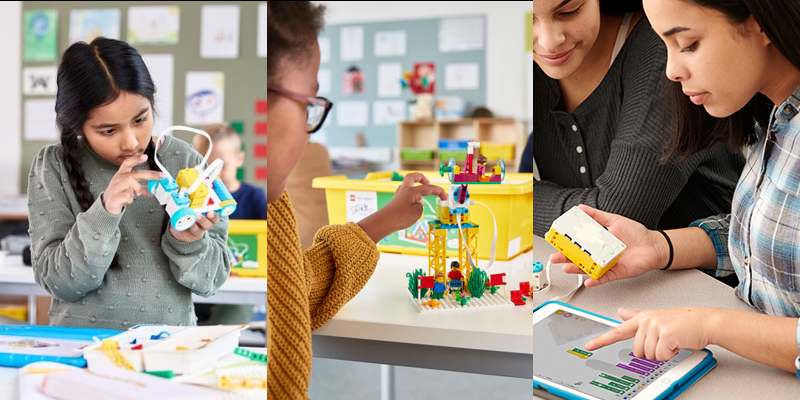
LEGO® Education focuses on STEAM education (Science, Technology, Engineering, Arts, and Math) to provide comprehensive and accessible learning solutions for students in preschool through middle school. Emphasizing hands-on experiences and engaging lessons, LEGO® Education aims to ignite curiosity and interest in diverse subjects. By integrating purposeful play into the classroom, they prioritize joyful, meaningful, and actively engaging learning experiences that improve cognitive, social, emotional, creative, and physical outcomes. The iterative nature of their instructional methods encourages exploration and refinement of understanding. Additionally, LEGO® Education recognizes the significance of social interaction, promoting collaborative learning. Their commitment to STEAM education reflects a holistic approach, fostering well-rounded student development and making education an enjoyable and enriching journey. Through these strategies, LEGO® Education contributes to a dynamic and comprehensive learning environment that inspires students across different age groups.

Striking a Balance:

The Power of STEAM While STEM and STEAM each bring unique strengths to the educational table, the true power lies in finding a harmonious balance between the two. By combining the analytical prowess of STEM with the creative thinking instilled by the arts, we can nurture students who are not only technologically adept but also possess the talent to think clearly, communicate effectively, and adapt to an ever-changing world.

In the ongoing STEM vs. STEAM debate, it’s crucial to recognize that both approaches have valuable contributions to make in preparing students for the future. The ideal educational landscape is one that seamlessly integrates the analytical power of STEM with the creative ingenuity of the arts. By embracing both sides of the spectrum, we can empower students to become well-rounded individuals capable of navigating the complexities of the modern world and contributing meaningfully to society. In the end, it’s not a matter of STEM or STEAM but rather a quest for the perfect blend that unlocks the full potential of our future leaders and innovators.

Contact us

Fill in your details below or send us an email on info@knowledge-hub.com

School Radio Station: Promising Launching Pad For Marketing Skills In The Dynamic Media Landscape

School Radio Station: Promising Launching Pad For Marketing Skills In The Dynamic Media Landscape

School Radio Station: Promising Launching Pad For Marketing Skills In The Dynamic Media Landscape

In today’s dynamic media landscape, radio broadcasting remains a potent tool for communication and engagement. But beyond disseminating information and entertainment, it offers a unique opportunity for students to develop valuable marketing skills that are highly sought-after in today’s job market. Through participation in school radio stations, students can gain hands-on experience in various aspects of marketing, which we will discuss in this Blog.

Market Research and Analysis: Understanding Your Audience

Effective marketing starts with understanding your target audience. Radio broadcasting provides students a hands-on platform to delve into this crucial aspect.

Identify target audiences:

Through audience research, student broadcasters analyze demographics, interests, and listening habits to tailor their content to resonate with specific groups. This includes conducting surveys, analyzing station data, and understanding market trends.

Grasp market trends:

Staying ahead of the curve is vital in the ever-evolving marketing landscape. Students gain exposure through school radio stations to learn about current trends in advertising, social media marketing, and audience engagement, allowing them to develop relevant and engaging content.

Analyze data like a pro:

Radio broadcasting generates a wealth of data on listener preferences and engagement. Students learn to analyze this data, identify patterns, and use it to inform their marketing strategies, ensuring continuous improvement and effectiveness.

Content Creation and Marketing: Mastering the Art of Persuasion

Creating compelling content is key to capturing the audience’s attention and driving action. Participating in radio broadcasting equips students with the skills to:

Craft persuasive messages:

Students learn to write scripts, develop interview questions, and select music and sound effects that effectively convey their message and resonate with their target audience. This includes understanding the principles of storytelling, which is the key to hosting a popular school radio station. The activity fosters persuasive language and an opportunity to build emotional connections.

Become marketing wizards:

From creating eye-catching posters and flyers to crafting engaging social media posts, students gain experience in promotion. They learn graphic design principles, effective communication, and digital marketing strategies, equipping them to promote their radio shows and events effectively.

Develop captivating on-air personalities:

Radio broadcasting thrives on engaging on-air personalities. Students learn to develop their unique voices on their favorite school radio station, master vocal delivery, and hone their interviewing and public speaking skills. This allows them to connect with listeners personally and build a loyal audience.

Event Planning and Execution: Putting Theory into Practice

Radio broadcasting isn’t just about speaking into a microphone. Students learn invaluable event planning and execution skills, including:

Organizing radio events:

Students gain experience planning and executing special events, from live concerts to fundraising drives. This involves managing budgets, coordinating logistics, securing permits, and navigating the complexities of event management.

Building relationships with sponsors:

The school radio station relies on sponsorships to thrive. Students learn to research potential sponsors, develop compelling proposals, and negotiate mutually beneficial partnerships. This enhances their communication, negotiation, and business development skills.

Evaluating success:

Analyzing the success of events is crucial for continuous improvement. Students learn to track attendance, measure engagement, and analyze data to assess the effectiveness of their event school radio station strategies. This allows them to refine their approach and ensure future events are even more successful.

Media Literacy and Critical Thinking: Navigating Today’s Information Age

Beyond the technical skills, radio broadcasting fosters essential media literacy and critical thinking skills, including:

Understanding the media’s impact:

Students in schools across Dubai and other Middle East regions learn how the media shape’s public opinion, influences consumer behavior, and reflects societal values. This critical awareness empowers them to become responsible consumers of information and discerning individuals in today’s media-saturated world.

Identifying bias and propaganda:

Discerning fact from fiction is crucial in an age of information overload. Students learn to analyze media messages for bias, identify propaganda techniques, and develop a healthy skepticism toward online content.

Communicating ethically:

Radio broadcasting provides a platform for learners to develop ethical communication practices. They learn to avoid harmful stereotypes, respect diverse viewpoints, promote positive social change, and communicate responsibly and respectfully.

A study by the National Association of Broadcasters found that students participating in school radio station broadcasting programs significantly improved their communication, teamwork, and problem-solving skills. Additionally, 80% of graduates from such programs reported being employed in marketing-related fields within a year of graduation.

Radio broadcasting offers students a unique and engaging environment to develop valuable marketing skills. Participating in this dynamic platform gives them hands-on experience in market research, content creation, event planning, media literacy, and ethical communication. These skills empower our youth to become well-rounded individuals equipped to thrive in the ever-evolving marketing landscape and contribute meaningfully to today’s information-driven world.

Contact us

Fill in your details below or send us an email on info@knowledge-hub.com

How to Input and Organize Survey Data on Microsoft Excel with the TechnoSales Curriculum

How to Input and Organize Survey Data on Microsoft Excel with the TechnoSales Curriculum

Input and Organize Survey Data on Microsoft Excel with the TechnoSales Curriculum

In the realm of data management, the seemingly mundane task of organizing survey data in Excel holds immense potential to unlock a wealth of valuable insights. This article delves into the significance of data structuring and its impact on extracting meaningful information from surveys. As we embark on this journey of data mastery, we’ll incorporate practical lessons from the TechnoSales curriculum. These lessons will serve as a comprehensive guide for students, teaching them the fundamental techniques of survey data entry in Microsoft Excel, effective data formatting, and essential formula applications.

Importance of Organizing Survey Data in Excel:

Ease of Analysis:

Well-organized data facilitates easier analysis, allowing you to draw meaningful insights and trends. Data Integrity: Proper organization reduces the risk of errors, ensuring data integrity. It minimizes the chances of misinterpretation or mistakes during analysis.

Efficient Reporting:

A well-organized dataset streamlines the process of generating reports. It saves time and effort in creating visualizations or summaries.

Facilitates Collaboration:

If multiple people are working with the data, an organized structure makes it easier for them to understand and collaborate on the project.

Long-Term Usability:

Organized data is more likely to remain usable over the long term. Revisiting and working with data is easier when it’s structured clearly and consistently.

Compliance and Auditing:

For projects that require compliance or may undergo auditing, an organized dataset is essential for transparency and accuracy.

TechnoSales Curriculum Activity

Now that we have seen how important it is to organize data in Microsoft Excel, elementary-grade students can systematically learn these skills under the TechnoSales curriculum by TechnoKids. In TechnoSales, students plan a bake sale to raise money. This task requires them to investigate food preferences and analyze financial data to make decisions about the fundraiser. Findings are organized into a report with graphs to show why their decisions will make the bake sale successful.

The following session plan is covered:

  • Introduction to Microsoft Excel
  • Conducting survey and organizing data on Microsoft Excel
  • Analyze survey results.
  • Representing data in Pie Graph format
  • Preparing a report using Microsoft Word
Through this Blog, you will learn the correct step-by-step procedure to enter survey data and organize Dessert Survey Results
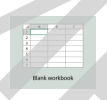
Open Excel and Click and Blank Workbook.

Blank Workbook


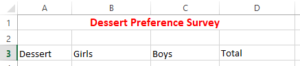
Add the Title ‘Dessert Preference Survey’ and make it look good as a part of the TechnoSales Curriculum lesson plan.
  • In Cell A1 type Dessert Preference Survey

Dessert Preference Survey

  • Merge and Centre the title – Click & drag to select the cells – A1, B1, C1, and D1
  • Under the Home Tab pane, go to the ‘alignment’ section and ‘merge and center.

Merge

To format the text
  • Select the title Dessert Preference Survey
  • Use different options from the Home Tab to experiment with other commands like font style, font size, bold, italics, underline, and color.

Record the survey information.
  • Write column headings as under by moving from cells A1 to D1 by pressing the Right -> arrow key.

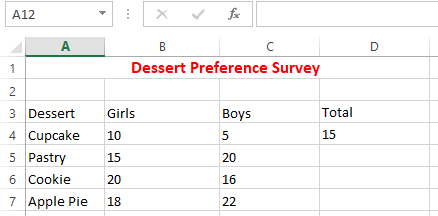
Record the Survey Information


  •  
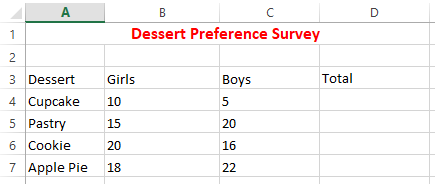
  • Enter the names of desserts under the Dessert Heading in A4 and continue until all the desserts mentioned in the survey are populated.

Record the Survey Information 1

  • Input the counts by indicating how many girls and boys favored each dessert. Press the enter key to proceed to the next cell.

Record the Survey Information 2


Calculate the Total Using the AutoSum Formula
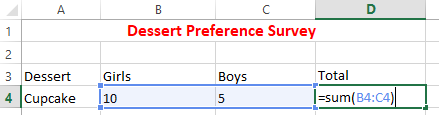
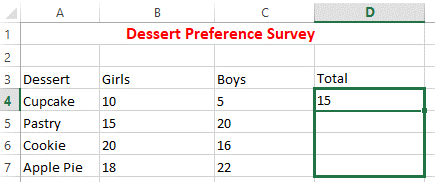
  • Go to Cell D4, select the AutoSum button from the Home Tab, and press enter.

AutoSum Formula

AutoSum Formula 1

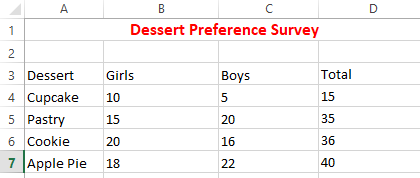
  • Drag the AutoFill Cell down from D4 to calculate the total of other dessert items + and draw inference on the survey under the TechnoSales curriculum.

Calculation

Cal1

If you glimpse through the Formula Bar you will get to see the formulas as;

=SUM (B4:C4)
=SUM (B5:C5)
=SUM (B6:C6)
=SUM (B7:C7)

Rename the Worksheet
  • Choose “Sheet 1,” located at the bottom of the Excel worksheet, then click the right arrow key. Select the “Rename” option and input “Dessert Survey” as the sheet title.

renaming the worksheet

In summary, the TechnoSales curriculum, illustrated by a bake sale scenario, seamlessly guides elementary students in surveys, analysis, and reporting, nurturing robust data literacy and survey organization skills. This integration harmoniously combines Excel’s power with education, fostering insightful decision-making.

Contact us

Fill in your details below or send us an email on info@knowledge-hub.com

Harnessing The Power of Wind: A Journey into 5th-Grade Science Activities

Harnessing The Power of Wind: A Journey into 5th-Grade Science Activities

Harnessing The Power of Wind: A Journey into 5th-Grade Science Activities

Have you ever felt the breeze on a windy day and wondered, “Could we use this power for something more than just making trees sway?” The answer is a resounding yes! Wind is a natural force that has captivated us for ages and is a potent source of clean energy. This blog lets us understand how wind emerges as a superpower by harnessing its potential correctly. As you continue reading, discover a fascinating experiment perfect for exploring wind power and precisely tailored to align with 5th-grade science activities.

The Force Behind the Wind

The wind is the movement of air masses from areas of high pressure to areas of low pressure. The Earth’s uneven heating by the sun is the primary driver of these pressure differences, creating the atmospheric conditions that result in the wind. Force of the wind is determined by its speed and density. When wind speeds increase, its force grows exponentially. Wind turbines can harness this force to generate electricity.

Wind Turbines: Converting Wind Force into Energy

Wind turbines are modern marvels that transform the wind’s kinetic energy into electrical power. The turbine resembles a towering structure consisting of blades attached to a rotor, which spins a generator to produce electricity. The design of wind turbines is crucial in optimizing their efficiency. The blade’s shape, size, and height of the turbine are all factors considered to capture the maximum amount of wind energy. As part of 5th-grade science activities, have you ever undertaken a project on turbines in class?

Wind Energy: Clean and Sustainable

One of the key advantages of wind energy is its sustainability and environmental friendliness. Unlike fossil fuels, wind energy production does not emit greenhouse gases or other pollutants, contributing to a cleaner and healthier planet. As technology advances, the efficiency of wind turbines continues to improve, making wind energy an increasingly viable option for powering homes, businesses, and entire communities.

The Future of Wind Energy

Looking to the future, wind energy is poised to play a growing role in our global energy landscape. Advances in technology, increased investment, and a growing awareness of the need for sustainable energy sources are driving the expansion of wind power. Offshore wind farms hold great promise for capturing strong and consistent winds, providing a vast source of clean energy.

LEGO® Education BricQ Motion Prime Set makes 5th-grade science activities easy Land Yacht Experiment Materials required:

  • Land Yacht kit containing bricks, sails, and wheels.
  • A fan to provide the wind force.
  • Strips of tape to mark starting positions
  • Worksheets to record observations and data.
  • A sense of curiosity and a thirst for scientific understanding
Experiment 1: Downwind Sailing

Assemble the land yacht model to examine the behavior of the yacht sail downwind on a land surface. Position the yacht on the starting line and watch it slide as the fan’s breeze pushes it forward effortlessly.

Optimization Quest

Intrigued by the land yachts’ downwind performance, it is time to embark on an optimization quest to determine the ideal sail angle and shape for maximizing downwind travel. Start experimenting with various angle adjustments and sail configurations. Later, record the observations. The goal is to achieve the greatest distance traveled, driven by the wind’s invisible force.

Experiment 2: Crosswind Challenge

Introducing a new dimension, now shift your focus to crosswind sailing. Position the land yachts perpendicular to the fan to check the wind’s sideways force. With subtle adjustments to the sail angle, guide the land yacht across the fan’s breeze, observing its lateral movement.

Experiment 3: Upwind Adventure

The final experiment takes you on an upwind adventure, attempting to defy the wind’s natural direction. Strategically angle the land yachts slightly towards the fan, seeking to harness the wind’s power to sail against its flow. Manage to steer the land yacht upwind, albeit at an angle rather than directly into the wind.

Unveiling the Mysteries of Invisible Forces

Explore the intricacies of wind force and its impact on object motion as an integral topic for 5th-grade science activities. Through the experiment, students discover that wind.

In wrapping up our exploration, it’s clear that wind isn’t just a gentle force; it’s a potent source of clean energy. The hands-on experiment designed for 5th-grade science activities showcases the dynamic nature of wind energy, from downwind sailing to optimizing sail angles—an engaging journey for students, fostering curiosity and understanding in the captivating world of wind power.

In concluding our exploration, it is evident that wind is not merely a gentle force but a potent source of clean energy. The hands-on experiment illuminates the dynamic nature of wind energy—from downwind sailing to optimizing sail angles. Thanks to the LEGO® Education BricQ Motion Prime Set, conducting 5th-grade science activities and explaining the concept of wind and motion through hands-on projects is now easily achievable. The set is readily available in Dubai and other Middle East regions.

Contact us

Fill in your details below or send us an email on info@knowledge-hub.com