
Benefits of Screenless Coding Using The Matatalab Pro Kit

Benefits of Screenless Coding Using The Matatalab Pro Kit

Benefits of Screenless Coding Using The Matatalab Pro Kit

We know that children have short attention spans. A 9-10 year-old kid has an attention span of about 20-30 minutes. There are so many distractions around the little ones, that they may not be able to sit steady and focus.

Also, excessive screen time is a major concern, as it is found to increase the risk of obesity and impact the child’s sleep patterns. Technology can also cause emotional problems and a feeling of isolation that can negatively affect the overall development of the individual. So how can one be a coding hero and impart lessons to kids without actually getting them to sit in front of a computer?
Introducing Screenless Coding

We are aware of online coding taught by coding classes using computers & laptops, but what is hands-on coding, and can one ever learn a programming language offline? Although this seems to be a new concept, it is being readily accepted and adopted by schools in Dubai and also other regions of the Middle East. Matatalab is one of the best screenless coding tools that’s being preferred by educators, children, and parents, so as to make coding as easy as learning a new language in school.

What is Hands-On Learning?

Hands-on coding can be any activity where students can make use of concrete manipulatives to practice coding concepts. Learning by doing teaches children to undergo real experiences, as being able to touch and see something is more powerful, than merely learning from a textbook. Children feel involved when they are engaged to learn and can use their sense of touch to feel the materials. Some kids are receptive to auditory expression, while others find visual learning more exciting. Subjects like math, science, and even coding are made uncomplicated & easily digestible, thanks to hands-on teaching techniques.

What is Matatalab Pro?

Matatalab Pro is specially curated for children 4 years and above who wish to start their coding journey in their early preschool years and continue thereon. The unique thing about this program is that it is completely simplified and just as kids would learn ABC, they can learn the basics of programming using a game-based approach. What is Matatalab Pro? Matatalab Pro is specially curated for children 4 years and above who wish to start their coding journey in their early preschool years and continue thereon. The unique thing about this program is that it is completely simplified and just as kids would learn ABC, they can learn the basics of programming using a game-based approach.

Salient Features of Matatalab Pro

You might just fall in love with coding and embark on a journey that may lead you to an exciting career path later on in life, with this most revered Matatalab kit. Since kids start at a young age learning with Matatalab, it will grow on your child and improve their STEAM learning capabilities.

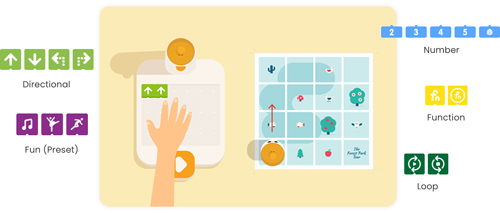
  • Learning to code will seem like playing with building blocks. There are a variety of blocks that come along with the kit, each representing a different command with arrows, numbers, and action symbols drawn on it.
  • The lessons are planned meticulously and advance from easy to tough, dividing the entire program into phases such as; Starter Pack (includes symbols, directions, and short commands), Mover (includes numbers, longer commands, and events), Computational Thinker (Pattern, loops, and functions).
  • There are several Ad-on accessories that make learning fun; musician ad-on, artist ad-on, sensor ad-on, Matata map.

Increases Computational Thinking

Capabilities Computational thinking is basically breaking down the problem into simple & easy steps, such that one will easily be able to understand and learn. Matatalab follows the principles of computational thinking and adapts the same in the following manner;

Decomposition – Complex codes are broken down into step-by-step patterns and then students need to put their learning to the test by reproducing the same in exams.

Pattern Recognition – It is the process of finding similarities and differences amongst multiple problems.

Abstraction – Children learn to ignore unimportant details and focus on the most important action points.

Algorithm – Taking appropriate action to organize them into a series of commands to solve a problem.

Therefore, Matatalab brings coding into your classrooms and integrates well into the STEAM curricula.


Contact us

Fill in your details below or send us an email on info@knowledge-hub.com

Figure of Speech: Their Examples and Explanation

Figure of Speech: Their Examples and Explanation

Should Students Solely Focus on Grades or Be Good At Extracurricular Activities Too

A figure of speech is an intentional deviation of words from their normal usage to produce a rhetorical effect. It adds drama and spice to the normal choice of words. What would it be like if there were no figure of speech used in plays written by Shakespeare! Boring right. Even novels and books under the fiction category make use of ‘figures of speech’ to make the paragraph more captivating for the reader and induce some amount of humor & emotions while reading. In today’s digitally inclined world, we can see its usage in advertisements, social media posts, and marketing campaigns across the net.

There are a number of different kinds of figures of speech, serving different purposes. The primary goal is to draw attention, but each may be for a different reason. For example; he is as tough as nails, is an example of a simile, where the person or thing is compared to another, for the sake of emphasis.

This blog aims to highlight some common ‘figures of speech’ with examples for better understanding.

#1 Personification

You will find references to personification in children’s story books. Here, the idea, thought, or inanimate object is given a human form, for the sake of provoking imagination. This is a good way to draw the attention of the reader to something that’s important in the poem or story. Here are a few examples: 

  • The sun smiled across the sky.
  • My alarm clock buzzes away loudly, to wake me up each morning.
  • The flowers danced in the wind.
  • The chair sighed, as that heavy woman sat on it.

#2 Onomatopoeia

Wow, such a tongue twister name to the figure of speech it is! Onomatopoeia is used when a word is written to describe a sound. An action that puts sound into language, to create an effect in nursery rhymes and theatrical performances, is a representation of Onomatopoeia.

For example

  • The water droplets went splish-splash when children jumped on the puddle.
  • The owl hooted loudly last night.
  • Students were chattering away during Math class.
  • The rooster cries ‘cock a doodle doo’ at the time of dawn every morning.

#3 Oxymoron

Oh, how life is a bittersweet symphony! Oxymoron uses contradictory words that go against common sense, but still, hold true. The contradiction creates a paradox in the minds of the reader, but still manages to produce a concept that has a new meaning. Without even realizing it, we use these common phrases often in conversation with someone.

  • It is an open secret that she is expecting a girl child.
  • Melinda and her fiancé share a bitter-sweet relationship.
  • Vir Das is a seriously funny comedian.
  • The salad dressing at the restaurant was awfully good.
  • Climb down the stairs to reach my residence at Greenway Gardens.

#4 Hyperbole

When you want to exaggerate a statement and make it appear as important as a king, then make use of the Hyperbole speech. Let’s have a look at some examples; -It’s been ages since I have worn these shoes to the gym.

  • I died of embarrassment at the party.
  • It’s raining cats and dogs.
  • He’s as skinny as a scarecrow.
  • I’m so hungry, I could eat a pig.
diverse-kids-reading-books

#5 Pun

A ‘pun’ usually introduces playfulness by offering two meanings of the same word and leaving the reader to figure out for themselves the underlining emotion. Some playful examples of puns are as below;

  • You were right, so I left the restaurant.
  • The butcher did not want to take a risk, as the steaks were too high.
  • Why did the Teddy bear refuse to have tea? Because he was stuffed. Where do Polar bears vote? The North Poll.

#6 Irony

Irony is the most common figure of speech, used widely while conversing. The sentence or words used mean literally opposite to its actual meaning. Basically, irony is used to indirectly put a harsh message across, in a sweet manner. Some examples of irony are;

  • After looking at Monica’s poor score, her class teacher said, “You will surely stand first with the highest honor in class.”
  • Coming home from a stressful day and seeing a messy room, “it’s great to be back home.”
  • The good news is, that, “it is snowing outside and we are stuck at home.”
  • A fire station burned down yesterday.
  • Our dentist needs a root canal.

By practicing simple figures of speech, one can improve their spoken and written English. Knowing what words to use to frame a correct sentence doesn’t come naturally, but needs some practice. So, try and make your day-to-day conversations more interactive & engaging by using the appropriate figure of speech.

Reading Eggs is a readily relatable rapid reader program available in GCC regions and other Middle East countries. Now that’s how we use alliteration! This platform is available for students between 2-13 years of age and aims to improve their vocabulary & reading skills, by offering a whole library of books & gamified puzzles. Those residing in Dubai or UAE who wish to register for a FREE Trial.

Contact us

Fill in your details below or send us an email on info@knowledge-hub.com

Should Students Solely Focus on Grades or Be Good At Extracurricular Activities Too

Should Students Solely Focus on Grades or Be Good At Extracurricular Activities Too

Should Students Solely Focus on Grades or Be Good At Extracurricular Activities Too

For ages, there has been a debate about whether students should dedicate all their efforts to studies or also pay some attention to sports, dramatics, art, and other such extracurricular activities.

Well, there is no straightforward answer to this and each student needs to find his or her niche. However, the fact remains that when you are approaching colleges for admissions, they prefer an academically sound student, while also excelling in any other vocation, which is a bonus.

High graders who score brilliantly in SAT have many options of colleges at their disposal and can literally choose the one they wish to apply for. On the other hand, average graders may not have too many college options, but they can get admission basis their co-curricular achievements.

Colleges would love to have someone who is a national-level dancer and is also a sincere student at the same time. So if you want to ‘stand out’ and be more than just a bookworm, go out there and do what you love the best.

Often students who excel and are a master of their act, are said to be more emotionally evolved and socially accepted, besides being physically fit. They display a spirit of healthy competition, which is essentially the need of the hour. Even in an office environment, employees who display more enthusiasm and courage, move up the ladder sooner than one who is simply good at his work but doesn’t participate in social events.

Here are some good reasons to inculcate a liking for extracurriculars, alongside studies:

#1 Develop a Hobby

Students are often burdened with studies and they need some activity that could help take their minds off the stress. Hence, extracurricular activities help children discover a new hobby and drive them to follow their passion, which could turn into their profession later on in life. Spending time doing something you like and enjoy, is the greatest gift.

#2 Enhanced Skills

Every sport or activity has the potential to instill skills and personality traits in the student. For example; being an athlete teaches you to be consistent and accept that winning & losing is all part of the game. A dancer will have good hand-eye coordination and also be creatively inclined.

#3 Higher Academic Performance

The skills that you acquire while pursuing the art form, will come in handy at the time of studies. For example; those who are involved in community service will have an innate potential to solve problems and this skill comes in handy while solving math sums. Even well-documented research shows that students who scored well academically were experts in their chosen field of co-curricular avenues.

#4 Socially Conscious

Children who engage in activities meet with other like-minded friends and interact with them. They bond together and build lasting relations. In this way, a child learns to make social connections and is more confident while interacting with people.

#5 Time Management

When kids juggle school studies and go for cricket training, they become champs at time management. Developing a well-balanced approach will enable the individual to go far in life and later they will know how to devote time not just to work, but to family and hobbies as well.

#6 Empathy & Tolerance

Engaging in community service and setting aside time to do something good for others, is a quality that must be inculcated as early as possible in life. Some schools encourage students by giving extra marks and certificates for working certain hours at an NGO and dedicating their time to social service.

So now that we know the numerous benefits of devoting time & effort to co-curriculars, be assured your time at tennis coaching won’t be futile.

Kids are way too smart and tech-savvy these days and they can use this to their advantage. Ace a coding Olympiad and other such computer science competitions, by practicing ‘computer skills’ via the TechnoKids platform. Especially in digitally advanced countries like Dubai in the Middle East, a great emphasis is paid to teaching kids the nuances of technology, as they believe the dawn of tomorrow will be made even brighter with the advent of technological innovations. Alongside the west, UAE & other GCC regions are emerging as a superpower by offering the world record-breaking infrastructure, thanks to enhanced engineering prowess and correct use of technology. So, let’s get smarter with TechnoKids (link), another great co-curricular activity you can invest yourself in.

Contact us

Fill in your details below or send us an email on info@knowledge-hub.com

Why Robots Are Becoming More Human-Like

Why Robots Are Becoming More Human-Like

Why Robots Are Becoming More Human-Like

Robots these days have become smarter than ever before. Along with an increased IQ (intelligent quotient), they are programmed to demonstrate an EQ (emotional quotient) which makes them express emotions, just like we do. Does that mean the plastic body robot, powered by a battery is going to take over the human race? Well, relax, that is really not the intention. In fact, the robot is built with great precision to help humans and assist them to take on tasks that are dull, difficult, and dangerous for us. Though there’s a long way to go before a robot can completely replace human intervention, AI has definitely put some soul into the machine.

So let us see what are the advantages of having a robot friend around across different environments:

Robots in Households

Domestically programmed robots are experts at running mundane errands and reducing the burden of homeowners significantly. These fascinating assistants can mop the floor, clean your swimming pools, change the light bulb, fold the laundry, and even make coffee for you. They are capable of doing all this with a smile and never complain about getting tired! Not only this but they are also wired to provide emotional support to the elderly and even nurse them to good health. Babysitting is another job they are good at. Your kids are sure to be entertained by admiring the cartoon-like eyes of the robot and the funny facial gestures they make before singing your kid to sleep. So, essentially your friend can perform multiple jobs in the house with ease.

Robots in Offices

We have heard of robots working on heavy machinery and helping carry loads around the factory, which is otherwise a very difficult & dangerous task for the workforce to accomplish. While these industrial bots are excellent, even corporate headquarters and office set-ups have started employing humanoid robots to contribute here & there. These buddies can be deployed to get printouts from the printing machine or even manage accounts of cash coming in from customers. They have even taken over the security desk and keep a check on vendors who enter the workplace while having the add-on task of monitoring their body temperature. The best part is, that they don’t need breaks, would never ask for a leave, and speed up the process, thereby leaving employees more time to accomplish important goals, instead of wasting time on unnecessary tasks.

Robots in Educational Institutes

Robots have come to play a major role in fulfilling the learning and developmental needs of students. Modern-age education is focused on STEM (Science, Technology, Engineering, and Math) curriculum, which is adopted by most schools in Dubai and other regions of the Middle East. Through this, children develop skills such as computational thinking & problem solving, which is the need of the hour. Robots encourage students to learn technical stuff in an engaging & interesting manner. Group projects on coding and learning programming languages become easier, thanks to the creativity used by children to power robots and build apps, just like inventors do.

Miro-E is an excellent example of an educational robot used in most science labs across schools in developed nations like the UAE. This cute animal-like-looking friend acts as a companion for students to learn difficult topics of computer science, robotics, and other such lessons. This pre-assembled character is made of a number of sensors, motors, and software operated by brain-based control systems. It also demonstrates emotions such as; moving, thinking, speaking, observing, hearing, and feeling. Miro-E inspires us to keep learning and exploring further. To know more about Miro-E and its availability in GCC regions, visit our link: https://knowledge-hub.com/miro-e/

Contact us

Fill in your details below or send us an email on info@knowledge-hub.com

An Easy Guide To Curating A Professional Newsletter

An Easy Guide To Curating A Professional Newsletter

An Easy Guide To Curating A Professional Newsletter

A Newsletter is a medium of communication used by organizations to share information with customers and other stakeholders within the business network. They are sent to the recipient’s inbox via email or a print version is posted to their home address. Though we are in the age of a social media revolution where snippets of content are spread in an easily understandable & engaging manner, a newsletter acts as a back-up to support the social media campaigns. What can’t be elaborated in a 3-liner post on Instagram, can be explained in greater detail in the newsletter.

There could be numerous purposes for which a newsletter is drafted such as; promoting the launch of a new product/service in the UAE region, simply keeping in touch with followers, or even appealing to audiences to subscribe to the brand’s social pages. Whatever the aim is, a good newsletter has the potential to achieve it all.


Here are a few steps to create your newsletter:

#1 Prepare a Strategy

Have clarity as to what is the aim of sending the newsletter. Also, be clear about your target audiences. The communication must be in sync with the marketing strategy. As per the goal, the content specialist can curate the wordings. A newsletter announcing a discount offer is worded differently, from the one which highlights the star performer for the month or the one that sends across e-greeting wishes on specific festivals. Another important factor to consider is how often would you be shooting out the newsletter. Keep in mind that the frequency and timing are as important as the content. If you keep bombarding inboxes every now & then, you may lose subscribers and the click-through rate may be very low. Some may even mark you as spam and ignore the message. The aim is to not be too pushy, but to stay on top of your target audience’s mind so that they don’t forget about you.

#2 Newsletter Content & Headline

In case you are sending an e-newsletter, make sure the subject line is catchy, but not too confusing. Even the titles and sub-titles must be cleverly chosen so that there is no ambiguity about what lies ahead when one decides to scroll further or turn the pages of the printed copy. Keep the wordings crisp, make it fun to read, and be unique with the content. Set the flow right, by establishing a strong introduction, followed by a body copy, and then conclude using positive statements, followed by a call to action button that leads them to a landing page.

#3 Design and Images

An important element to consider is how presentable the newsletter looks. There are so many interesting templates and layouts to choose from if you use the right newsletter-making software which is easily available online. Make sure the images aren’t pixilated and ensure you crop them correctly before inserting them into the newsletter. The color contrast must be carefully decided such that the background blends well with the font. Even the logo should be placed in a prominent position and look as though it all fuses together.

#4 Add Personal Touches

Make the recipient feel special by customizing content based on their taste & requirements. These small acts of going out of your way and making audiences feel special will go a long way. Spell names correctly and send special newsletters on birthdays wishing your customers. Shoot-out welcome emails and special surprises to new buyers and acknowledge the loyalty of the old ones by giving them gift points that can be converted into cash discounts.

#5 Mailing List

Preparing a detailed mailing list is like a treasure trove that needs to be valued. It is like a holy grail that needs to be kept up-to-date so that the emails are sent to the correct recipient.

Flipped Learning

So now that you know the tricks & trades of curating a newsletter, get started right away! Wait, but what if you are in school and had to make a newsletter as your classwork project assignment?

This module is dedicated to school students who wish to learn how to prepare a professional-looking publication using Google Docs or Microsoft Word platforms. TechnoKids has marked its way into educational institutes across Dubai in the Middle East and other regions like GCC. The kit furnishes you with resources and lesson plans that allow learners to create a front cover for the newsletter, draft content & add taglines, and finally distribute it amongst their classmates in print and online formats.

Contact us

Fill in your details below or send us an email on info@knowledge-hub.com