

Fostering Imagination & Nurturing Curiosity In Children: The Building Blocks to Success

Fostering Imagination & Nurturing Curiosity In Children: The Building Blocks to Success

Fostering Imagination & Nurturing Curiosity In Children:

The Building Blocks to Success

Imagination is the beginning of invention. It can transport you to any place and bring ideas to life. Children are intrinsically imaginative. Their imagination helps them gain confidence and a sense of regulation and they begin to see things differently. They begin to question things they don’t understand. It is imperative that teachers and parents alike nurture the child’s curiosity and imagination to bring ideas to fruition.

MatataLab is reshaping the world and harnessing the power of children’s imagination by guiding them to master technology in an easy way. It has been determined to provide cognitive and creative technology tools through which children between the ages of 3 to 9 years can learn coding. In Dubai as well as the rest of the UAE, Matatalab’s coding robots have grown from strength to strength and become a much sought-after tool, for kindergarteners, elementary schools, and educational establishments for their ground-breaking STEAM educational solutions.

Middle East schools believe that learning that takes place in collaboration with the students themselves is essential to their educational journeys. Students who are not imaginative or creative can experience trouble envisaging beyond the standard and reality. Most GCC schools have harnessed the advantages of imaginative play or dramatic expositions into subjects and topics taught at school in place of imparting textbook knowledge.

They have found that a deeper knowledge of the topic permeates the classroom when topics are approached in this manner. Imaginative play also helps to build communication skills and social interactions as children experiment with language and communication with their peers. Help your child enhance his fantasy world by inventing scenarios for him where he can test the limits of his capabilities. You may also encourage reading all sorts of books which develop reading and learning skills and participate in all subjects of the curriculum.

Similarly, translating the same topics into art and having a ‘wall of art’ will allow children to construct a complete fantasy world around the images they view and transport them to that imaginary world.

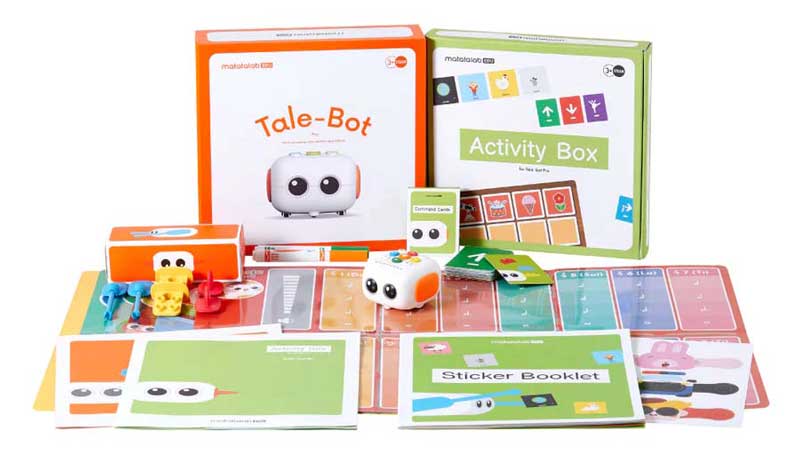
Every invention that we are grateful for today was once part of the imagination of a creative little boy or girl. When a child grows up imagining a world without physical limits, he often sees things in a new light and achieves the unthinkable. Encourage your child to play with open-ended educative toys such MatataLab’s Tale_Bot Pro Program, which helps students between ages 3-5 years to practice hands-on coding. It also provides Add-on features that complement one’s learning and skill development. The Artist Add-On is great to extract some creativity from your child, while the Musician Add-On converts your little one into a pianist & allows him to compose lovely music. Imaginative play using the MatataLab kit allows kids to hone coding skills and be creative. A perfect win-win!
As parents, you can help spark the creativity and imagination of your child by showing an active interest when they share stories about their day as well as by asking questions that prompt them to think and ponder about alternate solutions. Questions like ‘What if…’ or “How else…” plant seeds of alternate options in a child’s mind and from where they can take off in a completely new direction. By asking questions and showing an interest, the child learns that sharing his thoughts and stories is not scary and he feels less inhibited about sharing. Adopt the role of a cheerleader in the time you spend with your child and try shedding the role of a judge as far as you can. Encouraging feedback is the key here.

In conclusion, the next time that your child comes to you with a handful of play dough or a bucket full of building blocks, take time out to encourage the endless play options rather than tell him you have chores to complete yet. And if the chores simply cannot wait, then there is always MatataLab, the online platform which encourages learning for your child using technology in the same educational and fun manner.

Contact us

Fill in your details below or send us an email on info@knowledge-hub.com

The Advantages of Coding at Night: Burning the Midnight Oil to Bring Ideas to Life

The Advantages of Coding at Night: Burning the Midnight Oil to Bring Ideas to Life

The Advantages of Coding at Night:

Burning the Midnight Oil to Bring Ideas to Life

As children, we have all been told “There is a time and place for everything” and that still holds true. Various parts of the day are perfectly suited to certain types of activities. For starters, people not only in Dubai but all over the world, find that the early hours of the morning are best suited to exercise to refresh the mind and body. Similarly, most students find that the morning after a good night’s rest is best suited to complete tasks that require concentration and learning. Hence, they prefer to wake up early and study for a test rather than burn the midnight oil.

With reference to software developers, their preferred time of day to focus on work is at night. Nighttime is when they get the most work done. One of the main reasons could be that, coding is their secondary job or hobby and hence they are able to devote time only once they have returned from their day jobs.

Coding requires focus and hours of committed concentration and so developers prefer to work at it before or after the grind of day-to-day life. This kind of work-life requires prudence to ensure that they do not overwork themselves by burning candle at both ends.

There are many other reasons why developers like to work during hours that would seem odd to the rest of us. They require larger chunks of uninterrupted time as compared to a white-collared worker. An office-goer can schedule his day into 15-30 minute slots for his meetings, checking emails or brainstorming with his colleagues.

A coder who works on large abstract systems needs longer, uninterrupted periods to process a model in its entirety. Software development or programming takes many hours to effectively put together and the distractions of the day prove to be counterproductive. Hence, most developers prefer to work at night when they can be most productive.

Software development is also a creative job that requires ideation. The essential mental stimulation that is required is at its highest when they are relaxed and stress-free. The noise and time pressure that is associated with daytime activities are taken off their shoulders at night, thus allowing them to produce quality work.

Another reason which actually necessitates coders to work at night is that they work in tandem with other programmers from different countries and may need to communicate with them in real-time. For instance, a developer from the UAE may need to brainstorm with another developer working out of the USA through open-source communication tools.

It is also common practice for a programmer to fall asleep thinking about the information and suddenly come up with innovative ideas, prompting them to jump out of bed and continue into the wee hours of the morning.

So, as we have seen, software development is an interesting job to have which will be much in demand in the future.

Code Monkey is an award-winning online platform that teaches real coding languages in a fun, gamified manner. It is very popular with Middle East schools as well as parents in the GCC areas. Students studying in K-8 grades start coding early due to the popularity of the STEM model of learning. Code Monkey believes in the adage ‘catch them young’ and allows first-time coders to develop an interest in the subject through simplistic activities.

Contact us

Fill in your details below or send us an email on info@knowledge-hub.com

Age-Appropriate Milestones for Math Learners

Age-Appropriate Milestones for Math Learners

Age-Appropriate Milestones for Math Learners

What is Age-appropriate Learning?

The child starts observing things around him and gathers interest in learning about the environment, as soon as his sight is developed, between 5-8 months. This means learning starts even before the kid enters a daycare center or preschool. As the child progresses with age, the brain starts preparing neural pathways which allows him to remember and grasp the concepts taught in school.

Though the child may be brilliant enough to absorb large amounts of information at toddler age, it doesn’t mean he should be able to memorize the World Map by age 3 or know the multiplication of 2-digit numbers like a professional.

Age-appropriate learning, which is practiced across most schools in Dubai, is a method that encourages children to grasp knowledge, as-per their level of readiness. The idea is to make the child feel comfortable enough and not get too stressed about their studies. After all, all knowledge and no play time makes Arham a dull boy!

Age-Appropriate Math Learning

‘I Love Math’, never did a child say that at the first go! A liking for the development of Math Skills is a step-by-step progressive agenda. It is the prerogative of teachers in GCC schools and parents, to inculcate a liking for the subject by adopting various easy-to-relate strategies, to make Math a joyous subject. So, let’s look at the stages at which a Math learner should acquire skills, and how involvement must be fostered, to make it an enjoyable process. 

Development of Math Skills At Different Age Groups

At 0.8 – 3 years of age 

This is the pre-match phase, where children get introduced to numbers and math concepts like shapes, without actually progressing toward their functionality. It is literally the foundation of the Math program and thus, the basics have to be very strong. If the educator sets the right tone, it enhances the child’s analytical skills and facilitates growth opportunities. 

  • Learning to count numbers from 0 to 9  
  • Arranging objects from big to small and small to big order  
  • Understanding different shapes such as; round, square, rectangle, & triangle and associating objects with different shapes  
  • Introducing opposites like; long – short, in – out, large – tiny, etc.  
  • Making use of words such as more, less, greater, and minor; while conversing & using day-to-day vocabulary 
  • Playing games where the child fills a glass container with water and observes the difference in level and volume  

Use attractive materials and teaching aids such as; child-friendly plastic coins for counting, beads for counting & sorting, wooden manipulatives for learning shapes, and stacking wooden blocks as per the size, so that they can understand the concept of big & small. The above-mentioned material can be ordered on Amazon or purchased from a well-known local educational toy shop in the UAE.  

At 3 – 5 years of age 

By the age of 3, the child loves to experiment and develops curiosity. Students begin to get amused by gaining knowledge and get excited if you show them visually stimulating content that inspires hands-on learning. Some ideas to try with your Math learner in this age group include; 

  • Knowing how to count until 40 
  • Learning how to write number names till 20 
  • Going beyond simple shapes and being able to recognize; pentagons, rhombi, trapezia, hexagons, etc. 
  • Sorting objects as per different permutations & combinations (shape & color, quantity & size, odd & even numbers, etc.) 
  • Explaining what money is to children and its importance 
  • Matching the number of pom-poms with the corresponding digits 
  • Backward counting numbers from 10 to 1  
  • Comprehending the meaning of ascending order and descending order 
  • Solving puzzles and recognizing patterns to fit pieces together, to make a big picture
  • Knowing what greater than, less than, and equals to is and correctly placing the appropriate sign, as it should be
  • Taking the first step towards observing the different marks on the ruler and identifying what inch and cm, indicates
  • Able to correctly write the date in dd/mm/yy format and read the calendar 
  • Starting to note the time and recognize the difference between seconds, minutes, and hours    

By the age of 3+, children have a taste of digital teaching aids and therefore prefer learning on their tabs and mobile devices. To support Math learning and make it gamified, Mathseeds presents an excellent App-based platform for children of ages 3 and above. Mathseeds is quite popular all over the Middle East and they also offer a 30-day trial to start with. Their mascot Eggy is loved by all and challenges children to advance in Math via colorful animations, catchy music, and exciting rewards. So let’s motivate our children to be Math Experts, by following a patterned approach to teaching & make every small milestone count. 

Contact us

Fill in your details below or send us an email on info@knowledge-hub.com

Tips to Curate an Effective Video Advertisement

Tips to Curate an Effective Video Advertisement

Tips to Curate an Effective Video Advertisement

Video content is taking over the internet and social media by storm. An average consumer watches around 5 hours of video content on YouTube & other social media platforms per day and that’s quite a lot of time & dedication one invests each day.

What are video advertisements?

Video content is easy to consume and has a better recall, as it combines audio-visuals and graphic content which drives the precise information across in less than 13 minutes of watch time. Marketers keep aside a sufficient chunk of their advertising expenses for promoting video Ad content to targeted viewers.

Here are a few tips to make Videos appealing

#1 Personalize Messages

For a brand to stand out and attract attention, personalization offers far more scope as it creates a unique experience that consumers may have not received from any other source. Stats suggest that 90% of users are more likely to purchase products that resonate with their tastes and likings while seeking positive advantages that they are looking for from products or services. Personalization offers the opportunity to initiate a great conversation, establish deeper connections, increase brand credibility not only in GCC but all across the globe, and earn trust too.

#2 Keep It Short

Short and high-impact are the two important tips that you need to keep in mind. Best Ads are those that present creativity and take the audiences by surprise, within 15 seconds to a max of up to 2 minutes. This data is backed by research and survey results are in favor of content being 30 seconds or lower, so if you are thinking otherwise, we advise not to waste time, energy, money & resources on asking your video editor to add too many details and lengthy messages, which no one would be interested in reading anyways.

#3 Master the Art of Storytelling

Direct selling a product like a sales pitch via an advt. is not a good idea. People want to be entertained and at the same time be touched by stories that resonate with their lives. It depends on what your product is, but some messages that really touch people’s hearts are about stories that depict; a win after a failure, developing bonds with real friends & family in this fast-paced age of digitalization, and those that break stereotypes & go beyond societal stigmas. On the other hand, starting a wacky trend & adding some upbeat tunes to the Ad, also works just fine. Be imaginative, think out-of-the-box, and make the video as fun as possible.

#4 Include a Call-to-action

Now that your audiences have seen and appreciated your Ad, what next? A call to action feature is included at the end of the video so that one can take the action of clicking on a link and visiting the product landing page or service offering website. If you’re running a special offer, then instead of going through the long process of visiting the site and then navigating to the sales page, you can get people to directly reach the link.

TechnoCommerial by TechnoKids

To make your kids Media Savvy from an early age, the TechnoKids program presents to you the TechnoCommercial course. It is readily available for students in Dubai and other regions of the Middle East, and its salient features are as follows;

  • Be a pro at media analysis by doing some research about current trends and imagining how best students would like to incorporate the same in their projects.
  • Participants get an opportunity to use video equipment tools and blender to learn & cultivate their editing and video marketing skills.
  • Alongside mastering the art of creating meaningful commercials, children develop critical thinking skills, and problem-solving abilities, which are very much part & parcel of today’s STEM curriculum, practiced across schools in UAE.
  • While working with other co-creators in class, children brush up on their communication skills and learn to work in teams.
  • A reel story is taught in a proper manner as it would be done in real life. This includes stages such as; identifying the target group, adding video effects, music & transition slides, doing an actual recording with a camera, creating a storyboard, including voice-overs, and finally going live!

Contact us

Fill in your details below or send us an email on info@knowledge-hub.com

Negative Side-Effects of Excessive Screen Time For Children

Negative Side-Effects of Excessive Screen Time For Children

Negative Side-Effects of Excessive Screen Time For Children

Spending time on social media browsing through content has turned one’s hobby into an addiction for children. Ready access to fast WiFi connectivity and digital devices like tabs, laptops, and mobile phones, has affected the student’s attention span and reduced their physical activity, thus impacting overall development. Let us through this Blog understand the perils of excessive screen time on children so that parents & educators become vigilant about restricting its usage. 

Emotional Disturbance 

Children who are hooked to their PCs for more than 2 hours a day, are unable to process their emotions and even become irritable easily. An aggressive child may lose the ability to make proper judgments and fail to be empathetic towards each other. 

Social Isolation 

According to research by the American Journal of Preventive Medicine, higher usage of social media makes children three times more susceptible to social isolation. The sense of loneliness increases and there are higher chances of depression and anxiety. By the age of 4, a child should have many friends and spend time bonding with them. However, the sad truth is most preschoolers are homebound and geared to video games and unwanted play apps. 

Strain on Eyes and Restricted Physical Development  

It is no surprise that staring at the screen affects the eyes due to excessive strain and may cause problems with vision. To develop muscles, children need physical activity for at least an hour each day, if otherwise, one may suffer from obesity and develop all kinds of aches and pains at an early age. Kids who spend time outdoors are more agile, smarter & happier. The added advantage of exposure to Vitamin D improves bone health and uplifts the mood. 

Disturbed Sleep Patterns 

The increased use of digital devices in schools (especially across institutes in Dubai in the Middle East) and at homes causes increased alertness and doesn’t allow the body to be in a state of rest. This hyperactivity, especially streaming videos late through the night causes restlessness and leads to difficulty in sleeping. They say the blue light that is emitted from devices has a great negative impact by reducing melatonin (which is a hormone needed to have a good night’s sleep), thus causing insomnia. 

Low Self-Esteem 

Children need sufficient time to discover the world around them and also find a safe zone for themselves to discover their self-worth. Developing one’s own confidence, creativity, & passions, is beneficial in the long run and it is best if done early-on in life. Regretting spending golden years of one’s life just scrolling through your devices is such a regrettable decision, which will do no good in the future. 

Here are some tips to practice which will resolve these issues; 

  1. Set a fixed time slot for children to spend time on their tabs 
  2. Gift them educational toys that do not involve the usage of a screen. One such example is the Matatalab set that focuses on hands-on coding to encourage STEAM learning and important concepts like coding, without the usage of a screen. The MatataBot model is designed simplistically and combines blocks & a control board, to entertain children in a play-way manner. This kit is available across GCC and other regions of the UAE. 
  3. Practice what you preach! As an adult set an example by putting your phones away in the cupboard when not in use, and set rules that state, no devices on the dinner table, and also, no screen time post 8 pm. 
  4. Use parental control settings and restrict the content that is not meant for kids. This will give you the assurance of cyber safety. 
  5. Enroll your little ones in hobby classes like; football, chess, dancing, skating, etc. to utilize their time positively, without the need for a screen.

Contact us

Fill in your details below or send us an email on info@knowledge-hub.com