

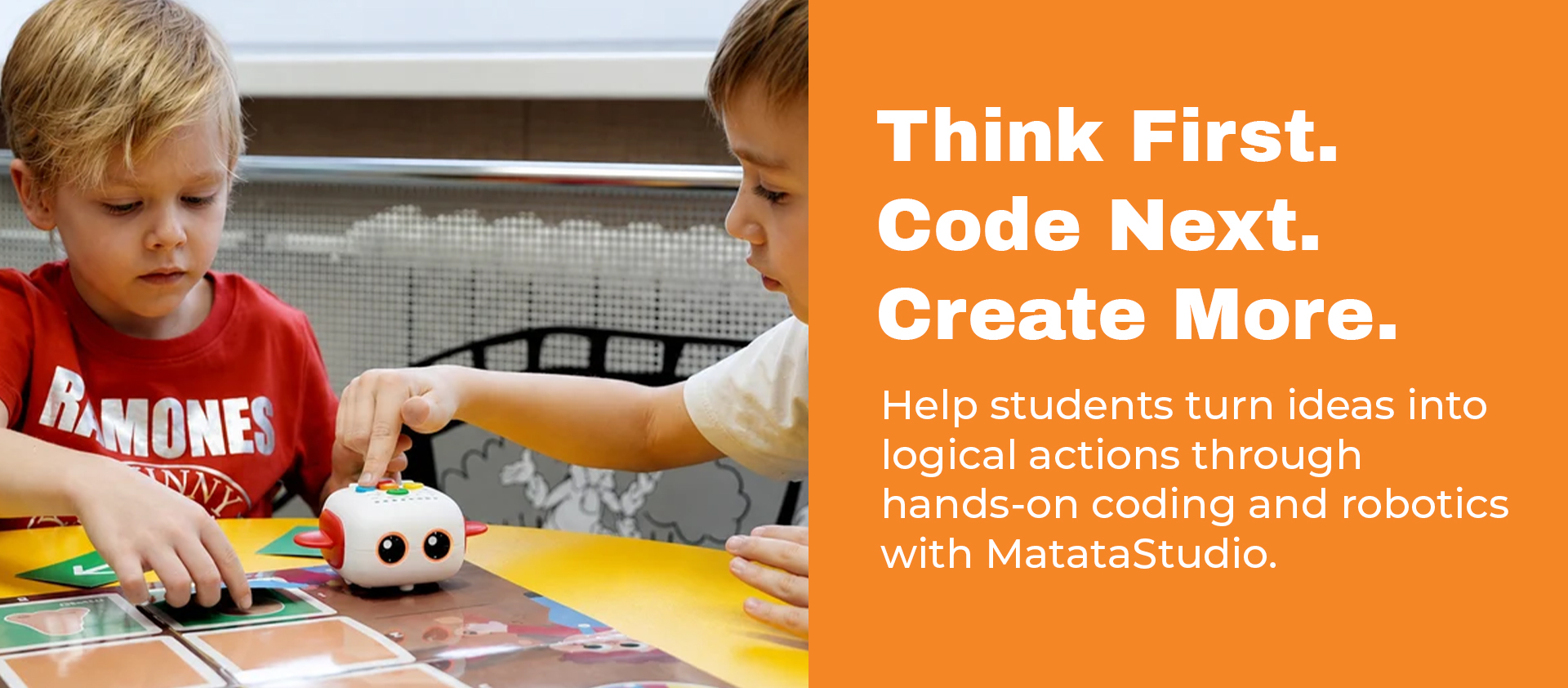
Before a robot starts moving, students need to decide what should happen first. Should it move forward? Turn left? Stop at a particular point? And what should happen after that?
Although these may seem like simple decisions, they introduce students to an important concept in computer science: sequencing.
Every coding activity begins with an idea, but turning that idea into something a robot can execute requires planning, logical thinking, and a clear sequence of instructions. Students must understand that actions need to happen in the correct order to achieve the desired result.
This is where hands-on coding and robotics activities become valuable learning experiences. With MatataStudio, students can explore how individual instructions work together, develop problem-solving abilities, and discover how computational thinking connects creativity with technology.
What Is Sequencing in Coding?
Sequencing is the process of arranging instructions in a specific order so that a task can be completed correctly.
Think about everyday activities such as brushing your teeth, preparing a sandwich, or getting ready for school. Each activity involves a series of steps that need to happen in a logical order.
Coding works in much the same way.
When students program a robot to reach a destination, they must determine:
- Where should the robot start?
- Which direction should it move?
- How many steps should it take?
- When should it turn?
- What should happen next?
If the instructions are entered in the wrong order, the robot may not reach its destination.
Through these experiences, students begin to understand that computers and robots follow instructions precisely. They also learn that even a small change in the sequence can produce a different outcome.
How Sequencing Develops Computational Thinking Skills
Computational thinking is not simply about learning to write code. It involves approaching challenges systematically, breaking problems into manageable steps, and developing solutions through logical reasoning.
Sequencing plays an important role in building these abilities.
1. Developing Logical Thinking
Students learn to identify the correct order of actions before executing a task. They begin to understand cause and effect, recognising how one instruction influences the next.
2. Improving Problem-Solving Abilities
When a robot does not perform as expected, students must examine their instructions, identify what went wrong, and reorganise the sequence. This encourages them to approach problems with patience and a solution-focused mindset.
3. Building Planning Skills
Rather than entering random commands, students learn to think ahead. They visualise the desired outcome and plan the instructions required to achieve it.
4. Encouraging Creativity
Sequencing also gives students opportunities to experiment. There can be different ways to complete the same challenge, allowing learners to explore alternative solutions and test their ideas.
These skills extend beyond coding and support learning across mathematics, science, engineering, and everyday problem-solving activities.
Making Sequencing Meaningful Through Hands-On Robotics
For young learners, understanding abstract coding concepts can be challenging when introduced only through textbooks or computer screens.
Hands-on robotics provides a more engaging approach.
When students physically interact with a coding device or robot, they can immediately see how their instructions translate into actions. They can experiment with different commands, observe the results, and make adjustments when something does not work.
For example, a simple classroom activity could involve programming a robot to navigate a path through a series of obstacles.
Students first study the path, identify the required movements, and arrange their instructions in the correct order. Once the sequence is ready, they execute the commands and observe the robot's movement.
If the robot takes the wrong turn, students revisit their instructions and identify the mistake.
This process transforms sequencing from an abstract concept into a practical learning experience.
How MatataStudio Supports Early Coding and Computational Thinking
MatataStudio brings coding concepts into the classroom through interactive, hands-on learning experiences designed to encourage exploration and creativity.
Its educational solutions help students engage with programming concepts through practical activities, where they can experiment with instructions, understand logical sequences, and develop problem-solving skills.
Instead of simply learning what a command means, students get opportunities to explore what happens when they use it.
Through structured coding challenges, learners can gradually develop their understanding of sequencing, logical reasoning, and the relationship between instructions and outcomes.
For educators, these activities also provide opportunities to introduce computational thinking in an engaging and accessible way, connecting technology with practical classroom learning.
Bringing Computational Thinking into Everyday Learning
Sequencing is one of the foundational skills that helps students understand how coding works. However, its importance goes beyond programming robots.
When students learn to organise instructions, anticipate outcomes, identify mistakes, and improve their solutions, they develop thinking skills that can be applied to many different situations.
Teachers can reinforce these concepts through simple classroom challenges, including:
- Arranging steps to complete an everyday activity.
- Creating a sequence of movements for a robot.
- Planning a route through a maze.
- Identifying missing or incorrect instructions.
- Reorganising commands to achieve a specific result.
These activities encourage students to think independently, collaborate with classmates, and learn through experimentation.
Conclusion
Before a robot moves, there is a process of thinking, planning, and decision-making.
Students must understand the challenge, organise their ideas, and translate them into a logical sequence of instructions. Every successful movement becomes an opportunity to strengthen their understanding of sequencing and computational thinking.
With hands-on solutions from MatataStudio, coding becomes more than entering commands. It becomes an opportunity for students to experiment, solve problems, and turn their ideas into meaningful actions.
Because learning to code starts with learning how to think.