

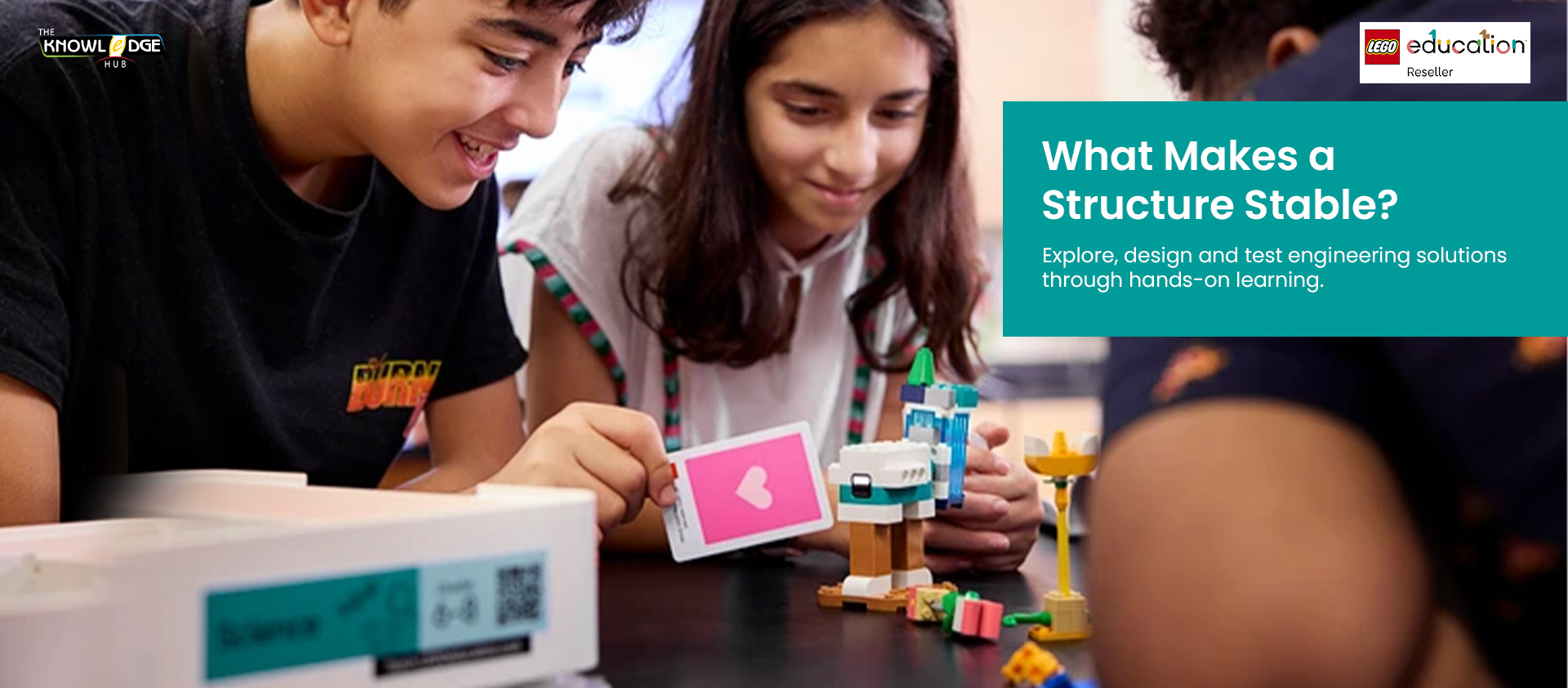
What makes a structure strong enough to stand, support weight and withstand different challenges? Is it the materials used, the way its components connect, or the arrangement of its parts?
These questions introduce students to one of the most interesting areas of engineering: structural stability.
From bridges and buildings to towers and everyday objects, engineers must understand how structures respond to forces and environmental conditions. For students, exploring these concepts through practical activities offers an opportunity to connect scientific knowledge with real-world problem-solving.
Through engineering design experiences, learners can investigate challenges, develop ideas, build models and discover how small design changes can make a significant difference.
Understanding Structural Stability in Engineering
Structural stability in engineering refers to a structure's ability to maintain its shape, balance and position when exposed to forces or loads.
A stable structure should be able to support its intended weight without collapsing, tipping over or undergoing unwanted deformation.
Several factors influence structural stability:
- Shape and geometry: Triangles, for example, are commonly used in engineering because their shape helps maintain rigidity.
- Material selection: Different materials have different strengths, flexibility and load-bearing capacities.
- Connections: How individual components are joined can influence the overall strength of a structure.
- Weight distribution: Distributing loads evenly can help prevent excessive pressure on particular areas.
- Base and support: A wider, well-supported base can improve balance and reduce the risk of tipping.
Understanding these principles helps students recognise why engineers consider more than just appearance when designing structures.
How Engineering Design Helps Students Explore Stability
Engineering is not simply about creating something that works the first time. It involves identifying a problem, exploring possible solutions, testing ideas and making improvements.
The engineering design process gives students a structured approach to this type of learning.
A classroom engineering challenge could involve designing a tower that can support a specific weight or building a bridge that can withstand a certain amount of pressure.
Students can approach the challenge through five key stages:
- Identify the problem: Understand the challenge and the requirements of the structure.
- Explore possible solutions: Discuss different shapes, materials, arrangements and connections.
- Create a design: Plan and build an initial model based on their ideas.
- Test the structure: Apply weight or introduce a challenge to evaluate its stability.
- Improve the design: Identify weaknesses, make adjustments and test again.
This process encourages students to understand that failure is part of learning. When a structure does not perform as expected, it provides useful information for the next attempt.
Classroom Activities That Make Engineering Concepts Practical
Practical engineering challenges allow students to investigate structural stability rather than simply learn about it through textbooks.
Teachers can introduce activities such as:
Build a Stable Tower
Ask students to design a tower using a limited number of building components. Challenge them to create the tallest structure that can remain standing independently.
Design a Strong Bridge
Students can explore different bridge designs and investigate how the arrangement of components affects the amount of weight a bridge can support.
Test Different Structures
Give students the opportunity to compare structures with different bases, shapes and connections. They can record observations and identify which designs perform best.
These activities encourage experimentation, teamwork, communication and evidence-based thinking.
Bringing Engineering Design into the Classroom with LEGO® Education Science
LEGO® Education Science provides hands-on learning experiences that help students explore scientific concepts through investigation, design and experimentation.
By engaging with structured challenges, students can develop ideas, construct models, observe results and improve their designs based on what they discover.
Rather than focusing only on the final model, the learning experience encourages students to understand the process behind their solutions.
Teachers can use these experiences to introduce engineering concepts in an engaging and accessible way, helping learners connect classroom activities with real-world applications.
For schools in the UAE looking to strengthen practical STEM learning, integrating engineering design challenges into science lessons can create meaningful opportunities for exploration and discovery. Learn more about our STEM education solutions in the UAE.
Developing Future-Ready Skills Through Engineering
Engineering design challenges help students develop skills that extend beyond science and technology.
As students investigate structural problems, they practise critical thinking, creativity, collaboration, and problem-solving. They also learn to evaluate evidence, communicate ideas, and make informed decisions.
Most importantly, they begin to understand that successful engineering is built on curiosity, experimentation, and continuous improvement.
Conclusion
What makes a structure stable is rarely just one design decision. It is the combination of shapes, materials, connections, support, and how effectively each component works together.
By introducing structural stability through hands-on engineering challenges, educators can help students move beyond theoretical learning and experience how engineering works in practice.
With LEGO® Education Science, students can explore, design, test and improve their ideas while developing the confidence to approach real-world challenges.