

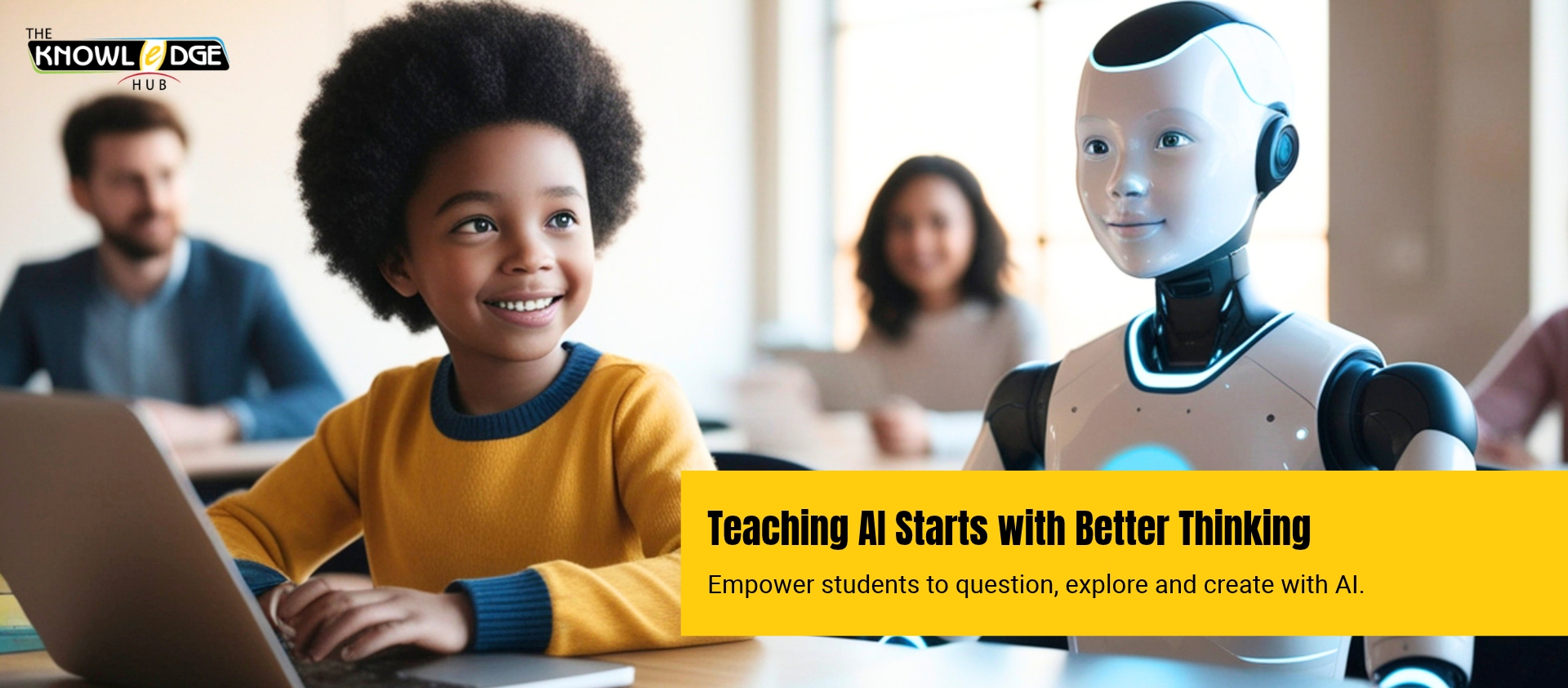
Artificial Intelligence is becoming an important part of everyday life, influencing how people communicate, work, learn and solve problems. As AI continues to evolve, schools have an opportunity to prepare students not just to use AI tools, but to understand how they work, evaluate their outputs, and apply them creatively.
Teaching AI in schools is about more than introducing students to new technology. It involves developing critical thinking, computational thinking, problem-solving, creativity, and responsible digital habits that help learners navigate an increasingly AI-driven world.
With structured learning experiences and practical activities, schools can help students progress from simply using AI to understanding and creating with it.
Why Should Schools Introduce AI Education?
Students are already encountering AI through search engines, digital assistants, content-generation platforms and other everyday technologies. However, using AI does not automatically mean understanding it.
Schools can bridge this gap by introducing age-appropriate AI education that helps students:
- Understand basic AI concepts and applications.
- Explore how AI systems generate information and content.
- Question and evaluate AI-generated responses.
- Recognise potential bias and limitations in AI outputs.
- Develop creative solutions using AI-powered technologies.
- Understand privacy, digital citizenship, and responsible AI use.
Introducing these concepts through structured classroom activities helps students become more confident, informed and responsible technology users.
What Should Students Learn When Teaching AI in Schools?
An effective AI learning programme should go beyond demonstrations and tool-based activities. Students need opportunities to explore, experiment, and apply their knowledge.
Here are five important learning areas schools should consider.
1. Understanding Artificial Intelligence
Students should begin by understanding what AI is, how it works at a basic level, and where it is used in real-world situations.
Activities involving AI-generated content, pattern recognition and simple machine learning concepts can make abstract ideas easier to understand.
2. Developing Critical Thinking Skills
AI-generated information is not always accurate or reliable. Students should learn to question responses, verify information, identify errors, and recognise limitations.
These activities encourage learners to think independently instead of accepting AI-generated answers without evaluation.
3. Exploring Creativity and AI-Powered Projects
AI can support students in brainstorming, generating content, exploring ideas, and developing projects.
When used as a learning aid, it encourages experimentation and creative problem-solving while allowing students to make their own decisions and improvements.
4. Exploring Coding and Machine Learning
Connecting AI education with coding and computational thinking helps students understand the logic behind intelligent technologies.
Through guided activities, learners can explore simple models, understand patterns and experiment with how machines learn from data.
5. Learning Responsible AI and Digital Citizenship
Responsible AI education should be part of every school's approach.
Students need to understand privacy, online safety, bias, ethics and appropriate technology use. These principles help them make informed decisions when interacting with AI-powered platforms.
How TechnoKids Supports AI Learning in Schools
Teaching AI in schools requires a structured approach that connects technology with practical classroom learning.
TechnoKids supports this journey by bringing together digital literacy, coding, computational thinking, project-based learning and AI education.
Its AI learning layer, TechnoHub, provides opportunities for students and teachers to explore AI through different learning applications.
For students, AI-supported learning experiences include:
- Exploring AI concepts and applications.
- Generating and working with digital content.
- Developing creative projects.
- Training simple AI models.
- Exploring machine learning concepts.
- Understanding responsible AI practices.
For teachers, AI capabilities can support project ideation, activity adaptation, differentiated learning, resource creation, and curriculum alignment.
This creates opportunities for educators to integrate AI into classroom activities while keeping learning objectives and student development at the centre.
Moving from AI Users to AI Creators
The purpose of AI education is not to make students dependent on technology. It is to help them develop the knowledge and confidence to use it thoughtfully.
When students learn to question AI-generated information, explore new possibilities, experiment with ideas and build projects, they develop skills that extend beyond technology.
Schools that introduce structured AI learning can create meaningful opportunities for students to become active participants in the future of innovation.
With TechnoKids, educators can take a step towards building classrooms where students do more than use technology — they understand it, think critically about it and create with it.
Explore TechnoKids and discover how your school can bring AI, coding and digital literacy into the classroom.