

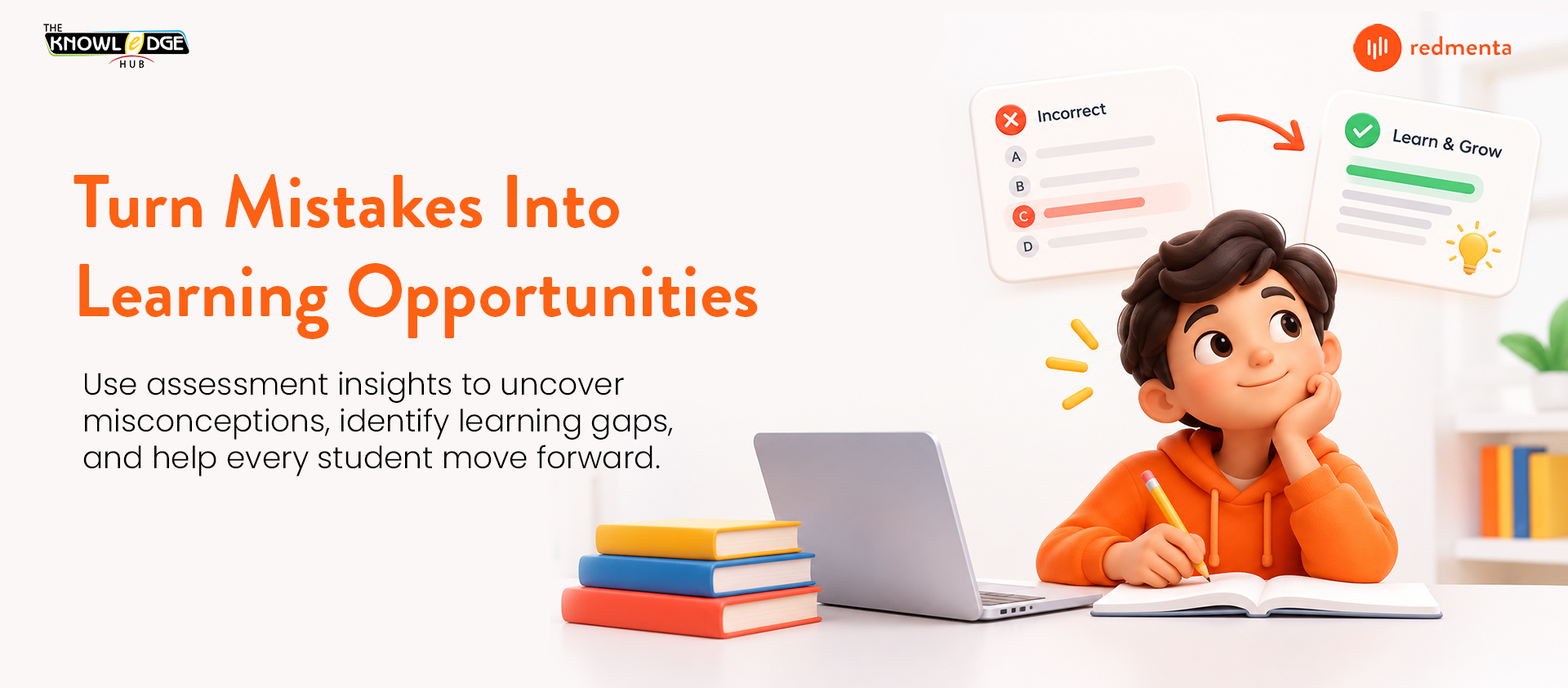
An incorrect answer doesn't always mean a student has failed.
Sometimes, it reveals a misconception.
Sometimes, it shows where more explanation is needed.
And sometimes, it becomes the starting point for deeper learning.
This is why effective assessment should go beyond identifying whether an answer is right or wrong. Assessment insights can help teachers understand how students are learning, where they may be struggling, and what support could help them move forward.
With digital assessment tools such as Redmenta, teachers can use assessment information to make learning more visible and turn mistakes into opportunities for improvement.
Why Student Mistakes Matter in Learning
A wrong answer can provide valuable information about a student's understanding.
For example, a student may select the wrong answer because they have misunderstood a concept, applied the wrong method, misread the question, or simply need more practice.
If assessment only records a score, these differences can remain hidden.
However, when teachers look beyond the final result, student mistakes can become useful learning signals.
This makes assessment more than a measurement tool. It becomes part of the learning process.
Assessment in education is most valuable when it helps teachers answer questions such as:
- What does the student understand?
- Where is the misconception?
- Which concepts need reinforcement?
- Which students need additional support?
- What should be taught or practised next?
From Assessment Data to Assessment Insights
Assessment data can tell teachers what happened. Assessment insights can help explain what may need attention next.
This distinction is important.
A class score might show that many students struggled with a particular question. But teachers need more than a percentage to respond effectively. They need information that can help them identify patterns, recognise learning gaps, and decide where additional explanation or practice may be useful.
Digital assessment platforms can make this process more efficient by bringing student responses and assessment information together.
With Redmenta, teachers can create digital assessments and use the resulting information to gain a clearer view of student learning.
Instead of treating assessment as the end of a lesson, teachers can use it as a starting point for the next learning activity.
Turning Wrong Answers Into Learning Opportunities
One of the most valuable aspects of formative assessment is the opportunity to respond to mistakes.
Consider a mathematics lesson where several students arrive at the same incorrect answer.
Rather than simply marking those responses as wrong, the teacher can investigate the pattern.
Is there a shared misconception?
Did students misunderstand the question?
Is a particular step in the process causing difficulty?
Do students need another example?
The answers can guide the teacher's next instructional decision.
This creates a simple cycle:
Assess → Identify → Understand → Respond → Learn
The mistake is no longer just an error. It becomes information that can support better teaching and deeper learning.
Supporting More Personalised Learning
Students do not always learn at the same pace or experience the same challenges.
Some may need additional explanation. Others may benefit from more practice, while some may be ready to apply their understanding to a more challenging problem.
Assessment insights can help teachers recognise these differences.
By reviewing student responses and identifying areas that require attention, teachers can make more informed decisions about follow-up activities, additional support, and opportunities for extension.
This can contribute to a more personalised approach to learning without making assessment feel like a separate activity.
Making Assessment Part of the Learning Process
Traditional assessment is often associated with grades, scores, and final results.
But assessment can play a much broader role in education.
When teachers use assessment throughout the learning process, they can gather information while students are still developing their understanding.
This is where formative assessment becomes particularly valuable.
A quick digital quiz, classroom activity, or knowledge check can reveal what students understand at that moment. Teachers can then use those results to adapt instruction, revisit difficult concepts, or provide further opportunities for practice.
In this approach, assessment doesn't simply ask, “What did the student get wrong?”
It asks, “What can we help the student understand next?”
How Redmenta Can Support Meaningful Assessment
Redmenta provides a digital environment where teachers can create engaging assessments and quizzes while gaining useful information about student responses.
Its assessment capabilities can support teachers in making learning more visible and using assessment information to inform their next steps.
For schools looking to make assessment more purposeful, this approach can help connect assessment with instruction, feedback, and student progress.
The goal isn't simply to collect more assessment data.
It is to make that information useful.
Better Assessment Starts With Better Questions
A student's incorrect answer is not necessarily the end of the learning process.
It can be a signal.
It can reveal a misconception.
It can highlight a learning gap.
Most importantly, it can show teachers where the next learning opportunity may be.
When assessment insights are used effectively, mistakes can become part of the learning journey rather than simply a reason to reduce a score.
Because effective assessment isn't just about finding out what students got wrong. It's about understanding where learning can happen next.
With Redmenta, schools can move towards a more meaningful approach to digital assessment—one that helps teachers understand student learning and turn assessment results into opportunities for growth.
Turn mistakes into meaningful learning opportunities with Redmenta.