

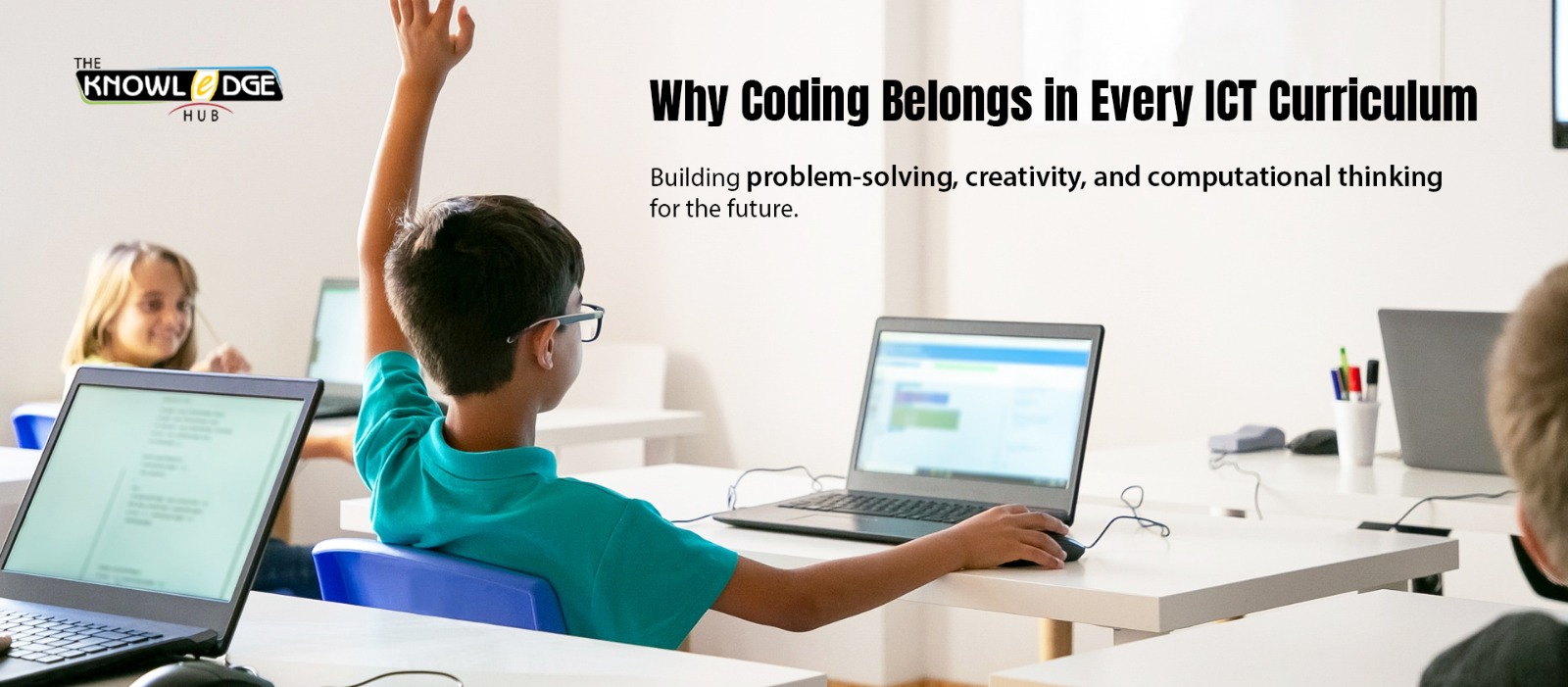
Technology is no longer limited to computers and digital devices. It is shaping how students learn, communicate, solve problems, and prepare for future careers.
As schools strengthen their ICT curriculum, the focus is increasingly moving beyond basic technology use. Students need opportunities to understand how digital systems work, solve problems logically, and create technology rather than simply consume it.
This is where coding becomes an important part of modern ICT education.
A well-designed coding programme can help students develop computational thinking, problem-solving, creativity, and digital confidence while giving them practical experience with technology.
What Is Coding in an ICT Curriculum?
Coding is the process of creating instructions that tell a computer or digital system what to do.
When introduced appropriately in schools, coding does not simply mean teaching students programming languages. It can involve activities such as:
- Creating sequences and instructions
- Understanding patterns and logic
- Using block-based programming
- Designing simple games and animations
- Building interactive projects
- Solving problems through algorithms
- Developing simple digital applications
The objective is not necessarily to turn every student into a professional programmer.
Instead, coding can provide students with a structured way to think, experiment, create, and solve problems.
Why Coding Matters in Schools
1. Develops Problem-Solving Skills
Coding requires students to break a larger challenge into smaller, manageable steps.
For example, when creating a simple game, students may need to determine:
- What should happen first?
- What happens when a user clicks a button?
- How should the character move?
- What happens when a condition changes?
- How can an error be corrected?
This process encourages students to analyse problems and develop logical solutions.
Over time, these skills can be applied beyond coding to mathematics, science, projects, and everyday decision-making.
2. Builds Computational Thinking
One of the most important benefits of coding is the development of computational thinking.
Students learn to:
- Break problems into smaller parts
- Identify patterns
- Create sequences
- Develop algorithms
- Test solutions
- Identify errors
- Improve their approach
These are transferable skills that can support learning across multiple subjects.
Coding therefore becomes more than a technology activity. It becomes a practical method for developing structured thinking.
3. Encourages Creativity
Coding is often associated with logic and mathematics, but it also provides significant opportunities for creativity.
Students can use coding to create:
- Games
- Animations
- Interactive stories
- Digital art
- Simulations
- Presentations
- Educational projects
Instead of simply using applications created by others, students begin to understand that technology can be a tool for expressing their own ideas.
This shift from technology consumer to technology creator is an important part of future-ready education.
4. Teaches Students to Learn Through Experimentation
Coding rarely produces a perfect result on the first attempt.
Students may write instructions that do not work, encounter unexpected results, and need to modify their approach.
This creates opportunities to practise:
Try → Test → Identify → Improve → Try Again
Such experiences can help students develop persistence and a growth mindset.
Rather than viewing mistakes as failure, learners can begin to see them as part of the problem-solving process.
Coding and Digital Literacy
Coding should not replace digital literacy. Instead, the two areas can complement each other.
Digital literacy for students helps them understand how to use technology effectively and responsibly.
Coding helps students understand how technology works and how they can create with it.
Together, they can support a broader set of ICT capabilities.
For example, a student might research information online, evaluate its reliability, use digital tools to plan a project, write code to create an interactive solution, and present the final outcome digitally.
This creates a more complete technology learning experience.
Coding Across Different Age Groups
Coding can be introduced progressively according to students’ age and developmental level.
Early Years
Young learners can begin with activities involving:
- Sequencing
- Patterns
- Directions
- Logical instructions
- Simple problem-solving
- Screen-free coding activities
These activities can introduce computational thinking without requiring complex programming.
Primary School
Students can progress to:
- Block-based coding
- Simple animations
- Interactive stories
- Basic games
- Programming challenges
- Robotics activities
The emphasis should remain on exploration, creativity, and problem-solving.
Middle School
Students can begin working with more structured programming concepts, including:
- Algorithms
- Variables
- Conditions
- Loops
- Data
- Debugging
- More complex projects
Coding can also be connected with mathematics, science, engineering, and other subjects.
Secondary School
Older students can explore more advanced areas such as:
- Text-based programming
- App development
- Data and information
- Artificial intelligence concepts
- Automation
- Advanced computational thinking
- Real-world programming projects
This progression allows students to build their skills gradually rather than encountering programming as an isolated subject.
How Schools Can Integrate Coding Into ICT Education
Coding does not have to be taught only as a standalone lesson.
Schools can integrate coding into broader learning experiences.
Project-Based Learning
Students can develop digital projects around real-world challenges.
For example, they could create a simple programme that helps explain environmental issues, mathematics concepts, or scientific processes.
Robotics
Robotics combines coding with physical problem-solving.
Students can programme robots to respond to instructions, navigate environments, complete challenges, or perform specific tasks.
This can make abstract programming concepts more tangible and engaging.
STEM Learning
Coding naturally connects with science, technology, engineering, and mathematics.
Students can use programming to collect data, control systems, simulate processes, or develop solutions to engineering challenges.
Schools looking to build this broader approach can explore a structured STEM Curriculum UAE that connects technology learning with practical STEM experiences.
AI Education
As artificial intelligence becomes increasingly important, coding can also provide students with a foundation for understanding how digital systems process instructions, data, and decisions.
Age-appropriate coding activities can therefore complement broader AI Education Solutions UAE, helping students move from simply using intelligent technologies to developing a basic understanding of how technology can be designed and applied.
The Role of Teachers in Coding Education
Effective coding education does not depend only on the technology available in the classroom.
Teachers need appropriate curriculum resources, training, lesson plans, and practical activities that allow students to learn progressively.
Professional development can help educators:
- Introduce coding concepts appropriately
- Select suitable programming tools
- Design engaging coding activities
- Connect coding with other subjects
- Support students through debugging
- Assess problem-solving and computational thinking
The goal is not for every teacher to become an advanced programmer.
The goal is to give educators the confidence and resources to make coding meaningful for their students.
What Makes a Strong School Coding Programme?
A successful school coding programme should focus on more than programming syntax.
It should provide students with opportunities to:
Think → Create → Test → Solve → Improve
Schools should consider whether their programme provides:
- Age-appropriate progression
- Hands-on activities
- Project-based learning
- Problem-solving challenges
- Computational thinking
- Opportunities for creativity
- Coding and robotics integration
- Connections with STEM
- Appropriate teacher support
- Opportunities to apply learning to real-world problems
When these elements come together, coding becomes an integral part of ICT education rather than an isolated technical skill.
How Knowledge Hub Supports Coding and ICT Learning
Knowledge Hub helps schools build future-ready learning environments through curriculum solutions and educational technologies covering ICT, coding, robotics, STEM, AI, and teacher development.
Through structured learning experiences, schools can help students progress from basic digital skills toward computational thinking, coding, creative technology projects, and more advanced technology concepts.
The aim is to create a connected learning pathway where students do not simply learn how to use technology, but also develop the confidence to understand, create, and solve problems with technology.
Conclusion
The purpose of coding in schools is not simply to teach students how to write programmes.
It is to help them think logically, solve problems, create ideas, experiment with technology, and understand the digital world around them.
As schools continue developing modern ICT programmes, coding can provide an important bridge between digital literacy and deeper technology learning.
By introducing coding progressively and connecting it with STEM, robotics, AI, and project-based learning, schools can give students practical skills that extend well beyond the ICT classroom.
For schools looking to strengthen their technology learning ecosystem, Knowledge Hub provides curriculum and educational technology solutions designed to support students and educators throughout their digital learning journey.
Frequently Asked Questions
Why should coding be included in an ICT curriculum?
Coding helps students develop problem-solving, logical reasoning, computational thinking, creativity, and technology skills that can support their academic learning and future careers.
What age should students start coding?
Coding concepts can be introduced from the early years through age-appropriate activities such as sequencing, patterns, logic, and simple programming. More advanced programming can be introduced progressively as students develop their skills.
Does coding help with other subjects?
Yes. Coding can support mathematics, science, engineering, problem-solving, and project-based learning. It can also connect naturally with robotics and STEM education.
Is coding only useful for students who want technology careers?
No. Coding develops transferable skills such as logical reasoning, problem-solving, creativity, persistence, and structured thinking that can benefit students regardless of their future career path.
How is coding connected to computational thinking?
Coding gives students a practical environment in which to apply computational thinking concepts such as decomposition, pattern recognition, algorithms, logical sequencing, testing, and debugging.