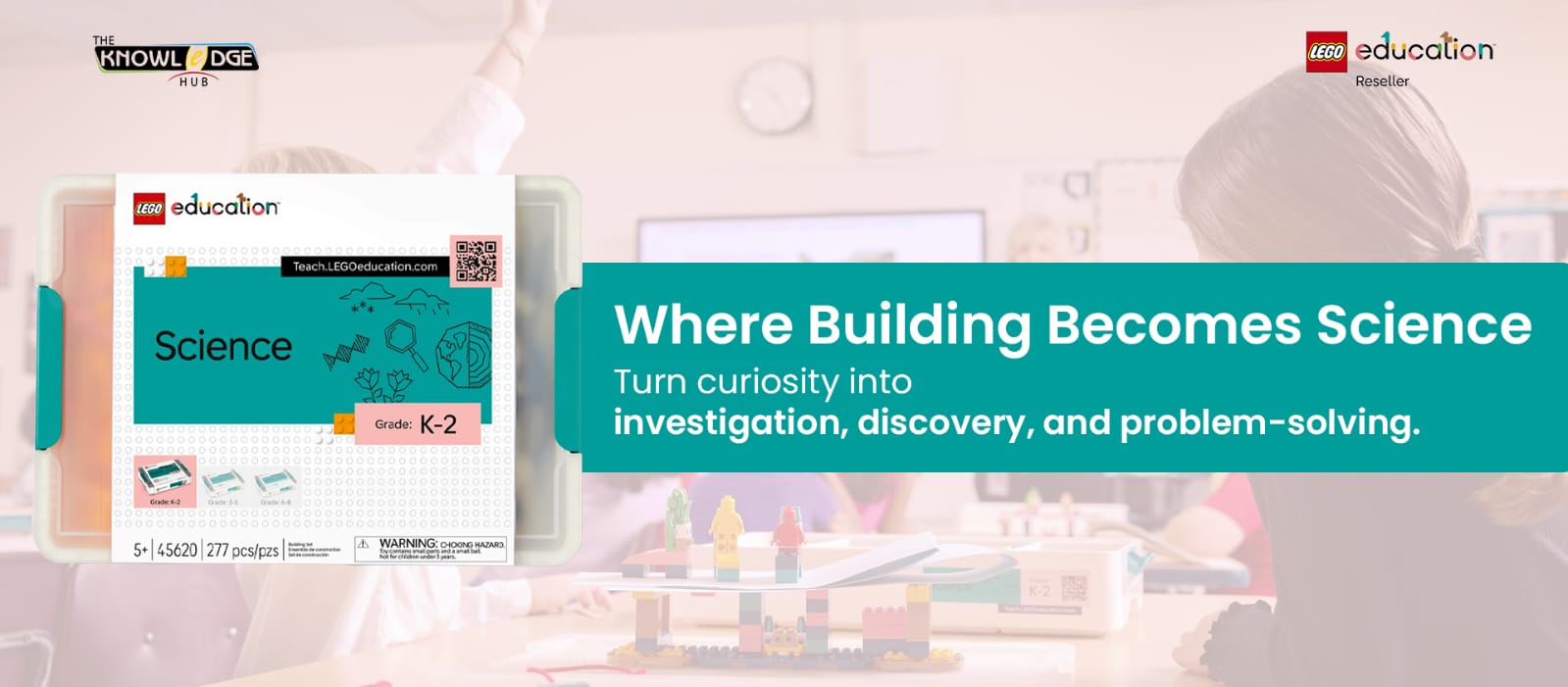
What if a LEGO®® Education kit could become more than a building activity? What if it could be the starting point for a science investigation?
For young learners, science becomes more meaningful when they can touch, build, observe, test, and discover. The LEGO® Education Science Classroom Bundle K–2 brings hands-on materials and structured learning experiences together to help students explore scientific ideas through active participation.
Instead of simply learning about science concepts, students can experience them.
From Building Models to Asking Questions
Young children are naturally curious. They want to know what happens, why something moves, what makes a structure stable, and how they can make it work differently.
A hands-on science experience gives students an opportunity to turn that curiosity into investigation.
With the LEGO® Education Science Classroom Bundle K–2, students can build models and use them as tools for exploring scientific concepts. The building process becomes a starting point for questions such as:
- What happens if we change one part of our model?
- Why did the model behave differently?
- How can we make our solution work better?
- What can we observe and learn from the results?
These questions encourage students to think beyond completing a task and begin approaching learning like young scientists.
Making Science More Hands-On
Science concepts can sometimes feel abstract when students encounter them only through pictures, explanations, or worksheets.
Hands-on learning changes that experience.
When students physically construct a model and experiment with it, they can see the connection between an idea and its real-world application. They can test what they predict, observe the outcome, and make changes based on what they discover.
This creates an active learning cycle:
Build → Explore → Test → Observe → Improve
The process encourages students to participate in their own learning rather than simply receiving information.
Developing More Than Science Knowledge
The value of hands-on STEM learning extends beyond understanding scientific concepts.
As students investigate and improve their models, they also practise important skills such as critical thinking, creativity, communication, collaboration, and problem-solving.
For example, a student may build a model that does not work as expected. Instead of seeing this as failure, the experience can become another opportunity to investigate.
What went wrong?
What could be changed?
What happens if we try another approach?
This mindset helps children understand that learning often involves experimentation, revision, and persistence.
A Strong Foundation for STEM Learning
Early exposure to STEM can help children develop positive attitudes toward science, technology, engineering, and mathematics.
The LEGO® Education Science Classroom Bundle K–2 supports this by making scientific exploration tangible and engaging for young learners. Building gives students something concrete to work with, while investigation encourages them to think about why their models behave in particular ways.
For teachers, this approach can also create opportunities to move from simply asking students for the right answer to asking them to explain their thinking.
That shift is important.
When students can explain what they observed, describe their reasoning, and suggest improvements, they are developing the habits of mind that support deeper learning.
When Building Becomes Learning
The most valuable part of a hands-on science activity isn't necessarily the finished model.
It's everything that happens while students are trying to create it.
They ask questions. They make predictions. They test ideas. They observe results. They encounter challenges. They make changes. And they try again.
That is where building becomes learning.
With the right learning experience, a LEGO®® Education kit can become more than a collection of bricks and components. It can become a tool for helping young learners explore scientific ideas, develop problem-solving skills, and discover that curiosity is the beginning of learning.
For K–2 classrooms, that's a powerful way to introduce children to STEM: not just by telling them about science, but by giving them opportunities to investigate it.
Conclusion
Early science education is most powerful when children are encouraged to explore rather than simply memorise. By combining hands-on construction with investigation and problem-solving, the LEGO® ® Education Science Classroom Bundle K–2 can help create learning experiences where young students actively engage with scientific thinking.
Because sometimes, the best way to understand how something works is to build it, test it, and find out for yourself.