

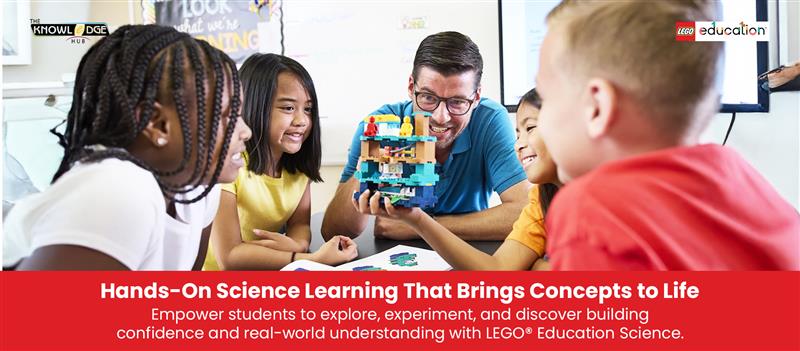
Every experiment is a new opportunity to learn. In today’s evolving education landscape, students need more than theoretical knowledge—they need experiences that allow them to explore, test, and understand concepts in real-world contexts. This is where hands-on science learning for students becomes essential.
With LEGO® Education Science, classrooms are transformed into interactive environments where students actively engage with scientific concepts. Instead of simply observing, students participate in experiments, make changes, and discover outcomes on their own. This approach not only strengthens understanding but also builds confidence in learning.
Learning Science Through Experimentation
Science is best understood through experimentation. When students actively test ideas, they gain a deeper understanding of how concepts work in practice.
Traditional teaching methods often focus on fixed outcomes, but hands-on learning encourages students to:
- Explore different approaches
- Test hypotheses
- Observe results
- Refine their ideas
LEGO® Education Science supports this process by providing structured activities that guide students through experimentation while allowing room for creativity and independent thinking.
Building Confidence Through Trial and Error
One of the most valuable aspects of hands-on science learning is the ability to learn through trial and error. When students experiment, they understand that not every attempt leads to immediate success—and that’s part of the learning process.
With LEGO® Education Science, students are encouraged to:
- Try new ideas without fear of failure
- Learn from mistakes
- Improve their solutions
- Build resilience and confidence
This environment helps students develop a growth mindset, where challenges are seen as opportunities rather than obstacles.
Encouraging Critical Thinking and Problem Solving
Hands-on science learning goes beyond understanding concepts—it develops essential thinking skills.
Through structured experiments and activities, students learn how to:
- Analyze problems logically
- Evaluate different solutions
- Make informed decisions
- Adapt and improve their approach
LEGO® Education Science integrates these skills into every activity, ensuring that students are not just learning science but also learning how to think critically and solve real-world problems.
Making Science Engaging and Interactive
Engagement plays a key role in effective learning. When students are actively involved, they are more likely to retain information and develop a genuine interest in the subject.
LEGO® Education Science uses interactive elements to make science lessons more engaging. Students can build models, conduct experiments, and visualize concepts in action. This approach turns abstract ideas into tangible experiences, making learning more meaningful and enjoyable.
As a result, students become more curious, motivated, and eager to participate in classroom activities.
Supporting Teachers with Structured Learning
While hands-on learning is highly effective, it requires the right tools and structure to be implemented successfully in classrooms.
LEGO® Education Science provides educators with:
- Ready-to-use lesson plans
- Guided experiments
- Curriculum-aligned activities
- Easy-to-use classroom resources
These tools help teachers deliver engaging science lessons without the need for extensive preparation. Educators can focus on guiding students through the learning process while ensuring that educational objectives are met.
Preparing Students for Future Learning
The skills developed through hands-on science learning are essential for future academic and career success. Fields such as engineering, technology, healthcare, and environmental science all require strong problem-solving and analytical abilities.
By engaging in experimentation and discovery, students build a strong foundation in scientific thinking. Hands-on science learning for students helps them develop curiosity, confidence, and the ability to approach challenges with a solution-oriented mindset.
With LEGO® Education Science, students are not only learning science—they are developing skills that will benefit them throughout their educational journey and beyond.
Conclusion
Every experiment offers a chance to learn, grow, and improve. Hands-on learning transforms science education by making it interactive, engaging, and meaningful.
With LEGO® Education Science, students test ideas, make changes, and discover what works. This process builds confidence, encourages curiosity, and helps students develop a deeper understanding of scientific concepts.
By embracing hands-on science learning for students, schools can create classrooms where learning is driven by exploration, experimentation, and discovery—preparing students for a future filled with possibilities.