

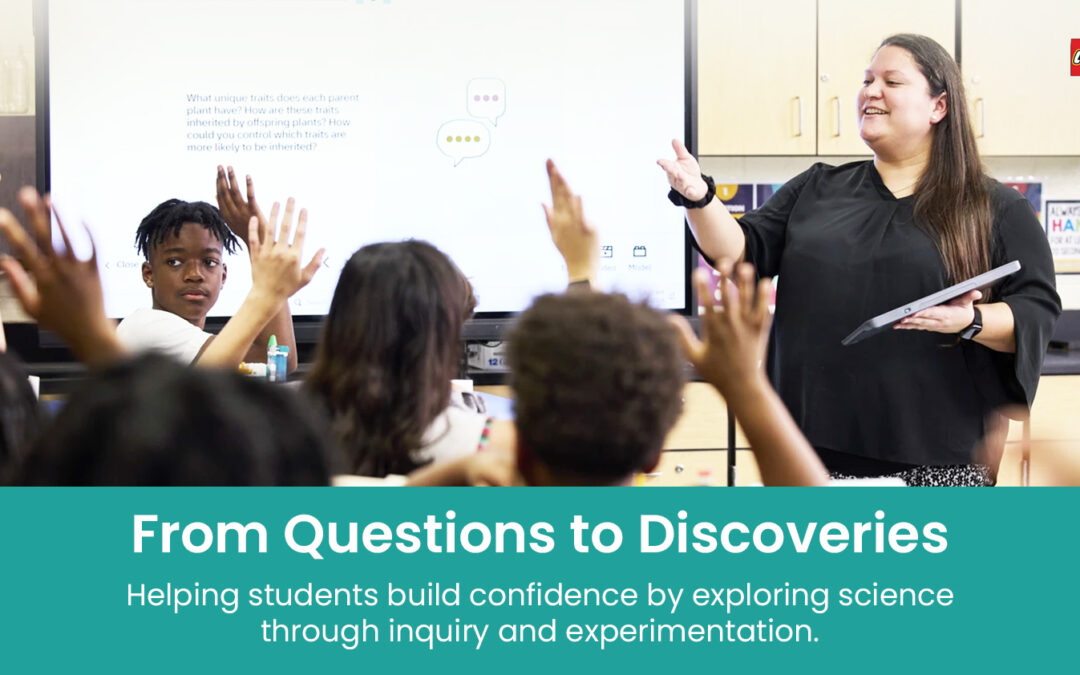
Every great discovery begins with a question. In today’s classrooms, encouraging students to ask questions, explore ideas, and test their understanding is essential for meaningful learning. This is where inquiry-based science learning for students plays a powerful role.
LEGO® Education Science is designed to bring this approach into the classroom by transforming curiosity into hands-on exploration. Instead of simply memorizing concepts, students actively engage in learning by investigating, experimenting, and discovering how the world works.
The Power of Curiosity in Science Learning
Curiosity is the foundation of scientific thinking. When students ask questions, they begin to think critically and explore possible solutions.
Traditional teaching methods often focus on providing answers. In contrast, inquiry-based learning encourages students to:
- Ask questions
- Investigate ideas
- Test hypotheses
- Draw conclusions
LEGO® Education Science supports this process by creating an environment where curiosity is not only encouraged but also structured into the learning experience.
Learning Through Exploration and Discovery
Hands-on exploration helps students understand scientific concepts more effectively. With LEGO® Education Science, students engage in activities that allow them to build, experiment, and observe outcomes in real time.
This approach helps students:
- Understand cause-and-effect relationships
- Develop analytical thinking
- Connect theory with real-world applications
By actively participating in experiments and problem-solving tasks, students gain a deeper and more lasting understanding of science concepts.
Encouraging Confidence Through Experimentation
One of the key benefits of inquiry-based learning is that it builds student confidence. When students are given the freedom to explore and test their ideas, they become more comfortable with trial and error.
LEGO® Education Science creates a safe learning environment where:
- Mistakes are part of the learning process
- Students are encouraged to try new ideas
- Learning becomes a journey rather than a fixed outcome
This helps students develop resilience and confidence in their abilities.
Developing Critical Thinking and Problem-Solving Skills
Inquiry-based science learning goes beyond understanding concepts—it helps students develop essential life skills.
Through structured activities, students learn how to:
- Analyze problems
- Think logically
- Evaluate results
- Improve their solutions
LEGO® Education Science integrates these skills into every learning experience, ensuring that students are not just learning science but also learning how to think like scientists.
Supporting Teachers in Modern Classrooms
For educators, implementing inquiry-based learning can sometimes be challenging. LEGO® Education Science provides structured lesson plans and resources that make it easier to adopt this approach in the classroom.
Teachers benefit from:
- Ready-to-use lessons
- Guided inquiry frameworks
- Hands-on classroom activities
- Easy integration into existing curriculum
This support allows teachers to focus on facilitating learning rather than preparing complex lesson structures.
Conclusion
In a rapidly evolving world, developing curiosity, critical thinking, and problem-solving skills is more important than ever. Inquiry-based science learning for students provides a powerful way to achieve this.
With LEGO® Education Science, classrooms become spaces where students ask questions, explore ideas, and discover answers through hands-on learning. By nurturing curiosity, educators can help students build confidence and develop a lifelong love for learning.


Recent Comments