
Audio Enabled E-Readers Help Struggling Readers Gain More Confidence

Audio Enabled E-Readers Help Struggling Readers Gain More Confidence

Audio Enabled E-Readers Help Struggling Readers Gain More Confidence

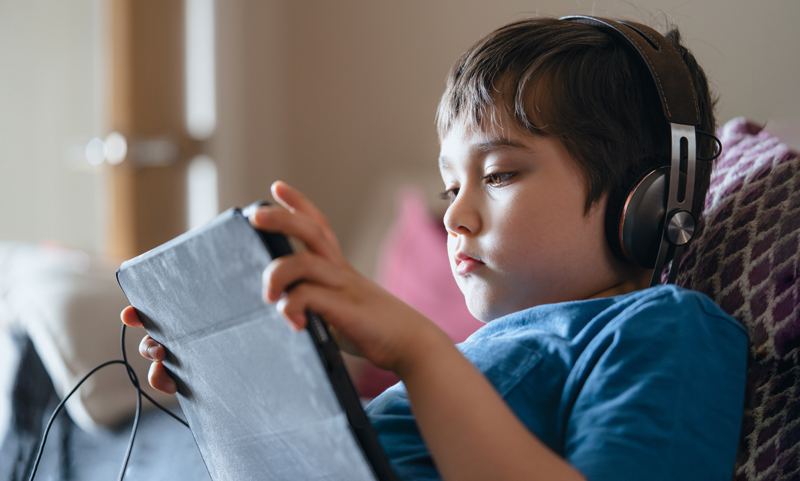
Are you worried about your child’s reading skills? Does your child often make excuses to escape reading time and instead call his friends over to play? Sometimes children are not confident enough to pick up a book and read because they are embarrassed not being able to read correctly and unable to answer questions at the end of the story. Observe this avoidant behavior, and rather than forcing your child to read a book end-to-end, let’s help him find ways to make reading a more enjoyable experience.

Trendy E-Reading Platform

For the digital-savvy generation, an e-reading platform is a convenient option. One doesn’t need to visit a book store and spend money on buying the ‘current bestseller’ title, as the e-reader stores 1000s of eBooks across different genres, on your preferred device. You can read while being on the move, because it’s easy to fit the phone or an iPad device in your purse, thereby giving you an option to read any book at any time, to match your mood and level of interest.
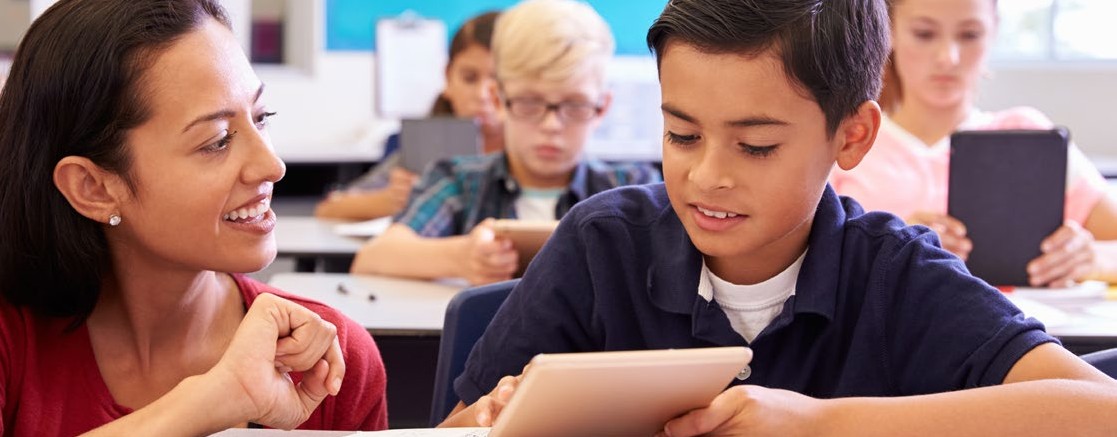
image005

E-Reading Benefits to Students

Unlike the physical copy, which could be mishandled with scratches and dog ears on the pages, the e-reader is a more sought-after option. The font of the eBook can be increased, to avoid strain on your little learner’s eyes and thereby eliminating chances of irritable mood while reading. Many e-readers can be personalized, according to the reader’s preferences.

The Renaissance myON® Reader is a popular e-reading tool, preferred by mums & educators all across the world, especially in the Middle East, including Dubai. What’s special about the myON® Reader, is that it is extremely student-friendly and provides a personalized experience to the readers. myON®’s pool of library is expansive and covers over 6,000 student-appropriate eBooks. This intelligent reader offers recommendations of book titles based on the individual student’s interest, class grade, and Lexile® reading level. Even a non-reader, is encouraged to read, thanks to the additional support offered by myON® Reader. One such interesting support function is the neutral-voice audio tool that spotlights word-by-word text, thereby making it easier for the listener to focus on the story and comprehend the passage. Learn more about the Renaissance myON® Reader by visiting our website and subscribing to it in GCC regions around the UAE.

image001

Voice Activated Audio Reader Benefits Struggling Readers:

As mentioned above, children may find it difficult to read due to various reasons. Some of the deterrents include; having limited vocabulary, minimal English language skills, suffering from various learning difficulties like dyslexia, or being unable to associate sounds to the appropriate letter. Here’s how an audio reader can assist the learners when they find reading as a herculin task for them;

Helps Improve Vocabulary  

Having an audio feature enables the person to listen to the recording of the story in the book, instead of reading the book. Hearing new words during the story, can help increase the student’s vocabulary and comprehension skills. Vocabulary enrichment enhances the child’s speaking, writing, and thinking skills. Also, students learn the correct pronunciation and are inducted to a refined way of mastering the language. 

Better Understanding of the Story  

Research proves that when you listen to a story, one gets more imaginative and is better able to derive the meaning from the story. The child’s brain creates different visual images which helps him connect the scenes, and weave them into the story. On the contrary, when one reads, the brain is more focusing on the words and trying to decode the text, which may sometimes distract the child from the main plot.  

A Boon for Special Learners

Dyslexia is a learning disorder that affects the learner’s ability to read, spell, write, and speak. Children with dyslexia suffer, as they find it difficult to read and therefore feel left out in class. eBooks and audiobooks require no comprehension of written text, instead, the special learners just need to plug into earplugs and listen to the story. While listening they may have better retention and be able to learn at a better pace.

Lastly, listening to audio also helps relax eyes, and stay away from the harmful radiations that screens might emit. Therefore, it is safe to conclude that, audio-enabled e-readers have multiple benefits not only to those who have difficulty in reading but also to other bright students.


Contact us

Practical Activities Using Montessori Materials – A Foundation for Math At Preschool  The Montessori Way

Practical Activities Using Montessori Materials – A Foundation for Math At Preschool The Montessori Way

Practical Activities Using Montessori Materials – A Foundation for Math At Preschool The Montessori Way

Dr. Maria Montessori was the founder and pioneer of the Montessori method of teaching. If you have ever entered a Montessori classroom, you would know how different it looks from any other preschool in the vicinity. However, two Montessori-based classrooms will always have a similar layout and pretty much the same materials on display. Today, the Montessori method is followed in all parts of the world, including Dubai in the Middle East.

The Montessori way focuses more on self-directed activities and follows a hands-on approach. The prepared classroom environments are tidy, orderly and provide close to real-world experiences to the children. Children are free to explore and choose the activity of their interest, which allows them to learn by doing and correct their mistakes themselves since the materials are designed in such a fashion. The Montessori Directress is merely a guide and an observer, helping children develop confidence and discipline.

Montessori based Math 

At first, children are introduced to concrete Math materials, and as they get comfortable, they move to abstract activities.

Concrete materials are things that can be held, touched, and felt. So, before the child picks up a crayon and writes 1-10 on paper, they have number cards with different textures to run their finger over it. Eventually, students learn to write and say the numbers in order, without the help of materials.

Montessori Math Materials 

Number Rods

Number rods are a bunch of red and blue color wooden rods that are arranged in ascending order from smallest to biggest. There are a number of practical activities that you can undertake with these rods.

Firstly, ask the child to randomly lay the rods on a mat, and then arrange them from smallest to biggest with the red section on the left side. Practice counting by using your index finger and middle finger together, and run them over each rod, and each section of the rod (red & blue). While pointing, say aloud ‘this is one’ and this is ‘two’. Continue gradually by introducing only 3 numbers at a time.

Now randomly say to the child ‘give me seven’. The child finds the rod which has seven sections with alternating blue & red marks.

Sandpaper Numbers

Numbers 0 to 9 are cut out from sandpaper and stuck on green paper. Take one number card at a time and trace with your finger three times over the number gently while saying it out aloud ‘one’. Repeat this for number two and so on. Introduce three cards in a day and proceed slowly. Along with number recognition, the child is also learning the pattern of writing numbers. After some practice, children would find it effortless to re-produce the digits on paper.

Spindle Box

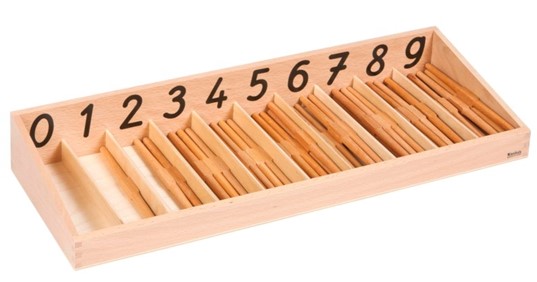
The spindle box has 10 compartments with numbers written on the wall to represent each section. Ask the child to read the number printed above one of the sections. The child has to count that many spindles and place them in the compartment. For number ‘eight’ the child needs to count that many spindles and place them in the compartment.

Teaching Students 11- 19 with Beads on Hanging Frame

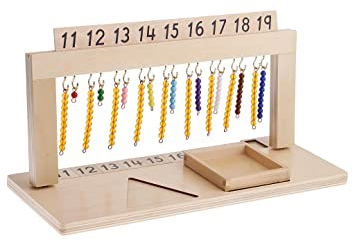
The frame has hooks and numbers 11 to 19 mentioned on a horizontal bar at the top. To represent number 11, children pick up the bead chain that has 10 beads and another chain that has 1 bead 10+1 = 11. Ask the child to now count and place 19 beads. The child needs to choose the bead chain that has 10 beads first, and the other one which has 9 beads 10+9 = 19. This activity teaches children addition, subtraction, and the decimal system. In this way, children can learn to count in 1000s.

‘Mathletics’ is an amazing mathematics platform for educators and learners. They support learning for students in the classroom and at home, through interactive activities, games, and challenges. Mathletics is highly recommended by educators, and most schools in GCC and UAE encourage parents to download the Mathletics platform and practice Math problems at home. They offer students the chance to put their mathematical skills to use through relevant, attention-grabbing activities. It is the perfect mathematics engagement program for schools and homes.

Contact us

Upskill & Grab the Opportunities of These Highly Popular Foreign Languages 

Upskill & Grab the Opportunities of These Highly Popular Foreign Languages 

Upskill & Grab the Opportunities of These Highly Popular Foreign Languages  

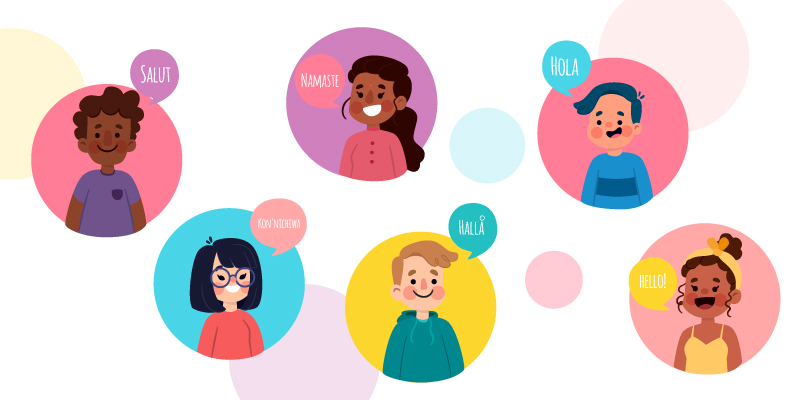
What do we first associate with the word language? Wouldn’t most people think of their mother tongue being their primary mode of communication? Sure, it is and none can take away the essence of one’s own language that is so dear to them, that they have known and received beautifully from their parents or guardians. That language becomes their way of being. Then as a child gets into school, he or she is introduced to more languages and their mother tongue may or may not constitute in that list. Those would be languages specific to the state or region or would mainly be the national language of the country. For E.g. If one is a resident of Dubai of the United Arab Emirates, their mother tongue could be Pashto whereas the official language of the Middle East and most GCC countries is Arabic. To some, Arabic may be their mother tongue as well as their first language in school. Then would come the second language offered by the school and so on and so forth. English is the most popular second language in the world, with about 1.4 billion speakers. So, generally, a child would learn three to four languages in school, and out of those possibly one or two could be foreign languages learned either by choice or made mandatory as part of the curriculum. 

The question that arises is, why is there a need-to-know foreign languages? When one is born and bred in a particular country, they generally live there for a sufficient amount of time, get their education, earn their livelihood, start a family of their own and lead a great life for which the languages they have known since childhood are enough to suffice them in their personal and professional space. Is there actually a reason to upskill? Of course! Yes! Not one but many and we will tell you why. Learning new languages can be the most fascinating and can bring along life-elevating experiences going beyond the comfort zones of one’s caregivers and alma mater, just the individual must be eager to acquire knowledge and seize opportunities and hence would befriend unknown languages. There is never an age to learn. A child could start learning multiple foreign languages of his or her preference from a young age or one can even upskill later post-college or even at work or otherwise. Knowing multiple languages gives one a sense of liberation, extreme pride, and happiness. To be able to learn to read, write and speak world languages is a gift that needs to be constantly practiced and nurtured. 

If ever the thought of migration crosses one’s mind or if a person wishes to study or work abroad or just wants to be an avid traveler, knowing additional languages is always a blessing, comes in very handy, and is super helpful. Not only can the person help themselves but also the companion, friend or family member traveling along with them, should they not know the language of the place. The crucial point is that nobody can take undue advantage or fool you for whatsoever reason and you can smartly handle the situation. Moreover, you can never get lost in a foreign country and can tap the maximum avenues to enjoy and have an amazing time, just with the greatest benefit of simply knowing the language. These are sufficient reasons to urge you to take up another language. More the merrier. 

If you ever thought that you would never have the need to move out of your country for any reason and it is not important to know additional languages then think again. Let us assume a situation wherein you are in your home country and are at your workplace and your busy senior suddenly asks you to welcome a French delegation of top-notch associates. Wouldn’t it be a collar on your sleeve if you knew French, at least the most frequently used words for communication, to begin with? With your humble attempt, not only would you make your guests feel warm and inviting but it would show immense gratitude on your part to speak a little of their language. Similarly at work, again in your own country, if you had to visit a foreign restaurant with your international colleagues, you would need to know the basics of the language of the people you are surrounded with as in certain situations, even English would not come handy, though it may be the most widely spoken foreign language across the world. Whether it is your native country or while being in a foreign country, in any case, it is a must to know other languages. 

 We bring to you below, apart from English, some highly popular foreign languages and we hope this motivates you to definitely upskill and there will indeed be a host of opportunities that you will be able to grab along the way for sure. 

French 

As we stated the above example for you, we would like to further mention that French is the second most widely learnt foreign language in the world after English. French is the official language of 29 countries, the renowned ones being Switzerland, Tunisia, Canada, and the obvious France. 

Chinese 

Much as for English, Chinese is also the most widely used language in the world spoken by about 1.2 billion people in comparison to English like we told you is about 1.4 billion. Chinese isn’t that easy to learn. It has various dialects; however, they use the same writing system that helps one to communicate with speakers of other dialects. Mandarin is the official state language of China and a dialect of Chinese so it would be fantastic to master it with great practice. 

Spanish 

It is the official language of about 20 countries and Spain is quite popular as a destination owing to its culture that is rich in dance and sport. A sizable amount of people even in the United States speak Spanish. There are a good number of fabulous shows and movies to watch on the internet with Spanish as a language and hence the popularity to learn and know it. 

German 

Again, it is not a very easy language to learn as it has rigid grammar rules but the observance is that the ones who speak English may find German quite familiar as they belong to the same language family. It is widely spoken in Austria, Switzerland and of course Germany and also in the entire European Union. Germany is one of the best countries for business, art, and literature. 

Russian 

It is one of the most widely spoken languages both in and outside of Europe. It is spoken across Russia, Georgia, Belarus, and Ukraine. Russian is one of the six official languages of the United Nations. The US government has identified Russian as a priority language. Russia is rich in history and knowing the language will give further insight into the works of famous people such as Tolstoy and many more. 

Japanese 

It is a language that is mostly spoken only in Japan and is very difficult to learn as there are three writing systems in the Japanese language and it too has the most complex grammar. However hard the language may be, the challenge is to still conquer it and know it since Japan is undoubtedly a beautiful place to visit, do business with their people and the applause-worthy virtue of the Japanese is that they are supremely punctual. When it comes to technology, they have proven to be one of the most innovative nations of the world. 

 “Reading Eggs” – Where children learn to read! It is an amazing online platform that makes learning to read, easy, and fun. They engage kids with great online reading games and activities. Children love these games, songs, golden eggs, and other rewards which, along with feeling proud of their reading, really motivate children to keep exploring and learning. 


Contact us

Raise your child to become an inventor

Raise your child to become an inventor

Raise your child to become an inventor

Children of today, are the shining light for a better future that may be marked with scientific achievements and some truly great feats in engineering amongst others. To reach such a future we need our children to think critically about circumstances and problems so that when they do come upon such challenges, they may find a solution and even invent a solution.

An invention is something such as a device or process that has been created or made up, or the process of creating or making up something or figuring out a way to do something. An inventor is someone who invents a particular process or device or who invents things as an occupation. Critical thinking leads to inventions and there are a few action-points that can be undertaken to further the child’s interest in it:

Basic understanding of science:

If your child wants to try and explore a new idea, make sure you help them understand the basics of that particular subject. For example, if they want to create an electrical device, the child needs to have a basic understanding of voltage, currents, electrical circuits, and Ohm’s law. This is easily doable as any browser on the internet has options of explaining even complicated concepts to children in a simple and easy-to-understand way.

Nurture their curiosity:

From a very young age, children are keen to ask questions and have them answered. It is important to nurture their innate curiosity across different subjects. You can nurture them towards scientific and critical thinking just by spending some time with them and trying to answer their questions. Children should never feel hesitant to ask the right questions.

Events around the world:

It is important to talk to our kids about the updates around the world. The Famine in Somalia, The War of Afghanistan, etc. are events that they should know about so they may be aware of the services that can provide to those that need them. This builds a sense of humanity in students as well.

Urge them to experiment:

An important hurdle of any invention is a failure. There may be a lot of times when a child fails at the ‘end result’. However, it is important to let them know that that ‘failure’ is a part of inventing and Edison made 1000 unsuccessful attempts before inventing the light bulb. What is important is never giving up even after you fail. By inculcating this belief in your child, you make them fearless to try new things and hence, make them bold and never afraid to fail and always looking to succeed. That, after all, is the spirit of science.

bbs_page2_kids_pingpong

Contact us

Aid them in materializing their imagination:

An inventor’s biggest challenge is actually building what they spent so long creating in their heads. Help them realize these inventions, even if it means investing in buying resources or purchasing books that facilitate the culmination of the product or innovative discovery. Doing this helps with leadership skills and cooperativeness. Both of these are important life skills.

Carolina, from technical science expertise to business and leadership acumen, have a range of strengths. Their products such as Building Blocks of Science, Microscope Slide Sets, Science Centrifuge, etc. serve schools by helping the children find their footing in the sciences along with creating a safe environment to nurture critical thinking and experimentation to their hearts’ content.

In addition to serving schools, their products have also been used by scientific and health communities in countries like UAE and USA, with cities like Dubai being at the forefront. If you are based in GCC or UAE and wish to learn more about Carolina’s Smithsonian Science syllabus, visit our website, click on the following link:

Building Blocks of Science

Raising a Generation of Earth Keepers

Raising a Generation of Earth Keepers

Raising a Generation of Earth Keepers

Every year Earth Day is celebrated on 22nd April to create awareness about the rising levels of pollution and to devise strategies to keep our blue planet safe. The need to protect and safeguard our planet is crucial now than ever before. But while there is a buzz created during Earth Day celebrations in schools, colleges, and corporates, it doesn’t culminate into continuous practice and an ongoing agenda for us Earthlings.  

Therefore, schools are now including Environmental Studies as a separate subject for classes IX to XII and for grades I to VIII it is a part of the social science syllabus across progressive cities like Dubai and other regions in the Middle East. The aim is to raise a generation of responsible Earth Keepers, who practice vigilance in their everyday lives and adopt Environmentally Friendly alternatives which are not only sustainable but also contribute to making our Earth greener.  

Projects & Activities that Promote Green Thinking 

Grow Your Own Food:  

Allocating a patch of land to cultivate a school garden to grow seasonal veggies, fruits, & flowers, seems like a fun thing to do. It’s a very hands-on approach and children have to take efforts to ensure proper maintenance of the plants sown by them in the garden. By getting their hands dirty, students learn to take care of plants and start appreciating the food that is on their plates. They also learn why the wastage of food is discouraged. Moreover, organically grown food is much healthier and free from harmful pesticides. Taking back home freshly ripen ‘veggie’ serves as a validation for children and they become torchbearers of change by spreading the message of ‘growing your own garden’.  

Get Creative with Recycling:  

What could you possibly do with all the newspaper heap that gets collected in hour homes at the end of the month? Throw it in the garbage? Nah…instead let’s get creative. Use newspaper for wrapping birthday gifts rather than buying extra glitter paper from a shop. Students can cover their school textbooks with newspaper wrapping, giving it a kind of vintage feel. Alternatively, ‘used plastic bottles’ can be recrafted to become plant holders and can double as a flower pot. The possibilities are endless here; just ask students to use their imagination and be as creative as possible.  

Responsible Trash Disposers:  

Schools can host ongoing campaigns through the year by dividing children into groups – ‘green segregators’, ‘blue recyclers’, and ‘black champions’ – each representing the respective recyclable color dustbin found in our neighborhoods. The responsibility of each team is not only to dispose of waste correctly; green bin – for biodegradable waste such as vegetable skins, blue bin – for dry waste such as plastics, and black bin – for electronic waste & hazardous medical waste, but to propagate the same in their respective residential societies and neighborhood areas.  

Replacing Plastic Items:  

It’s no secret that plastic is an absolute threat to the environment and every measure must be made to curb the usage of plastics. However, due to its cheap pricing and durable nature, plastic items are unavoidable and are rampantly available in the market due to their high demand. Now the onus lies on us, the citizens of the world to stop the usage of plastic by replacing it with items of other eco-friendly materials. Every classroom should have a practice of encouraging students to shop for household items or toys that are non-plastic in nature and even go to the extent of having competitions where children get a platform to invent things made of ‘biodegradable’ materials, to replace the nuisance of plastics. Like, using wooden toothbrushes and bamboo straws, or even earbuds made of paper sticks, are some good ideas to start with. 

Go Paperless – Create Digital Awareness  

Children can use their graphic design skills to design attractive e-postcards, e-posters, and e-pamphlets and run social media campaigns online. Teachers can opt for the TechnoKids comprehensive module on TechnoEnvironment that has ready-made step-by-step lesson plans and resources to enable students to get started. The in-built templates, paired with good knowledge of graphic design & publishing skills using Microsoft Publisher, will empower children to conceptualize and execute impact-worthy campaigns that appeal to audiences and evoke Environmental Consciousness amongst peers & other audiences. To avail of the TechnoKids digital resource curriculum in UAE or GCC regions, visit our website.


Contact us