

Coding is often associated with entering commands, moving robots and creating digital projects. However, effective coding begins long before students write their first instruction. It starts with thinking.
Before a robot moves forward, turns or completes a task, students must understand what they want it to do, decide which action should happen first and determine what comes next. This process introduces an essential learning ability: computational thinking.
Developing computational thinking skills helps students approach challenges logically, organise information and break complex tasks into smaller, manageable steps. These abilities are valuable not only in coding but also in mathematics, science and everyday problem-solving.
What Are Computational Thinking Skills?
Computational thinking is a problem-solving approach that involves understanding a challenge, identifying patterns, organising information and developing step-by-step solutions.
It does not necessarily mean working with computers. Instead, it teaches students how to approach problems systematically and think logically before taking action.
There are four important elements of computational thinking:
- Decomposition: Breaking a larger problem into smaller, manageable tasks.
- Pattern Recognition: Identifying similarities and patterns that can help solve problems.
- Abstraction: Focusing on important information while ignoring unnecessary details.
- Algorithm Design: Creating a logical sequence of instructions to complete a task.
Together, these skills help students understand how problems can be solved through structured thinking.
Why Should Students Think Before They Code?
When students begin coding without planning, they may rely on trial and error to achieve the desired result. While experimenting is an important part of learning, understanding the logic behind each instruction makes the experience more meaningful.
Planning before coding encourages students to ask important questions:
- What is the objective?
- What should happen first?
- Which action should follow?
- What happens if the sequence changes?
- How can the solution be improved?
These questions encourage logical reasoning, decision-making and independent problem-solving.
For example, when programming a robot to reach a destination, students must identify the starting point, calculate the required movements and arrange commands in the correct order. A small change in the sequence can produce a completely different outcome.
Through this process, students learn that successful coding depends on clear thinking and careful planning.
How Hands-On Coding Develops Sequencing Skills
Sequencing is one of the foundational abilities involved in computational thinking. It refers to arranging instructions in the correct order to achieve a particular outcome.
Young learners can develop this skill through simple activities that connect physical actions with logical instructions.
Consider a classroom activity where students need to guide a coding robot through a simple path.
First, they identify the destination. Next, they plan the movements required to reach it. They then arrange the commands, execute the instructions and observe the result.
If the robot takes the wrong direction, students can review their sequence, identify the mistake and make corrections.
This interactive process helps learners understand cause and effect while developing logical thinking, sequencing and problem-solving abilities.
Making Computational Thinking Engaging with MatataStudio
Introducing computational thinking at an early age becomes more engaging when students can see the results of their decisions.
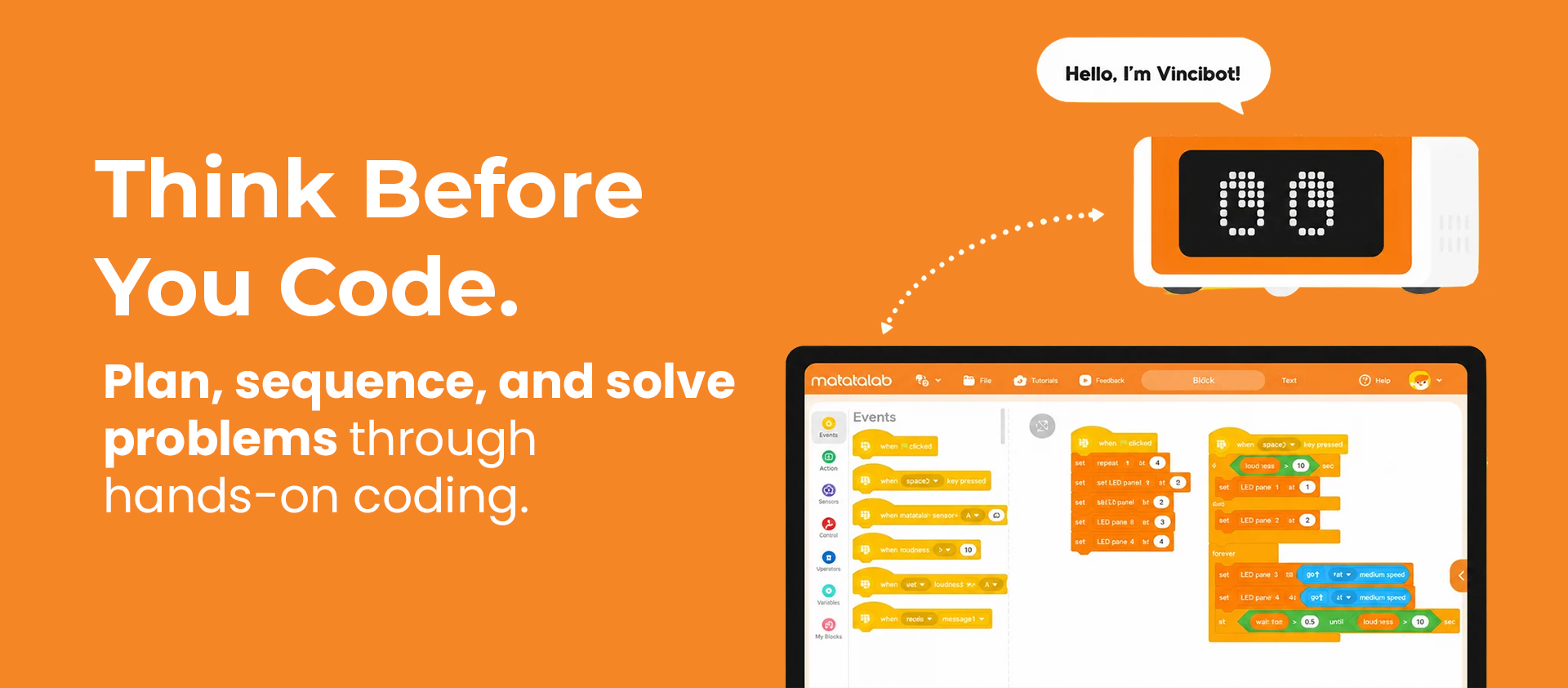
MatataStudio provides hands-on coding and robotics learning experiences that encourage children to explore programming concepts through interaction and experimentation.
Instead of simply learning coding instructions, students can plan actions, arrange commands and observe how their decisions influence a robot's movements.
These activities encourage learners to:
- Develop step-by-step thinking through coding challenges.
- Understand sequencing by arranging commands logically.
- Explore cause-and-effect relationships through experimentation.
- Identify errors and improve their solutions.
- Build confidence through independent problem-solving.
By connecting coding concepts with physical activities, MatataStudio helps make abstract ideas easier for young learners to understand.
For schools looking to introduce coding and robotics into their STEM programmes, hands-on learning resources can create meaningful opportunities for students to develop essential future-ready skills.
Preparing Students for More Than Coding
Computational thinking is not limited to programming or robotics. It supports a broader range of academic and practical learning experiences.
Students who learn to break down problems, recognise patterns and organise information can apply these abilities across different subjects.
In mathematics, they can approach complex calculations systematically. In science, they can organise observations and investigate solutions. In everyday situations, they can plan activities, evaluate choices and make informed decisions.
As schools increasingly introduce digital technologies and STEM learning, developing these foundational abilities becomes an important part of preparing students for future challenges.
Conclusion
Great coding begins with great thinking. When students learn to plan, sequence and organise their ideas before writing instructions, they develop skills that extend far beyond the screen.
Through hands-on coding and robotics experiences, students can explore how logic, creativity and problem-solving work together.
With MatataStudio, coding becomes more than making a robot move. It becomes an opportunity for young learners to think independently, experiment with ideas and turn their plans into meaningful actions.