

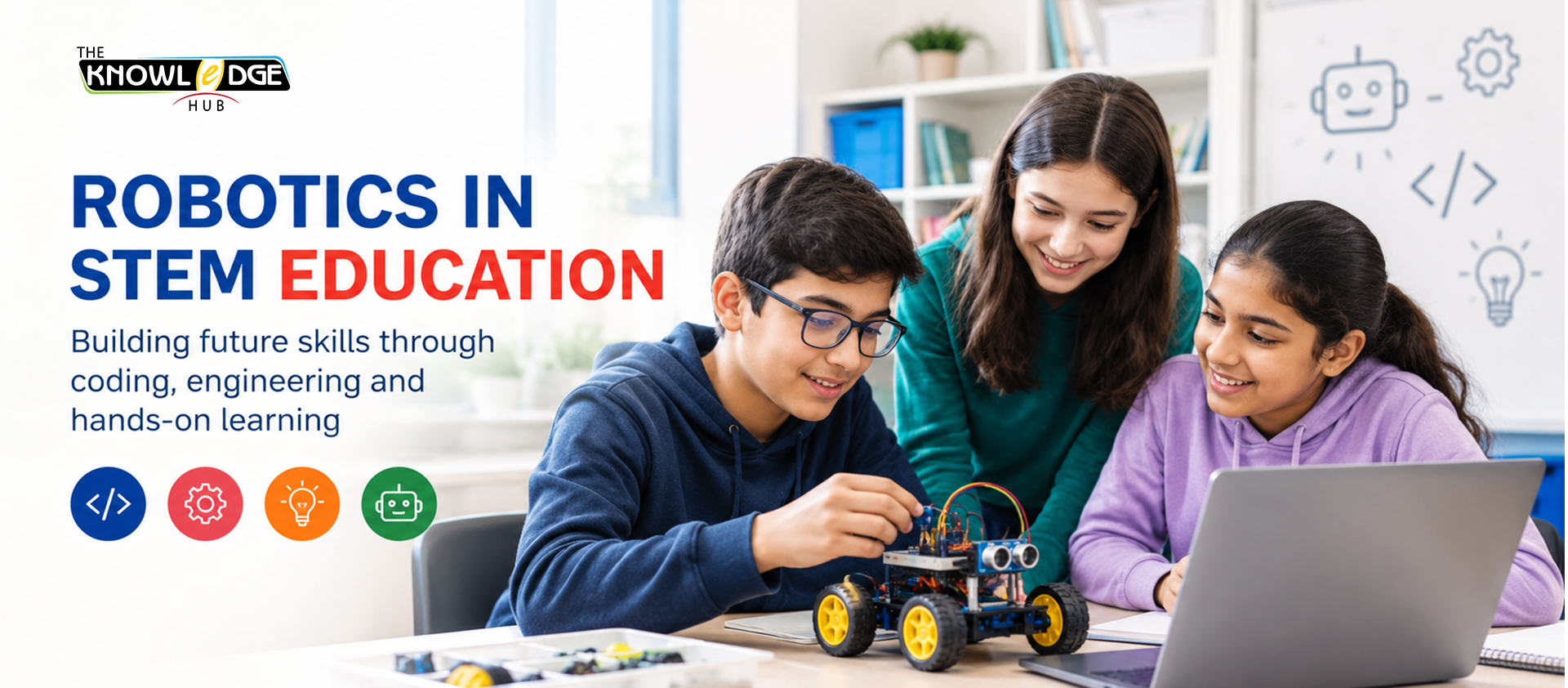
What happens when students move beyond learning about technology and start building and programming it themselves?
They begin to understand how ideas work in practice.
Robotics is becoming an important part of modern STEM education because it gives students opportunities to explore science, technology, engineering, and mathematics through hands-on experiences. By designing, building, and programming robots, students can connect classroom concepts with practical challenges.
A simple robotics activity can involve mathematics, engineering principles, logical reasoning, coding, and problem-solving. Students are encouraged to experiment, test their ideas, identify mistakes, and improve their designs.
For schools, introducing robotics into the curriculum can create more interactive learning experiences while helping students develop technical and transferable skills.
But how exactly does robotics support STEM education, and how can schools make it part of everyday learning?
What Is Robotics in STEM Education?
Robotics in STEM education refers to using robots, programming tools, electronic components, and engineering activities to teach concepts across science, technology, engineering, and mathematics.
Rather than studying these subjects only through textbooks, students interact with physical or virtual systems to understand how different concepts work together.
For example, students might build a simple robot that follows a predefined path.
To complete the activity, they may need to:
- Understand how motors and sensors work.
- Measure distances and calculate movement.
- Design the robot's structure.
- Write code to control its actions.
- Test its performance and correct errors.
This combination makes robotics a practical way to introduce interdisciplinary STEM learning.
Schools looking to develop a structured approach can explore our STEM Curriculum UAE resource.
7 Ways Robotics Supports STEM Education
1. Connects Science, Technology, Engineering and Mathematics
One of the biggest advantages of robotics is that it brings multiple STEM disciplines together in a single learning experience.
Students don't necessarily learn science, technology, engineering, and mathematics as separate concepts. They use them together to complete a task.
These experiences also demonstrate the wider benefits of STEM education, helping students develop critical thinking, creativity, collaboration, and problem-solving skills.
For example, when building a moving robot:
Science: Students explore motion, energy, forces, and basic electrical concepts.
Technology: They learn how electronic components, sensors, and programming tools work.
Engineering: They design, assemble, and improve the robot.
Mathematics: They use measurements, angles, distance, patterns, and calculations.
This integrated approach helps students understand how classroom knowledge can be applied to practical situations.
2. Develops Coding and Computational Thinking
Robotics provides a practical introduction to programming.
Students learn to give instructions that control how a robot behaves. These instructions might determine its direction, speed, movement, or response to environmental conditions.
Through robotics activities, students can develop computational thinking skills such as:
- Breaking complex tasks into smaller steps.
- Recognising patterns.
- Developing logical sequences.
- Understanding cause and effect.
- Identifying errors in instructions.
- Improving programs through testing.
For example, programming a robot to navigate a simple obstacle course requires students to plan a sequence of commands, test the instructions, and make adjustments when something goes wrong.
This helps students understand that coding is not just about writing instructions. It is about developing logical solutions to problems.
3. Strengthens Engineering and Design Skills
Robotics encourages students to think like engineers.
They need to consider how different components fit together, how a structure should function, and how design decisions affect performance.
A classroom challenge might ask students to build a robot capable of moving an object from one location to another.
Students may need to consider:
- The robot's structure.
- Wheel placement.
- Motor positioning.
- Balance and stability.
- Movement and direction.
- Material selection.
If the robot doesn't perform as expected, students can modify the design and test it again.
This process introduces the engineering design cycle: identify, imagine, plan, create, test, and improve.
4. Encourages Problem-Solving and Critical Thinking
Robotics activities rarely work perfectly on the first attempt.
A robot might move in the wrong direction, fail to detect an obstacle, or stop responding to instructions.
These situations give students opportunities to investigate what went wrong.
They learn to:
- Identify the problem.
- Examine the instructions and components.
- Consider possible causes.
- Develop a solution.
- Test the changes.
- Evaluate the result.
Instead of immediately looking for an answer from the teacher, students are encouraged to investigate and make informed decisions.
This strengthens their ability to approach unfamiliar challenges systematically.
5. Makes Mathematics More Practical
Mathematics becomes more engaging when students can see how it influences the outcome of an activity.
Robotics provides opportunities to apply mathematical concepts such as:
- Measurement and distance.
- Angles and direction.
- Speed and time.
- Geometry.
- Patterns and sequences.
- Basic calculations.
- Data interpretation.
For example, students programming a robot to travel a specific distance may need to calculate movement, measure results, and adjust instructions.
These activities help demonstrate how mathematical knowledge is used in engineering, programming, and technology.
6. Builds Creativity and Collaboration
Robotics gives students opportunities to experiment with different approaches rather than simply follow a fixed set of instructions.
Two student teams may receive the same challenge but develop completely different robotic solutions.
They need to brainstorm, share ideas, divide responsibilities, and evaluate different designs.
Collaborative robotics activities can help develop:
- Creative thinking.
- Teamwork.
- Communication.
- Decision-making.
- Leadership.
- Adaptability.
Students also learn to explain their designs and present their solutions to others.
7. Develops Persistence Through Experimentation
One of the most valuable lessons robotics can teach is that mistakes are part of the learning process.
A robot may fail to complete a challenge. A program may contain an error. A design may not work as intended.
Students need to investigate, modify, and try again.
This repeated process helps develop persistence and encourages students to view setbacks as opportunities to improve.
Rather than focusing only on the final result, students learn to value the process of experimentation.
Practical Robotics Activities for Different Age Groups
Robotics activities should be aligned with students' developmental levels, technical understanding, and curriculum objectives.
Early Years and Primary School
At this stage, the focus should be on exploration, sequencing, and understanding basic instructions.
Possible activities include:
- Moving a robot through a simple maze.
- Creating basic movement sequences.
- Exploring direction and patterns.
- Building simple robotic structures.
- Introducing cause-and-effect concepts.
These activities introduce foundational concepts in a visual and engaging way.
Middle School
Students can begin exploring more advanced robotics concepts.
Activities may include:
- Programming robots to follow specific paths.
- Using sensors to detect obstacles.
- Building robotic vehicles.
- Creating automated systems.
- Exploring simple engineering challenges.
- Developing basic conditional programs.
Students begin combining coding, mathematics, and engineering to solve more complex problems.
Secondary School
Older students can work on advanced robotics projects involving:
- Autonomous robotics.
- Sensor-based automation.
- Advanced programming.
- Artificial intelligence applications.
- Robotics engineering.
- Data collection and analysis.
- Real-world automation challenges.
These experiences can introduce students to technologies and concepts relevant to future academic and career pathways.
How Robotics Connects With Project-Based STEM Learning
Robotics is particularly effective when incorporated into project-based STEM learning, where students work on meaningful challenges that require them to design, build, test, and improve practical solutions.
Instead of completing isolated robotics exercises, students can work on challenges that require them to design and develop a complete solution.
For example, a school might introduce the challenge:
Can you design a robot that helps sort recyclable materials?
Students could research recycling systems, explore sensors, develop a robotic design, program its movements, and test its ability to sort objects.
This combines several learning areas:
- Science: Materials and environmental concepts.
- Technology: Sensors and programming.
- Engineering: Robot design and construction.
- Mathematics: Measurements, classification, and data.
Students can also document their process, present their designs, and suggest improvements.
This makes robotics a natural extension of project-based STEM learning.
What Do Schools Need to Introduce Robotics Education?
Schools do not need to begin with highly advanced robotic systems.
The right resources depend on the students' age groups, curriculum objectives, and existing infrastructure.
Some useful resources include:
Educational Robotics Kits: Provide components that students can assemble, configure, and program.
Coding Platforms: Allow students to develop instructions and control robotic movements.
Sensors and Electronic Components: Help students understand how robots interact with their surroundings.
Engineering Materials: Support building, designing, and testing physical structures.
Teacher Training: Helps educators understand robotics concepts and integrate activities into classroom instruction.
Schools should prioritise solutions that are age-appropriate, curriculum-aligned, easy for teachers to facilitate, and suitable for progression across grade levels. Alongside the right resources, teacher training and certification programs can help educators develop the confidence and practical skills needed to integrate robotics into classroom instruction.
The Role of Teachers in Robotics-Based Learning
Teachers play an important role in making robotics educational rather than simply entertaining.
Their responsibility is to connect each activity with a clear learning objective.
For example, a robot navigation challenge can introduce programming concepts, but teachers can also use it to explain angles, measurement, sequencing, and logical reasoning.
Effective robotics teaching involves:
- Establishing clear learning outcomes.
- Demonstrating concepts when necessary.
- Encouraging independent exploration.
- Asking guiding questions.
- Supporting collaborative activities.
- Helping students troubleshoot problems.
- Evaluating both the process and final outcome.
Continuous professional development can help teachers become more confident in facilitating robotics and other technology-based STEM activities.
Robotics Education in UAE Schools
As UAE schools continue developing technology-enabled and future-focused learning environments, robotics can provide students with practical opportunities to explore engineering, programming, automation, and innovation.
Schools can introduce robotics through classroom activities, dedicated STEM programs, coding initiatives, innovation projects, and specialised learning spaces.
The approach should align with the school's broader educational objectives and provide opportunities for students to progress from foundational activities to more advanced challenges.
For schools exploring structured robotics programs, Knowledge Hub offers robotics learning solutions and programs that can support the development of practical technology skills.
Robotics can also complement a wider STEM curriculum for UAE schools, helping students connect technical knowledge with practical applications.
Measuring Student Progress in Robotics Education
The success of a robotics activity should not be measured only by whether the robot works.
Teachers should also evaluate what students learn during the process.
Useful assessment areas include:
- Understanding of robotics concepts.
- Ability to develop logical instructions.
- Programming and debugging skills.
- Engineering and design decisions.
- Problem-solving approaches.
- Teamwork and communication.
- Ability to test and improve solutions.
- Understanding of mathematical and scientific concepts.
For example, a robot that fails to complete a challenge may still represent a valuable learning experience if students can explain the problem, identify its cause, and demonstrate how they attempted to improve the design.
Assessment should recognise both the final outcome and the thinking behind it.
Conclusion
Robotics provides a practical way to bring STEM education to life. For schools planning a structured approach, understanding the process of implementing STEM education in schools can help connect robotics activities with curriculum objectives, teacher preparation, and long-term learning outcomes.
By building and programming robots, students can explore how science, technology, engineering, and mathematics work together. They can develop coding skills, strengthen logical thinking, experiment with engineering concepts, and learn how to approach problems through testing and improvement.
For schools, robotics should be more than an occasional classroom activity. When integrated into a structured STEM learning program, it can provide meaningful opportunities for students to explore technology, collaborate with others, and develop solutions to real-world challenges.
The objective is not simply to teach students how to build robots. It is to help them understand how technology works and give them the confidence to design, create, experiment, and innovate.
Frequently Asked Questions
What is the role of robotics in STEM education?
Robotics connects science, technology, engineering, and mathematics through practical activities. Students build and program robots while developing problem-solving, coding, engineering, and logical-thinking skills.
What are the benefits of robotics for students?
Robotics can help students develop computational thinking, creativity, collaboration, problem-solving, programming, engineering, and critical-thinking skills through hands-on experiences.
At what age can students start learning robotics?
Students can begin exploring basic robotics concepts in the early years and primary grades through simple building, sequencing, and movement activities. More advanced programming, sensors, and engineering challenges can be introduced as they progress.
How does robotics improve coding skills?
Robotics gives students an opportunity to write and test code that controls physical actions. They learn programming logic, sequencing, conditions, debugging, and problem-solving through practical activities.
Does robotics require advanced technical knowledge?
No. Schools can introduce robotics using age-appropriate educational kits and beginner-friendly coding platforms. Students can gradually progress to more advanced systems and programming concepts.
How can schools integrate robotics into their STEM curriculum?
Schools can introduce robotics through curriculum-linked activities, coding lessons, engineering challenges, project-based learning, and dedicated STEM programs. Teacher training and appropriate learning resources help support successful integration.